The Fascia–Lymph Connection: Why Tight Tissue Blocks Drainage, Detox & Natural Glow
The Overlooked Factor Behind Puffiness, Stagnation & Body Congestion
When I first started working on fascia, I expected improvements in posture and pain.
What I did not expect was:
my face looking less puffy
my eye area smoothing
my jaw softening
my digestion improving
less heaviness in my body
deeper breathing
more calm through my nervous system
It did not take long to realize something important:
The lymphatic system cannot flow well through tissue that is compressed, dehydrated, or braced.
Fascia is not just “connective tissue.” It is the structural network of the body, and it influences how fluid moves, how pressure is distributed, and how easily tissue can glide.
If you are newer to fascia, start here first: Fascia: The Hidden Web That Shapes Your Movement, Posture, and Health
What is the lymphatic system really doing?
Your lymphatic system is your body’s fluid-regulating, waste-clearing, immune-transporting river. It helps:
remove metabolic waste
carry immune cells
clear cellular debris
drain excess fluid
keep tissues from swelling
support skin clarity and tissue health
But unlike your circulatory system, lymph does not have a heart-like pump.
It moves because of:
breath pressure
rib expansion
fascial elasticity
muscle contraction
walking
natural mechanical movement
When those are missing, fluid can slow down.
Where lymph gets stuck and why it matters
Based on both anatomy and lived experience, stagnation commonly shows up around:
the neck and jaw
the thoracic inlet under the clavicles
the rib cage and diaphragm
the abdomen
the groin and pelvic fascia
behind the knees and around the ankles
When those areas are restricted, dehydrated, or guarded, fluid has a harder time moving where it needs to go.
Signs your lymph flow may be compromised
Many people assume these symptoms are just hormones, aging, inflammation, “bad skin,” or genetics. Sometimes they are. But they can also reflect sluggish lymph movement:
puffy face in the morning
swollen ankles or hands
rings fitting tighter than usual
eye bags or under-eye pooling
sinus congestion
a heavy or boggy feeling in tissue
cold fingers or toes
jaw tension
bloating or sluggish digestion
achiness or stiffness that improves with movement
fatigue or brain fog
soreness that lingers after exercise
breast tenderness or pelvic heaviness
If you are reading that list and thinking, yes, that sounds like me, your body is not failing. It is usually asking for more space, glide, rhythm, and movement.
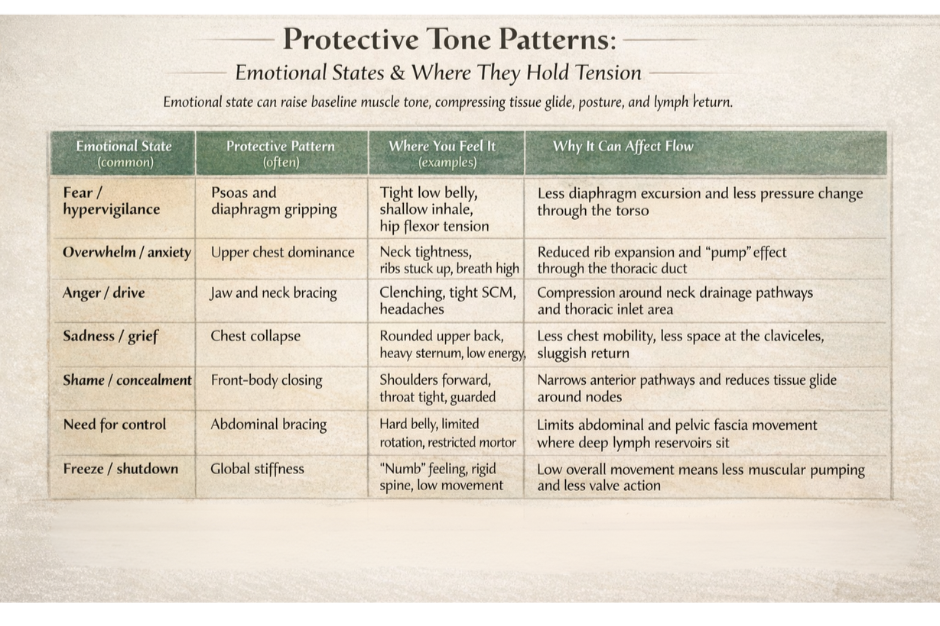
Protective tone: the missing layer
Fascial restriction is not only mechanical.
Your nervous system can raise baseline muscle tone when you feel stressed, overloaded, or unsafe. That protective tension changes rib motion, neck and jaw tone, and tissue glide, which can quietly slow lymph return.
This matters for lymph too, because protective tension changes how the ribs move, how the neck and jaw hold tone, and how easily fluid can move through tissue.
This is one reason fascia work can feel emotional sometimes. Releasing tissue often changes the defended state underneath it too. Your body is not irrational. It is adaptive.
The connection between emotional patterns and physical structure runs deeper than most people expect. Read How Emotions Affect Your Spine and Physical Alignment for a deeper look at that relationship.
The key most people miss: drainage needs to start centrally
Not peripherally.
A lot of social media lymph routines:
start at the face
push fluid downward
skip whether the exit pathways are actually open
But if someone pushes fluid from the cheeks into a neck that is still tight, with the clavicles still restricted, they are pushing fluid into a backlog.
That is why sequencing matters.
A conceptual 5-phase overview
This is the map, not the full illustrated step-by-step.
Phase 1: Create the exit pathway
Start at the clavicles.
This is where lymph returns to circulation. If this space is still restricted, the rest of the system has nowhere to go.
Phase 2: Clear the head and neck channels
This phase is about creating space for fluid to descend through the head and neck pathways.
Phase 3: Free the rib cage and thoracic duct
This is where breath becomes non-negotiable.
Rib expansion and diaphragmatic movement help create the internal pressure changes that support lymph flow through the torso.
If breathing feels restricted or high in the chest, read 360 Breathing: The Key to Optimal Pressure Management and Pain-Free Movement
Phase 4: Decompress the abdomen and pelvis
This region is often ignored online, but it matters deeply.
The abdomen and pelvis are major areas for lymph collection, fluid movement, and return.
Phase 5: Activate and flush
Once the pathways are open, gentle rhythmic movement helps fluid continue moving:
soft bouncing
walking
arm swing
gentle oscillation
natural twisting
It does not need to be intense. It just needs to be rhythmic.
Supporting your lymph beyond the routine
The routine helps create space, but your daily habits either support or undo that work. If you want a more complete daily plan for food, breath, movement, and drainage support, this is exactly what I teach inside the 28-Day Lymph Reset.
1. Hydration and fascia
Fascia does not hydrate from water alone. It also depends on:
sodium
potassium
glucose
collagen and glycine
micronutrients
movement pulling fluid into tissue
Dehydrated fascia tends to feel sticky and resistant. Better-supported fascia tends to glide better.
If you want the nutrition side of this, read Micronutrients for Lymph and Fascia Support : A simple 7-day reset
2. Breathing and pressure
Deep, 360-degree breathing:
mechanically pumps fluid through the torso
mobilizes the diaphragm
creates internal pressure changes that support lymph flow
helps expand fascia from the inside
That is why breathing is not just calming. It is structural.
If this piece of the puzzle feels especially relevant, explore my 360° Breathing course.
3. Movement
Walking, twisting, arm swing, hip rotation, spinal motion, and foot function all matter.
Your body moves lymph best when it moves like a human body. If you want a simple way to build that in, read Movement Snacks vs One Daily Workout
Common mistakes people make
starting at the face
scraping aggressively
using tools on cold tissue
skipping the clavicle region
working in the wrong sequence
pushing fluid into restricted fascia
Your body needs sequencing, not force.
If you tend to attack tight tissue aggressively, read Why Stretching Makes Tightness Worse: Understanding Fascial Release & Functional Movement
Signs your lymph is improving
face looks less swollen
eyes brighten
jaw softens
chest feels more open
breathing deepens
head feels clearer
heaviness dissipates
you urinate more
digestion improves
mood lifts
skin looks brighter
People often describe feeling lighter and more present in their body.
If things still feel stuck
If an area feels dense, puffy, or silent, do not press harder.
Back up. Reopen the clavicles. Reestablish the exit pathway. Then re-approach gently.
Compassion usually works better than coercion.
Your body wants to flow
You are not broken. You are not “clogged.” Your body is usually doing its best with the inputs and constraints it has.
With:
space
warmth
glide
breath
rhythm
gentle sequencing
the body often becomes much more responsive.
Ready to build a daily environment your lymph can actually work in?
A drainage routine creates space. But if puffiness, heaviness, and stagnation keep returning, your body is usually asking for more than a single tool — it needs a consistent daily rhythm that supports flow from multiple angles at once.
The 28-Day Lymphatic Reset brings together everything this article covers into one structured daily plan:
A 7-minute morning routine that opens the lymphatic vessels before driving fluid through them
Rotating massage and breathing sequences that work through the body progressively
A nourishment plan that reduces the acidic load your tissues have been quietly buffering — so cells can rehydrate and backed-up protein can clear
A 4-minute movement snack that keeps flow going throughout the day
It is not a collection of isolated tools. It is a daily rhythm designed around how fascia and lymph actually work together.
One payment. Lifetime access. Return to it whenever your body needs a reset.
If you want individualized help identifying the structural patterns underneath it, explore 1:1 coaching.