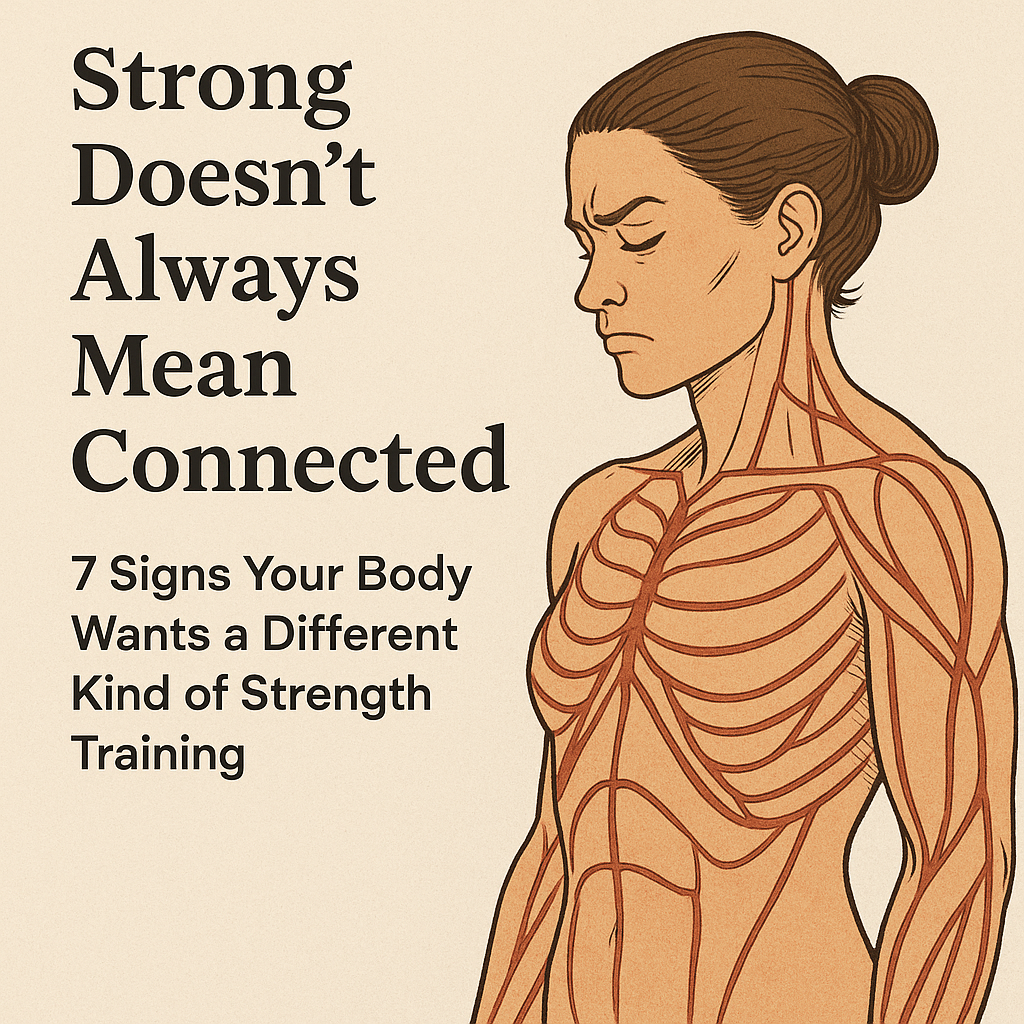
How breath, pressure, gait, and fascial sequencing create real strength that lasts
Real functional strength is not about how much muscle you have. It is about how well your body distributes load, breathes, rotates, stabilizes, and moves through space.
Most people assume that if they lift weights, run, or train hard, they must be functional. Strength becomes the proof. More weight. More reps. More sweat.
But after more than a decade of training and teaching movement, including my own dramatic shift from ten years of traditional working out to one and a half years of integrative gait-focused training, I have learned something that changed my entire approach:
You can be strong and still be disconnected.
You can have muscle without coordination.
You can train hard while your system compensates.
You can look fit and still feel tight, unstable, or out of sync.
If you feel like your workouts are not translating into better movement, better posture, or a more connected body, you are not alone. Below are some of the most common signs that your body wants a different kind of strength. Not more effort. More integration.
Sign 1: Your Low Back Does Most of the Work
If you feel almost every exercise in your low back, it is usually a sign that your system is relying on compensation rather than coordination.
A back-dominant pattern usually reflects:
limited rib movement
shallow breathing
tight hip flexors
a core that cannot pressurize evenly
an inability to rotate well through the pelvis
Your back steps in because it has to. Not because it should.
Sign 2: You Brace Instead of Breathe
If your default strategy is “tighten everything and go,” your system is working harder than it needs to.
Bracing is not stability.
Bracing locks things down.
Stability lets things work together.
When breath cannot expand in all directions, your core becomes a pressure problem rather than a pressure system. This contributes to what I call shallow, stress-based breathing, which changes how your ribs move, how your fascia adapts, and how tension builds throughout your system.
If you want to understand how to breathe in a way that supports pressure, stability, and whole-body connection, read 360 Breathing: The Key to Optimal Pressure Management and Pain-Free Movement.
If bracing is your default, breath is the fastest place to start.
The 360° Breathing Course teaches you how to build real ribcage expansion and internal pressure support so your body can create stability without locking everything down. One hour of content structured around your specific posture pattern. $27. Lifetime access.
Sign 3: Your Ribs Stay in Flare Mode
Rib flare is incredibly common for active people, especially lifters, runners, and anyone who sits for long periods.
Constant extension comes with a cost.
Rib flare can lead to:
shallow breathing
poor abdominal sequencing
a pelvic floor that cannot load or unload well
neck and shoulder tightness
over-recruitment of the back and hip flexors
If your ribs never settle, your breath never fills the back and sides of your rib cage.
Sign 4: You Feel Tight More Than You Feel Strong
Tight hip flexors. Tight hamstrings. Tight back. Tight jaw.
Tight pelvic floor.
Most people assume tightness equals strength, but tightness often equals guarding.
Your nervous system uses tension as a way to create “support” when the deeper stabilizers are not coordinating well.
This is why stretching helps temporarily but never changes the underlying pattern.
If you want to understand why stretching often makes chronic tightness worse instead of better, read Why Stretching Makes Tightness Worse: Understanding Fascial Release & Functional Movement.
Sign 5: You Leak, Lose Air, or Lose Pressure Under Strain
This shows up differently for women and men.
For women: leaking during lifting, running, jumping, or sneezing.
For men and women: abdominal doming, hernia-prone pressure strategies, breath-holding, or midline instability.
Both are signs of the same issue:
Your system cannot regulate pressure from the inside.
This is not a weakness problem.
It is a connection problem.
Sign 6: Your Gait Does Not Reflect Your Strength
You can be incredibly strong in the gym yet disconnected in everyday movement.
You can deadlift double your bodyweight and still walk with:
stiff rotation
limited hip extension
uneven loading side-to-side
I lived in this pattern until my mid 30’s.
When your gait does not reflect your gym strength, it means your system is strong in isolated pieces but not integrated as a whole.
Sign 7: You Build Muscle Easily but Still Feel Misaligned
You can build muscle on top of dysfunction.
You can get stronger without becoming more coordinated.
Your fascia adapts to the patterns you repeat most. Which means you can literally build strength around a compensation.
If you want a clearer understanding of how fascia adapts to the movement patterns you repeat most, read Fascia: The Hidden Web That Shapes Your Movement, Posture, and Health.
My Turning Point: From Compressed to Connected
For almost ten years, I trained religiously.
I lifted. I worked on my core in Pilates. I did “all the right things.”
And yet, my body never changed in the way I hoped.
I felt compressed.
My ribs stayed flared.
My low back overworked.
My hips never felt balanced.
My posture remained tense.
I assumed this was simply “my body.”
Everything shifted when I stopped training for effort and started training for connection.
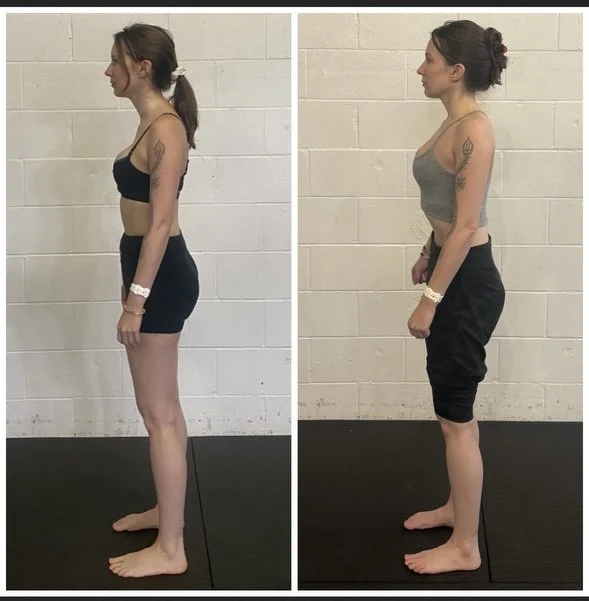
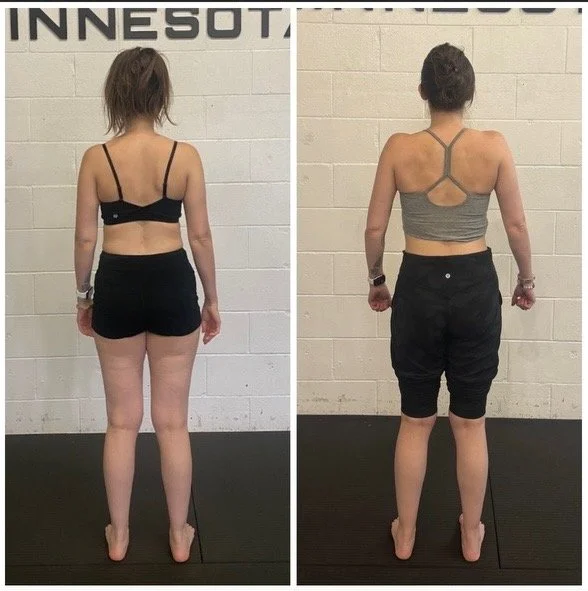
When I began focusing on breath mechanics, gait organization, rotational balance, and whole-body integration, things changed fast. Not in years. In months.
At eight months, my body looked and felt entirely different:
My chest started to open with structure and my forward head started to realign.
my ribs and pelvis coordinated
my gait smoothed
my back and neck stopped overworking
I looked taller, freer, more grounded
Strength was no longer something I forced.
It became something my body could access.
If you see yourself in my “before,” know this:
You are not stuck with your patterns.
Your body can learn new ones.
If You're Feeling a Similar Story in Your Own Body
If parts of this feel familiar — the tightness, the overworking, the misalignment, the effort without change — you are not alone.
Many clients start with me feeling exactly this way:
They train hard.
They are committed.
They are disciplined.
But their body still feels disconnected.
You don't need more intensity.
You need better organization.
Ready to begin repatterning your fascia?
Once you’ve identified your structural patterns, the next step is learning how to shift them gently — without forcing, stretching hard, or collapsing into passive positions.
Ready to Work Together?
If you want personalized support in rebuilding your foundation, improving your gait, developing real core stability, or training in a way that honors your system rather than compressing it, you can work with me online or in person.
Inside our sessions, we focus on the principles that changed my own body:
whole-body connection
pressure management
breath sequencing
rib–pelvis coordination based off of gait
integrated strength
sustainable stability
You do not have to figure this out alone.