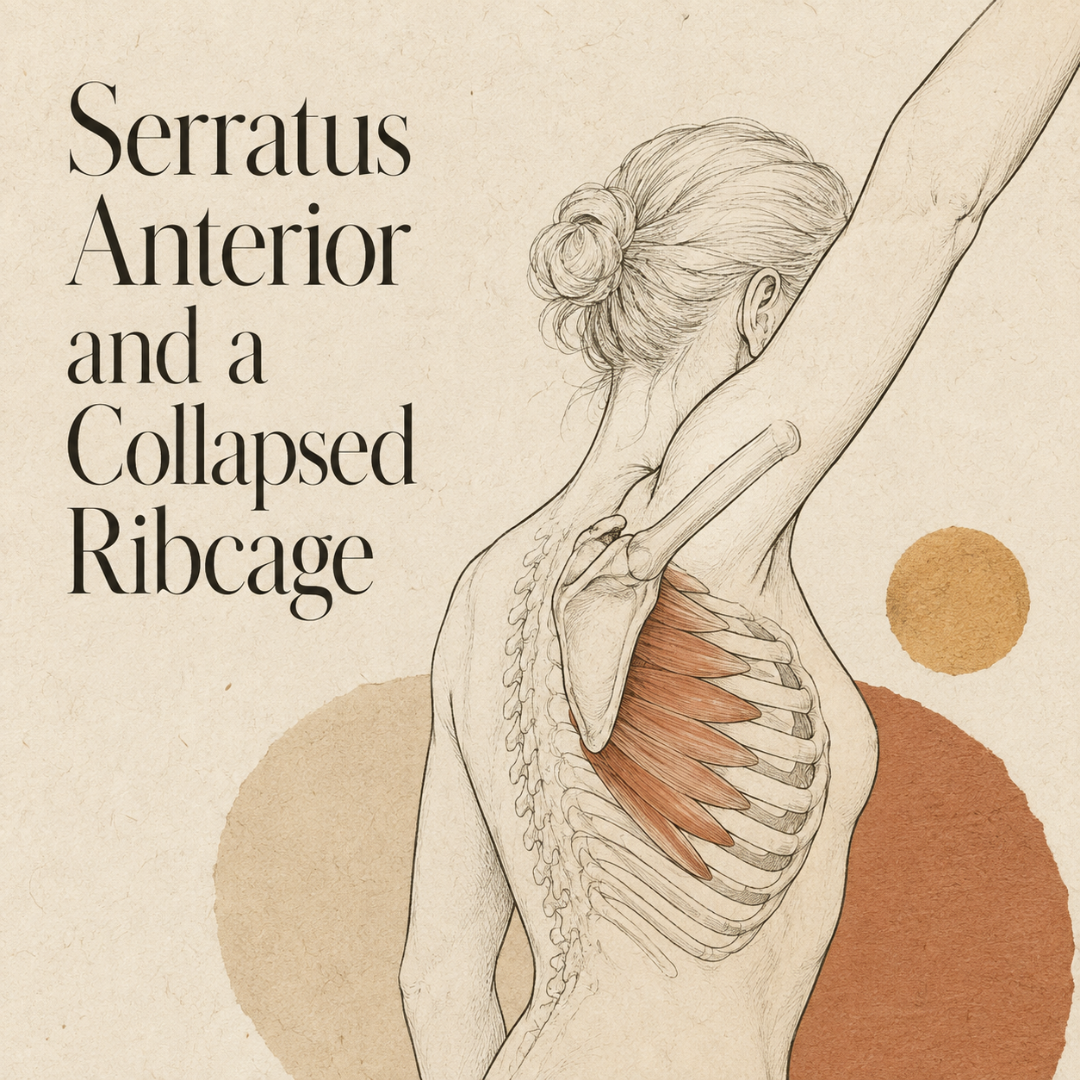
For years, I could hang from a bar without ever opening my armpits.
My arms were overhead, but I was still clamping the undersides of my shoulders toward my ribs. I had trained myself to pull my ribs down and back so thoroughly that even hanging became another place to brace.
From the outside, the position probably looked controlled. Inside, my neck was working, my upper back felt narrow, and my breath had nowhere to go.
The armpits gave the pattern away. I could not expose them without feeling as though I had lost control of my ribcage.
When I finally allowed my shoulder blades to travel upward and around the ribs, the position changed. My upper back widened. My arms felt connected to more than my neck, and I could breathe without forcing my ribs into place.
That experience changed what I started training. I needed better scapular upward rotation and a stronger connection between my shoulder blades and ribcage. Serratus anterior, working with the trapezius and the rest of the shoulder complex, became one important piece.
Most people hear about serratus in relation to scapular winging. Its role is much broader. Serratus helps connect the shoulder blade to a moving ribcage during breathing, reaching, rotation, and overhead movement.
If posture work keeps creating neck tension, you may not need another cue telling you where to hold your shoulders. You may need the support that allows them to move.
What serratus anterior actually does
Serratus anterior is a broad, fan-shaped muscle that wraps from the side ribs to the inner border of the shoulder blade.
It is often described as a scapular protractor because it draws the shoulder blade forward around the ribcage. That description can make protraction sound like rounded shoulders, but healthy protraction is not the same as collapsing the chest. It allows the shoulder blade to wrap around the curve of the ribs while maintaining contact with them.
Even with the arm resting at your side, this relationship influences how supported the shoulder blade feels against the ribcage. Serratus helps create width across the upper back without requiring the shoulder blades to be squeezed together or pinned down.
As the arm reaches forward, the scapula travels around the ribs. Serratus helps maintain that connection as the arm returns, allowing the shoulder blade to retract without its medial border peeling away or the upper chest collapsing underneath it. I see this loss of control more often than a true lack of shoulder mobility.
Overhead movement adds another demand. The shoulder blade upwardly rotates, posteriorly tilts, and externally rotates to follow the arm while serratus helps it remain connected to the ribcage.
The relationship can also work in the other direction. With the hand supported on a wall or the floor, the scapula has a more stable surface to press from, allowing the ribs and trunk to move in relation to it. A weight creates a different challenge: the arm must continue reaching while serratus maintains the shoulder blade’s connection to the ribs. In both situations, I can feel the ribcage changing shape beneath the scapula as I breathe, reach, and rotate. The ribs are not simply a fixed surface that the shoulder blade moves across. Both structures keep adapting to the movement.
That is especially clear to me in the side-lying serratus press. The weighted arm continues reaching while my ribcage rotates underneath the shoulder blade. Serratus helps preserve contact between the two while my obliques and the rest of my trunk control the rotation back toward the floor. This is where the exercise begins to shape more than my shoulder position. I can feel the side ribs, upper chest, and anterior neck join the reach without my sternum collapsing.
Serratus does not work alone. The upper and lower trapezius coordinate with it during arm elevation. The upper traps are supposed to participate. My problem was not that they were active. The effort had become concentrated around the back of my neck while the rest of my shoulder blade and ribcage contributed very little.
I now think about the anterior neck in much the same way. I am not trying to make it completely inactive. When it joins the reach, I feel a clearer connection between my head, upper chest, ribs, and arm. I become concerned when the muscles at the back of my skull grip because they are trying to hold the structure together without enough support underneath it.
I could place my arms overhead, but I could not organize that range well. My upper chest collapsed at rest, my lower ribs flared when I tried to create height, and my armpits clamped when I hung from a bar. Strengthening serratus did not solve those patterns by itself, but it gave my shoulder blades a stronger relationship with the ribs underneath them.
More shoulder mobility would only have given me additional range. What I needed was support inside the range I already had.
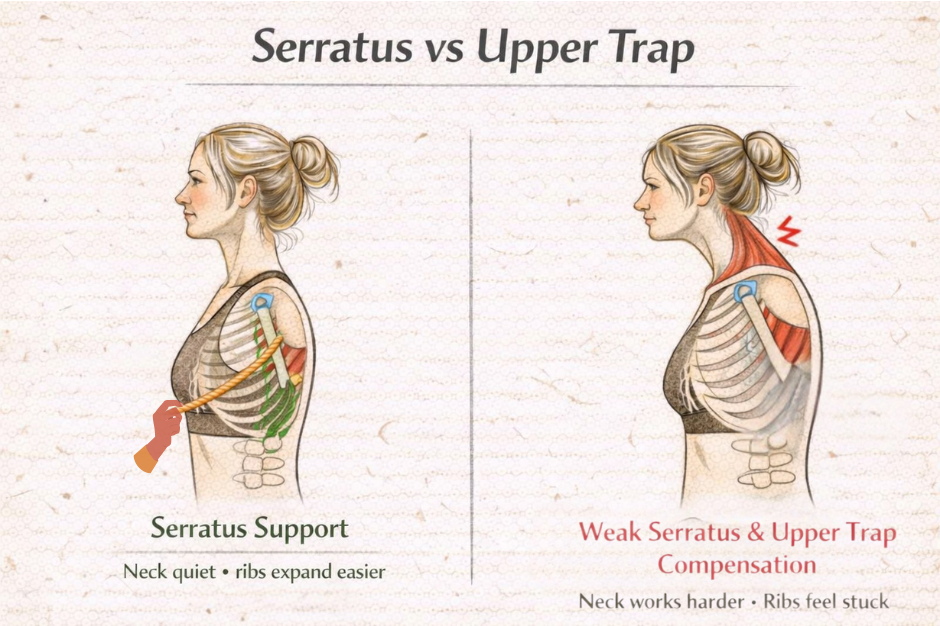
Serratus support with the arm at rest
Left: support around the shoulder blade and side ribs helps the upper back maintain width. Right: the shoulder girdle relies more heavily on a neck-dominant holding strategy while the chest and ribcage remain compressed.
This image uses a rope as a visual analogy. A useful support rope does not hold something steady by becoming rigid. It maintains enough tension to keep the pieces connected while still allowing them to respond to movement.
That is how I picture the role serratus had been missing in my body. I did not need it to pin my shoulder blade down. I needed enough responsive tension around the shoulder blade and side ribs that my upper back could hold width without my neck lifting and bracing the entire structure.
What a collapsed ribcage looked like in my body
My collapsed ribcage was visible long before I understood what I was seeing.
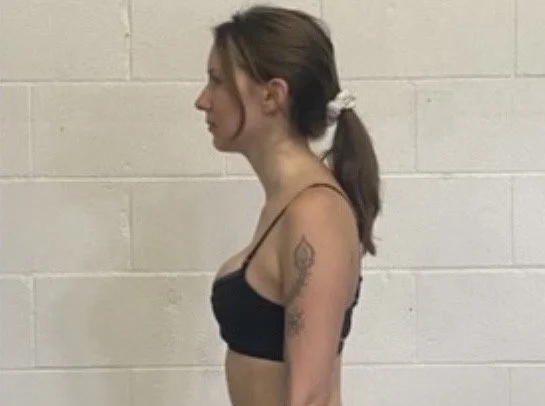
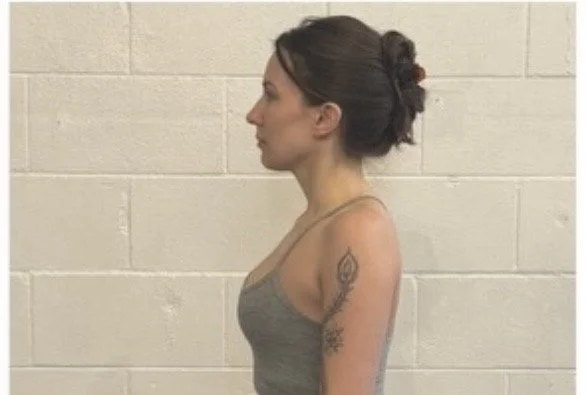
In older photos, my upper chest looked sunken and narrow. My shoulders sat forward, my upper back lacked width, and my lower ribs flared whenever I tried to create more height or lift my arms.
For years, I treated the rib flare as the problem. I became skilled at pulling my ribs down and back, but that only compressed the shape further. The flare looked more controlled while my upper chest remained collapsed underneath it.
Once my serratus began working more effectively with the rest of my shoulder complex, my shoulder blades gained a stronger relationship with the ribs. My upper back widened, and the front of my chest stopped looking so caved in. I could create more height without pushing the lower ribs forward or dragging the entire ribcage down.
Serratus did not create that change alone, but strengthening it gave my ribcage support I had never been able to manufacture through posture cues.
The spiral connection that changed my balance
Serratus is rarely discussed as a balance muscle, but strengthening it changed how balanced my entire body felt.
Before that, my upper body seemed to shear away from my lower half. That is not a scientific term, just the closest description I have for the sensation. When I stood on one leg or shifted my weight, my torso felt like a separate mass that could tip far enough to knock the rest of me over.
My legs would respond, but they always seemed one step behind whatever was happening above my pelvis.
The change made more sense when I stopped thinking about serratus as an isolated shoulder muscle.
In the Anatomy Trains model, serratus participates in the Spiral Line, a fascial pathway connecting the shoulder blade and ribs through the abdominal wall and toward the opposite side of the pelvis and leg. It provides a useful map for picturing how tension can travel diagonally through the body.
As my serratus became stronger and my shoulder blade gained a clearer relationship with the ribcage, I began to feel tension continue through my side ribs and obliques instead of stopping at my waist. My upper and lower body started responding to a weight shift together.
That was the feeling I had been missing. My legs no longer had to catch my upper body after it had already drifted off balance. I could feel a diagonal connection through my trunk helping me adjust before the tipping began.
Balance still depends on the feet, pelvis, eyes, inner ear, spine, breath, and nervous system. I would never credit one muscle with controlling all of it. In my body, however, the timing was difficult to ignore. My balance improved as I gained serratus control and a more organized connection through the Spiral Line.
This also changed how I understood strength. A muscle can perform its local action without contributing well to the movement around it. Serratus became useful to me when it stopped feeling like a shoulder exercise and started participating in rotation through my trunk.
I explore these diagonal patterns more deeply in Your Body Remembers Every Spiral It Ever Made.
Why I make space before adding strength
Once I understood that I needed more serratus support, it would have been easy to add a few punches and assume I had addressed it.
My body did not respond well to strengthening compressed areas.
The tissue around my armpits, side ribs, lats, and shoulder blades felt bound together. Loading it immediately produced more effort through my neck and the front of my shoulder. I could complete the exercise, but I could not clearly feel the connection I was trying to build.
Now I begin with a small amount of release work. Rolling through the muscular area below the armpit gives me pressure, movement, and sensory feedback before I add load. After a few slow passes, I can usually feel the shoulder blade travel more clearly around my ribcage.
From there, I progress from a supported wall reach into loaded reaching and rotation.
The progression I use to reconnect serratus to the ribcage
My serratus work became more effective when I stopped treating it as one isolated strengthening exercise.
I now use a four-part progression:
Foam-roller serratus and lat roll
I slowly roll through the muscular area below the armpit while moving my chest forward and back. This gives me pressure and clearer sensory feedback before I add load.
Serratus wall reach
Pressing into the wall helps me feel the shoulder blades travel around the ribs as I reach upward. I keep the range small enough to maintain upper-back width without collapsing my sternum or pushing my lower ribs forward.
Side-lying serratus press with ribcage rotation
I begin in a twist with the weighted arm reaching upward and the shoulder blade relatively protracted. As my obliques and trunk control the rotation back toward the floor, serratus helps maintain the shoulder blade’s connection to the ribs. The goal is to keep reaching into the weight without letting the medial border peel away or the upper chest collapse.
Quadruped block press with hand lift
I press through one hand on the block while lifting the opposite hand directly away from the floor. This connects serratus support to trunk rotation and the diagonal coordination used in balance and gait.
The order is intentional. I create space, find the connection with external feedback, add load, and then integrate that support into rotation.
Watch the Serratus Reset progression
This video shows how I move from creating space around the armpit and side ribs into supported reaching, loaded rotation, and one-arm weight-bearing.
Watch the relationship between the shoulder blade and ribcage rather than focusing only on the arm. I am looking for the scapula to maintain contact with the ribs through both the reach and the return. The anterior neck can contribute, but it should not grip or become the primary source of support. The sternum stays present instead of collapsing backward.
What I watch instead of chasing a burn
Once someone understands the sequence, I stop paying much attention to how intense the exercises feel. Serratus work can be subtle. A stronger burn tells me very little about whether the shoulder blade, ribcage, anterior neck, and trunk are coordinating well.
I watch what happens during the reach and, just as closely, what happens when the arm returns. Someone may press forward without obvious difficulty, then lose the connection as soon as they pull back. The shoulder blade retracts, its medial border lifts away from the ribs, and the upper chest collapses underneath it.
I see this in people who already have plenty of shoulder mobility, particularly those who are hypermobile. More scapular movement is rarely what they need. They need enough serratus control to keep the shoulder blade connected to the changing shape of the ribcage throughout the reach and return.
Retraction itself is not the problem. The shoulder blade needs to retract as the arm returns. I want that movement to remain controlled rather than having the serratus switch off and the shoulder blade fall toward the spine.
This is what I mean when I say the shoulder blade stays relatively protracted. I am not holding it rigidly forward. It can still retract, upwardly rotate, posteriorly tilt, and adapt to the arm. It simply maintains enough forward wrap and contact with the ribs that the medial border does not peel away when the direction changes.
The anterior neck is part of this relationship too. I no longer treat every sign of neck activity as compensation. During the side-lying press, lifting my head allows me to feel a continuous connection from the front of my neck into the serratus, trunk, and reaching arm. The problem begins when the neck grips at the back of the skull because it is trying to create support that is missing underneath it.
“Push the wall away” and “push the floor away” can help someone find serratus. They can also turn into a hard shove that sends the upper back backward and drops the sternum. I want pressure through the arm without losing space inside the ribcage.
In the side-lying press, I begin in a twist with the shoulder blade already relatively protracted. As my obliques and trunk control the rotation back toward the pillow, the weight continues reaching upward while serratus maintains the shoulder blade’s connection to the ribs. It is not a shoulder mobility drill. The work comes from preserving that relationship while the body changes position.
As that control improves, I often see:
More expansion through the side and back ribs
Less chest lifting during an inhale
Anterior neck muscles that contribute without gripping
A smoother return of the arm without scapular winging
Shoulder blades that feel connected without being pinned
More control as the ribcage rotates
A clearer connection between the upper and lower body during balance
Posture that requires less conscious holding
I sometimes picture this connection through the front and arm lines of the fascial system. It is the closest language I have found for the way the pull stopped ending at my shoulder and began traveling through my trunk.
For me, the clearest change was being able to expose my armpits overhead without losing the support underneath them. My anterior neck was still involved. My shoulder blades still moved. The difference was that they no longer disconnected from the rest of me.
Why the feeling may disappear without external support
Supported exercises reduce the number of variables my body has to manage. The wall gives me pressure to respond to. The floor carries part of my weight. The block tells one hand where to push.
When that external feedback disappears, the shoulder blades have to maintain their relationship with the ribcage while the rest of the body organizes the movement. A familiar strategy may return: the lower ribs flare, the sternum collapses, or the back of the neck grips.
Losing the connection away from the wall or floor does not erase what I found in the drill. It shows me what still needs to be integrated under greater demand.
If breathing and pressure are still difficult to organize, read 360 Breathing: The Key to Optimal Pressure Management and Pain-Free Movement.
If the pattern travels into your neck or jaw, continue with Neck Tension and Jaw Clenching: How Ribcage Position Changes the Whole Loop.
Take the ribcage work deeper
The 360 Breathing Mini Course builds on the relationship between space, breathing, pressure, and coordinated tension.
It includes one hour of progressive instruction, lifetime access, and several ways to explore ribcage expansion when one standard breathing exercise does not fit your posture or compensation pattern.
When you need another set of eyes
A drill can show you a new possibility. An assessment reveals what happens when your body has to carry it into standing, walking, reaching, and load.
During my 90-minute Movement Assessment, I look at how your ribcage, shoulder blades, breath, pelvis, and gait organize together. We identify where you are creating useful support, where compression is still doing the job, and which exercises should come first for your body.
The assessment is $150 and available online.
Read next
Neck Tension and Jaw Clenching: How Ribcage Position Changes the Whole Loop
360 Breathing: The Key to Optimal Pressure Management and Pain-Free Movement
Why You Can’t “Just Relax”: Nervous System Guarding Explained
The Spiral Line comes from Thomas Myers’s Anatomy Trains model. I use it here as a map for interpreting the whole-body connection I felt as my serratus control improved. That personal interpretation is not an official claim of the Anatomy Trains model.