Movement Snacks vs One Daily Workout
Why Small Doses of Movement Support Lymph Flow, Fascial Glide, and Steadier Blood Sugar
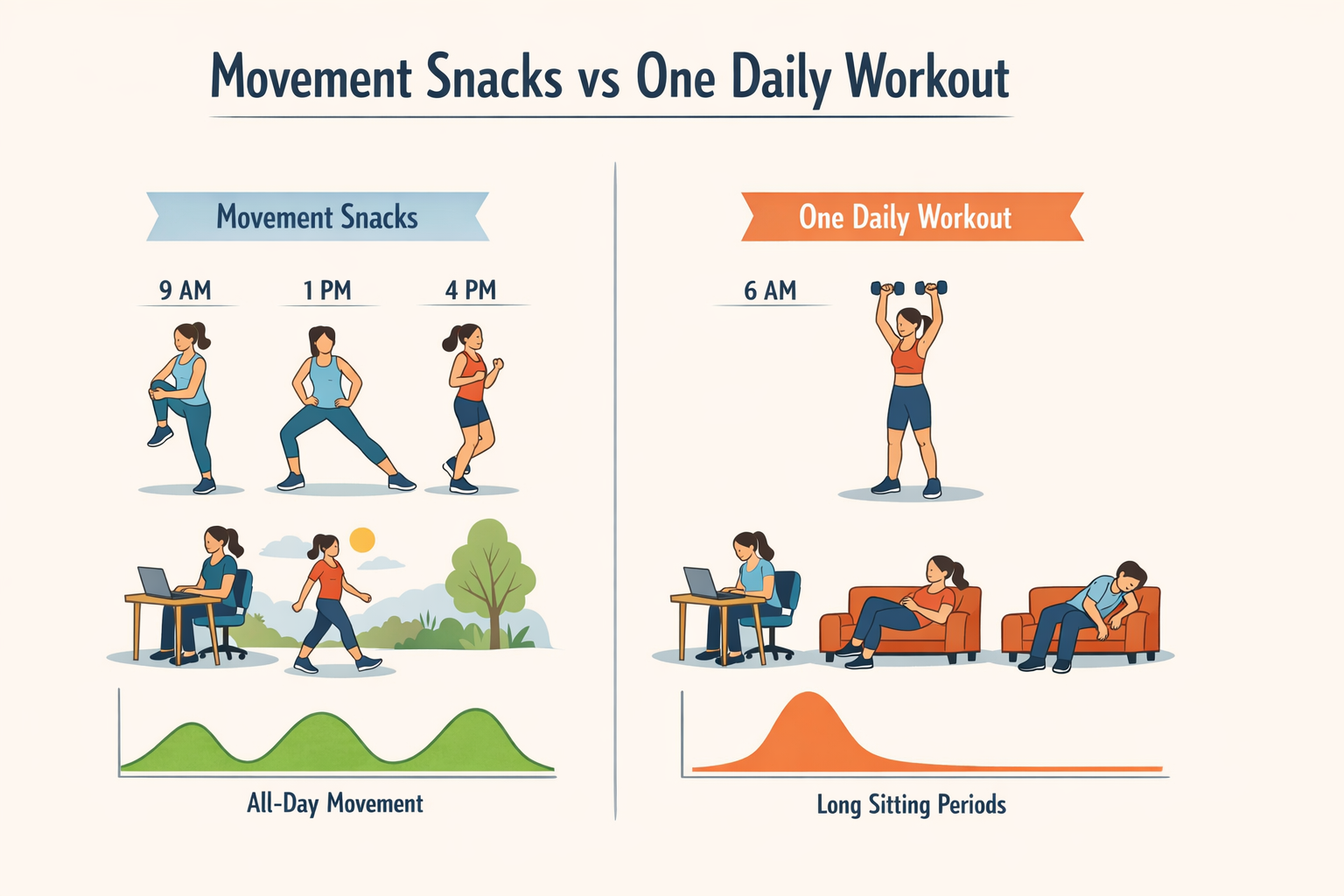
If you already work out most days, you are doing something powerful for your health.
But if you still feel stiff, puffy, heavy, or crash by the afternoon, it is not because you are doing it wrong. It is often because your body does not only respond to effort, It responds to rhythm.
That is where movement snacks come in.
Movement snacks are short bursts of movement (usually 2–10 minutes) sprinkled throughout the day. They are not meant to replace your workout. They are meant to support the other 23 hours, the hours where most people are sitting, compressed, and not moving much.
When your goal is to support lymph movement, fascial glide, and blood sugar regulation, frequency matters more than most people realize.
Do you feel compressed and stretch to no avail? Check out my article on: Why Stretching Makes Tightness Worse: Understanding Fascial Release & Functional Movement
What are Movement Snacks?
Movement snacks are short movement breaks you can do consistently without equipment, special clothing, or a perfect setup.
Examples: Do
3 minutes after you have been sitting
5 minutes after a meal
2 minutes between client sessions
6 minutes during the afternoon slump
The point is not intensity.
The point is repeated inputs that keep your system moving.
Why Movement Snacks Can Work Better Than One Workout
A single workout creates one big window of circulation, muscle pumping, joint motion, and breath-driven pressure change.
Movement snacks create multiple windows.
That difference matters because the systems that influence how you feel day to day respond best to repeated, varied movement:
Lymph
Fascia
Blood sugar and energy regulation
Let’s break that down.
1) Lymph Supports Better with Frequent Pumping
Your lymphatic system helps move fluid, proteins, and immune cells through a one-way network of vessels and lymph nodes.
Unlike your cardiovascular system, lymph does not have a central pump like the heart. It relies heavily on movement from:
muscle contractions
joint motion
changes in pressure from breathing
shifting positions and gentle bouncing or impact
A workout can absolutely help.
But if your day looks like this:
sit for hours
work out once
sit for hours again
You get one big pumping window, followed by long stretches of low motion.
Movement snacks create repeated pumping throughout the day, which is why many people notice they feel better when they move briefly and often.
In plain language: lymph likes opportunities. Movement snacks create more opportunities.
Learn more about the lymphatic system in my article: The Lymphatic System: Your Body’s Hidden Clean up Crew and How Fascia Helps It Flow
2) Fascia Responds to Consistent, Varied Inputs
Fascia is connective tissue. It wraps muscles, supports joints, and helps distribute force across your body. It also responds to hydration, temperature, load, and how long you stay in one shape.
When you sit in the same position for hours, the body often adapts by stiffening in that shape:
hips feel restricted when you stand up
your back feels “stuck”
your stride feels shorter
shoulders feel glued down or braced
A workout can help, but it does not always undo the effects of long stretches of stillness.
Movement snacks interrupt the “same shape all day” problem. They:
change joint angles
reintroduce tissue glide
load connective tissue gently and consistently
remind your nervous system that movement is available and safe
In plain language: fascia likes variety and reminders, not one heroic event.
Learn more about your fascia in my article: Fascia: The Hidden Web That Shapes Your Movement, Posture, and Health
3) Blood Sugar Regulation Improves When Muscles Turn On More Often
Your muscles are one of the biggest places your body can use glucose. When you move, your muscles increase their demand for fuel.
That is why movement snacks, especially after meals, often support:
steadier energy
fewer afternoon crashes
less desire to snack for stimulation
an easier time returning to focus
You do not need to crush yourself. You are giving your system more regular signals that fuel can be used and handled smoothly.
In plain language: small movement doses help your system stay online.
The Real Problem Is Not a Lack of Workouts
For many people, the issue is not that they never exercise.
The issue is that they are still for long stretches.
Stillness is compressive. It limits joint motion. It reduces muscle pumping. It reduces breath variability. It often contributes to a feeling of stagnation in the body.
Movement snacks solve that, not by replacing your workout, but by changing the structure of your day.
Are your workouts leaving you stiff? Explore: Strong Doesn't Always Mean Connected: 7 Signs Your Body Wants a Different Kind of Strength Training
A 4–6 Minute Movement Snack Routine
Joint Motion, Rhythmic Pumping, and Whole-Body Flow
This is a quick-start version you can do anywhere. No equipment. No perfect setup. The goal is to feel warmer, looser, and more awake when you finish.
When to use it
After 45–90 minutes of sitting
After meals (especially lunch)
During the afternoon energy dip
How to do it
Set a timer for 30–45 seconds per move. Move continuously and keep transitions short. Do one round. If you want more, repeat for a second round.
1) Lymphatic hops
Soft, light hops in place. Keep the bounce easy and springy.
Option: Do fast heel raises if hopping does not feel good.
2) Body waves (hip hinges)
Smooth hip hinges like you are folding and unfolding at the hips, arms swing forward in opposition. Keep ribs relaxed and neck long.
3) Side hops
Light side-to-side hops or quick side steps.
4) Arm swings
Relaxed arm swings forward and back. Let the arms be heavy.
Aim for looseness, easy rotation in torso.
5) Hip turns
Hops rotating hips and ribs oppositional of each other. Option: Feet planted, gently rotate hips right and left.
6) Trunk rotations
Hinge forward at the hips. Rotate through your ribcage letting arms drive the motion. Think ribs turning over the pelvis. Stay smooth and controlled.
7) High dead arms
Let your arms swing loosely, like ropes hitting the chest.
8) Golf swings
Easy, rhythmic rotations side to side like a golf swing.
Let the whole body turn together.
9) Low dead arms
Let the arms hang and swing loosely hitting the hips.
10) Knee tap march
March in place and tap the knee, alternating sides.
Stay tall and steady.
Learn more about how Fascia impacts the lymphatic system: The Fascia–Lymph Connection: Why Tight Tissue Blocks Drainage, Detox & Natural Glow
How To Scale It
Low energy day: pick 4–5 moves and do 20–30 seconds each
Standard: full routine once
Upgrade: full routine twice, or add a 5–10 minute walk after
What To Notice After
Look for simple body signs:
warmth through hands and feet
less stiffness in hips, back, or shoulders
easier breath
clearer focus
less heavy or sluggish feeling
This is not about soreness. It is about changing how you feel in your body.
A Rhythm That Fits Real Life
If you want this to work long-term, start with something you can actually do.
Minimum Effective Rhythm
1 snack after lunch
1 snack mid-afternoon
Steady Rhythm
1 snack in the morning
1 snack after lunch
1 snack late afternoon
Keep your workouts, your normal workout can replace that time of days movement snack. Movement snacks keep the body supple and ready to get the most out of your workouts.
The Takeaway
One workout can be amazing.
But your body also responds to what happens between workouts.
Movement snacks create repeated lymph pumping, repeated fascial inputs, and repeated muscle activation across the day. That is why they can support steadier energy and smoother movement.
Try the routine once today after sitting. Then try it again after lunch tomorrow. Let your body show you what it thinks.
This article gives you the quick-start version.
Inside the 28-Day Lymphatic Reset, the movement snack is built directly into your daily structure — fully timed, follow-along, and designed to work alongside the rest of the program so the pumping it creates actually has somewhere to go.
Because movement snacks work best when the rest of the system supports them. Breath that creates real pressure change. Drainage sequences that open the pathways before you move. Nourishment that reduces the acidic load your tissues buffer daily. And a consistent daily rhythm that gives your body the repeated inputs it needs to stop feeling stuck.
That is what the Reset gives you. Not a collection of isolated tools — a complete daily structure designed around how your lymphatic system actually works.
One payment. Lifetime access. Return to it whenever your body needs a reset.
Movement snacks are a great addition to your daily self care routine. Read about some other healthy habits in: 7 Practices That Transformed My Health and Happiness