Lymphatic Self-Massage Basics: Pressure, Direction, and Common Mistakes
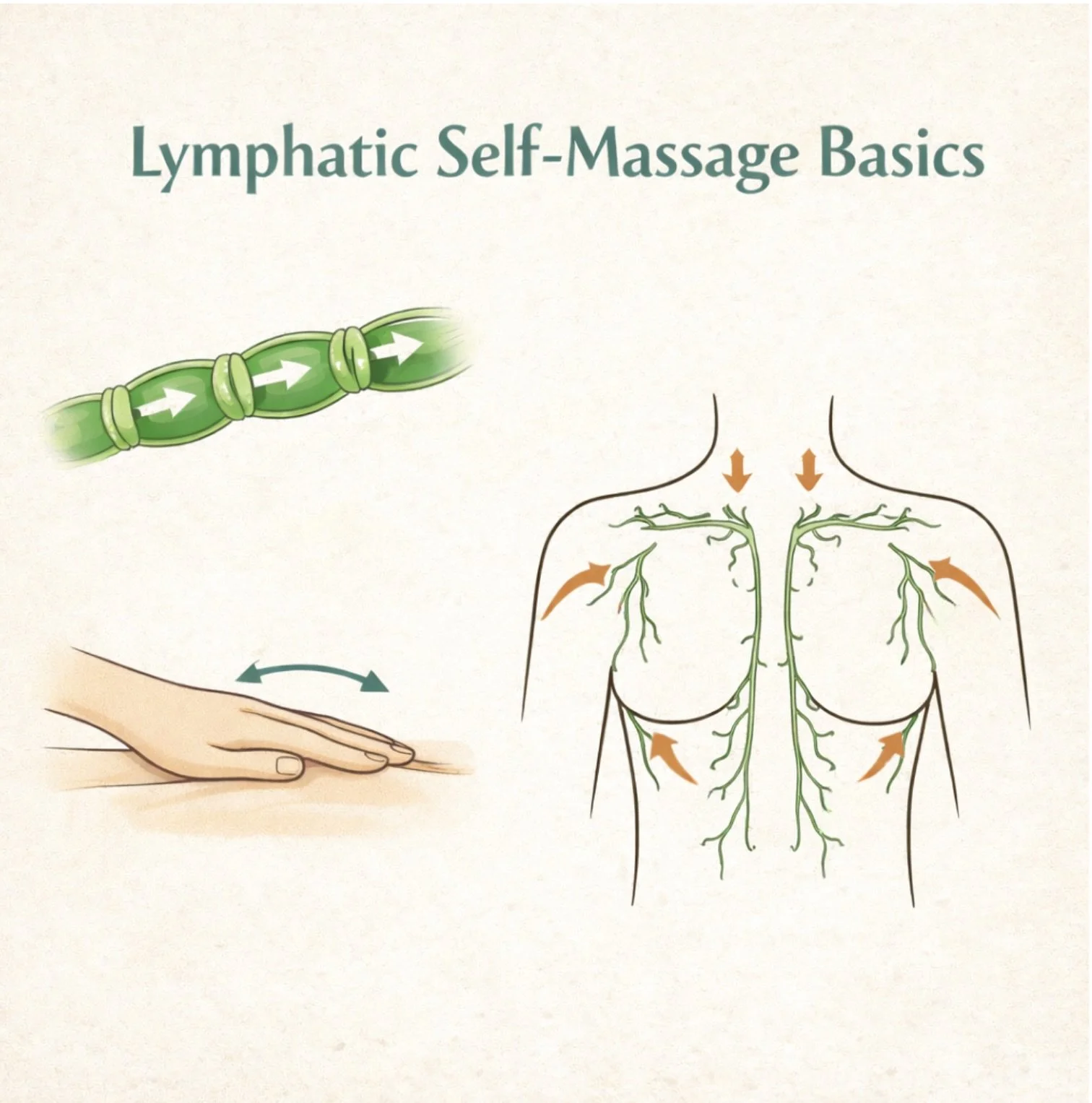
Many people hear that lymphatic self-massage can help reduce puffiness, support fluid movement, or help the body feel lighter. But one of the biggest misunderstandings I see is that people often approach lymphatic work the same way they approach deep tissue massage.
They press hard.
They move fast.
They focus only on the exact spot that feels swollen or stuck.
The problem is that those habits can work against the way the lymphatic system actually functions.
Lymphatic self-massage tends to work best when it is gentle, slow, and directional. Once you understand a few simple principles, it can start to feel much less confusing and much more intuitive.
In this article, we’ll walk through the basics:
why lymphatic massage uses light pressure
how lymphatic vessels actually move fluid
why direction matters
a simple way to think about body quadrants
common mistakes that can make lymphatic work less effective
If lymph is new to you, learn more in my article The Lymphatic System: Your Body’s Hidden Clean up Crew and How Fascia Helps It Flow
Lymphatic Massage Is Mostly a Skin Stretch
One of the biggest misconceptions about lymphatic massage is pressure.
Because we often associate massage with digging into tight muscles, it can feel surprising to learn that lymphatic work is usually much lighter. The lymphatic vessels that collect and transport lymph sit very close to the surface of the skin, so the goal is typically not to press deeply into muscle.
Instead, the goal is often a gentle stretch or movement of the skin.
Rather than digging into tissue, the technique may feel more like:
lightly stretching the skin
sliding the skin in a direction
softly scooping the surface tissue
If you see deep indentations in the skin, feel soreness afterward, or notice that you are bracing while doing it, the pressure is usually too strong.
Lighter pressure tends to work better because it allows the superficial lymphatic vessels to respond without being compressed by heavy force.
Because lymph vessels sit close to the surface of the skin, they are influenced by the quality and mobility of the surrounding fascia.Learn more in my article The Fascia–Lymph Connection: Why Tight Tissue Blocks Drainage, Detox & Natural Glow
How Lymphatic Vessels Move Fluid
The larger collecting lymphatic vessels are organized into small muscular segments called lymphangions.
Each lymphangion is separated by one-way valves that keep fluid moving forward and help prevent backflow. You can think of these segments like a chain of small chambers, each helping pass fluid along to the next section.
Because of this valve system, lymph tends to respond better to light, rhythmic guidance than to strong pressure. When pressure is too heavy, it can compress the vessels instead of helping fluid move.
Lymphatic movement is also not random. Fluid travels along specific pathways toward drainage regions in the body, where it is eventually returned to the bloodstream through vessels near the collarbone, including the thoracic duct on the left side and the right lymphatic duct on the right.
This organized, directional flow is one reason lymphatic massage is taught with intention rather than random rubbing across an area.
Why Direction Matters
Unlike general massage, lymphatic massage usually follows the direction that lymph is meant to travel.
Most lymph in the body eventually moves toward drainage regions near the neck, armpits, and groin, where lymph nodes help filter and process fluid before it continues toward those final re-entry points near the collarbone.
So instead of thinking, “This spot feels puffy, so I’ll just rub right here,” it is often more helpful to think, “Where is this area trying to drain?”
That shift matters.
In other words, instead of rubbing back and forth over the area that feels swollen, think about which nearby drainage region you are trying to guide fluid toward first. This is where the idea of body quadrants or drainage territories becomes really helpful.
A Simple Way to Think About Body Quadrants
You do not need to memorize the entire lymphatic system to start thinking about direction more clearly.
A helpful beginner framework is to imagine the body divided into four broad territories on the trunk. Each territory tends to guide lymph toward a nearby drainage region.
For example:
the upper body often moves fluid first toward the armpits, before lymph eventually continues through deeper pathways and returns to the bloodstream near the collarbones
the lower body often moves fluid toward the groin
some areas of the trunk can guide fluid upward toward the armpits or downward toward the groin, depending on the territory
These territories are sometimes called lymphatic watersheds because they behave a bit like geographic watersheds, where fluid tends to flow toward a particular basin.
The borders between these territories are not rigid walls, but they provide a useful mental map for understanding the general direction lymph tends to move.
The key takeaway is this: instead of aggressively rubbing the exact area that feels puffy, it is often more helpful to gently guide the skin in the direction the body already wants to drain.
Why a Broader Palm Often Works Better
Another common mistake is using the fingertips to dig into tissue.
Fingertips can create too much pressure in a very small area, which can make the work feel more like deep tissue massage than lymphatic support.
Using a broader contact, such as:
the palm
the flat part of the fingers
a softly cupped hand
can help distribute pressure more evenly and allow the skin to move without compressing deeper structures.
For many people, this immediately makes the technique feel calmer, gentler, and more effective. Slow, light strokes with a broader surface often work better than poking, pressing, or trying to force something to move.
Common Lymphatic Massage Mistakes
Once you understand the basic principles, the most common mistakes become easier to spot.
Using Too Much Pressure
Lymphatic vessels are delicate and close to the surface. Heavy pressure can compress the tissue instead of encouraging fluid movement.
Moving Too Fast
Lymphatic work tends to respond better to slow, rhythmic movement than to fast rubbing.
Only Massaging the Puffy Area
Sometimes the body needs more space closer to the drainage region before fluid can move well from farther away.
Treating It Like Deep Tissue Massage
Lymphatic massage is usually much lighter and more surface-focused than muscle work.
A good general reminder is that lymphatic self-massage should not feel aggressive. It should feel intentional, steady, and easy enough that your body is not fighting you while you do it.
Massage Is Only One Piece of Lymph Support
Self-massage can be a helpful tool, but it is only one piece of the picture.
Lymph movement also depends on several other factors working together, including:
rhythmic daily movement
breathing and pressure changes through the ribcage and trunk with 360° Breathing
posture and tissue compression
fascia glide and movement variety
hydration, digestion, and nourishment
When these pieces work together, the body often moves fluid more efficiently on its own. Massage can support that process, but it is rarely the only thing that matters.
This is also why a lymph-supportive routine often works better than relying on one isolated tool.
Learn more about 360° Breathing in my article 360 Breathing: The Key to Optimal Pressure Management and Pain-Free Movement
Get a daily rhythmic routine in the article Movement Snacks vs One Daily Workout
Massage works better when the rest of the system is working with it.
If you have been doing self-massage consistently but still feel puffy, heavy, or like nothing is really shifting, the technique is rarely the problem. The body needs more than one input to keep fluid moving well — breath, movement, nourishment, and daily rhythm all matter too.
The 28-Day Lymphatic Reset gives you the complete daily structure. A 7-minute morning routine that opens the lymphatic vessels before driving fluid through them. Four rotating self-massage sequences that work through specific areas of the body progressively. Four 360° breathing flows that support internal pressure changes throughout the month. A nourishment plan that reduces the acidic load your tissues buffer daily. And a 4-minute movement snack to keep flow going through the day.
Not a collection of isolated tools. A daily rhythm designed around how your lymphatic system actually works.
One payment. Lifetime access. Return to it whenever your body needs a reset.
If you want individualized help identifying the patterns underneath, Fill out the Fit Form.