Why Your Lymph Gets Stuck (and What Actually Moves It)
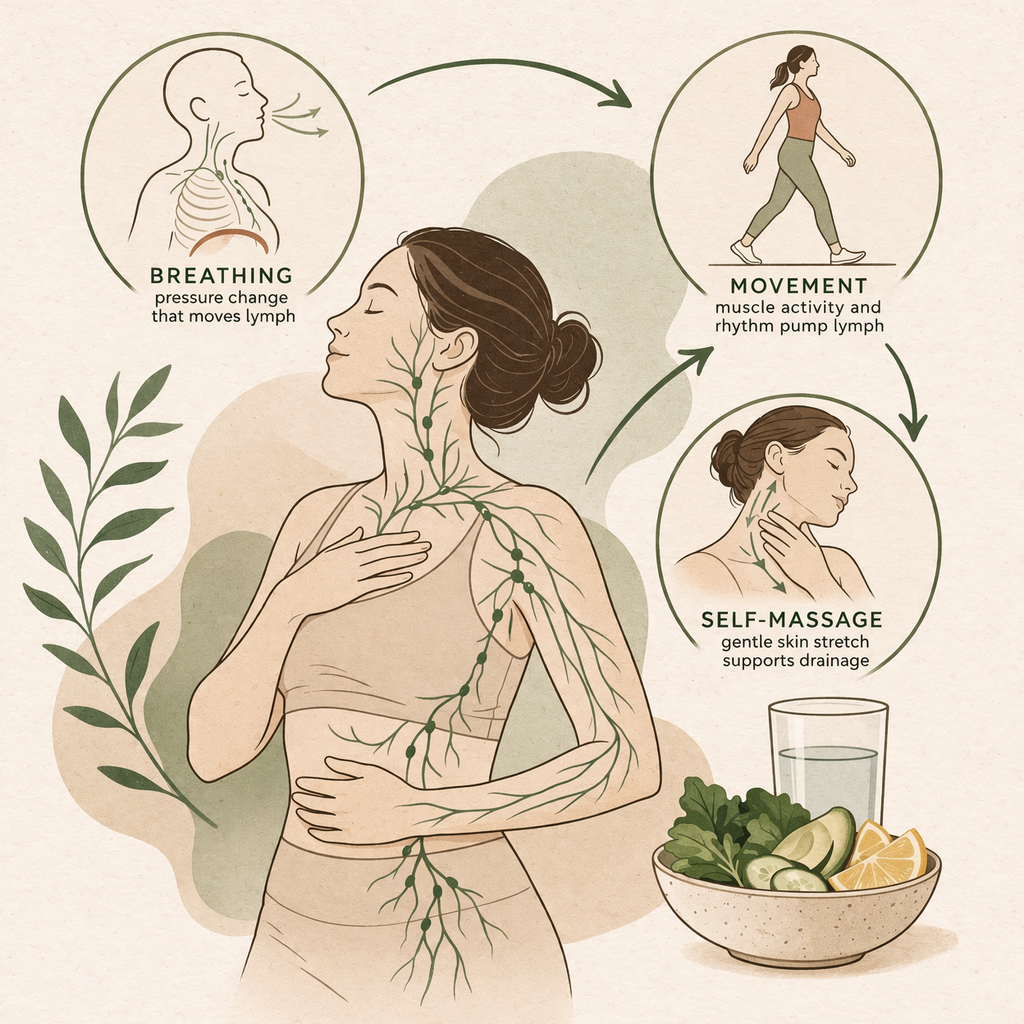
If you feel puffy in your face, belly, or legs, heavy in your body, or like your tissues get stiff and “stuck” even when you are trying to do healthy things, lymph may be part of the picture.
Lymph is often talked about like it only matters if you are dry brushing or doing self-massage, but that is not the full story.
Your lymphatic system does not have one central pump like the heart. Instead, it relies on movement, pressure changes, muscular activity, tissue motion, and fluid balance to help keep fluid moving.
That is why one occasional massage or one “lymph hack” does not always change how you feel.
If you want to support lymph flow in a way that feels grounded and practical, it helps to understand the main drivers that actually move fluid through the body.
First, what lymph actually needs
Lymph is part of your body’s fluid transport and cleanup system. It helps move excess fluid, proteins, waste, and immune-related material through a network of vessels and nodes.
Unlike blood, which is pumped by the heart, lymph depends on outside forces to keep moving.
That means your body benefits from regular inputs like:
breathing and pressure change
regular movement and muscular activity
joint movement and tissue glide
gentle manual support
hydration and mineral balance
When those inputs are missing, many people notice they feel more swollen, heavy, stiff, or stagnant.
Lymph is not the only reason someone feels that way, but it is often an overlooked part of the picture.
Learn more: The Lymphatic System: Your Body’s Hidden Clean up Crew and How Fascia Helps It Flow
1. Breathing helps pump lymph through pressure change
One of the most important and most overlooked drivers of lymph flow is breathing.
Every breath creates pressure changes inside the torso. When the diaphragm moves well and the ribcage can expand and recoil, that pressure change helps encourage fluid movement through the body.
This matters because lymph responds to pressure gradients. A body that is always held rigid, compressed, or breathing high into the chest may not create the same helpful internal movement as a body that can expand and recoil more naturally.
This is one reason breathwork can matter for more than stress relief.
It is not just about “taking a deep breath.” It is about restoring more usable movement through the ribcage, diaphragm, and trunk so your body has one more natural mechanism for moving fluid.
If your neck takes over when you breathe, your ribs feel stiff, or your breathing feels more vertical than expansive, that is often worth addressing.
Learn more: 360 Breathing: The Key to Optimal Pressure Management and Pain-Free Movement
2. Walking helps, but it is not always enough
Walking is one of the simplest and most helpful things you can do for lymph flow.
It gives you rhythmic muscle contractions, alternating motion through the pelvis and ribcage, and the kind of repeated whole-body movement that helps fluid keep circulating.
For many people, more walking does help them feel less stiff and less stagnant.
But walking is not always enough on its own.
If someone is very compressed through the trunk, sitting most of the day, breathing shallowly, or dealing with a lot of stiffness, a walk may not fully address the issue. It may help, but it may not be the complete answer.
This is where people often feel confused. They are doing the healthy thing. They are walking. But they still feel puffy, heavy, or stuck.
That is usually a sign that the body may need more than one input.
3. Movement frequency matters more than intensity
Lymphatic vessels are supported by the movements happening around them. When muscles contract and relax throughout the day, they create a kind of pumping assistance for nearby fluid.
That is the mechanism. And once you understand it, the practical implication becomes clear: your body usually responds better to distributed movement than to one concentrated effort followed by hours of stillness.
This is part of why sedentary days can leave people feeling puffy or heavy even after a solid workout. The workout helped. But the body spent the rest of the day without much input, and fluid had fewer opportunities to keep moving.
Short movement breaks throughout the day address this directly. A few minutes of intentional movement can help by:
changing pressure in the torso
moving joints through range
stimulating muscular contraction
improving tissue glide
reducing the “stagnant” feeling that builds from too much sitting
This does not need to be complicated or time-consuming. Simple options include gentle marching, arm swings, ribcage movement, spinal motion, heel drops, or a short reset after meals or long stretches of sitting.
If distributed movement feels like your missing piece, start withMovement Snacks: A 4–6 Minute Reset for Stiffness, Puffiness, and Low Energy.
The goal is not intensity. It is giving fluid more regular reasons to move.
4. Gentle self-massage can be helpful when done correctly
Self-massage can absolutely support lymph flow, but this is the place where many people accidentally overdo it.
Lymphatic vessels sit close to the surface. That means lymphatic self-massage is not about digging deep into tissue. In many cases, lighter pressure works better than heavier pressure.
The goal is usually to create a gentle skin stretch in the right direction, not a deep tissue release session.
A few important reminders:
use light pressure
think skin stretch, not muscle smashing
follow drainage direction
work in a calm, repeatable way
avoid turning it into a painful recovery session
This is where technique matters.
If someone uses too much pressure or moves fluid in a random direction, the massage may feel like “doing something,” but it may not be especially helpful.
Learn more: Lymphatic Self-Massage Basics: Pressure, Direction, and Common Mistakes
5. Tissue mobility and fascial glide matter too
Fluid moves through living tissue, not through a vacuum.
If your body feels bound up, compressed, or stiff, that can change how easy it feels for you to breathe, rotate, expand, and move fluid well.
This is one reason so many people describe feeling both tight and puffy at the same time.
It is not always about needing more aggressive stretching. Often, it is about improving tissue motion, restoring better rib and trunk movement, and reducing the sense of internal congestion that comes from always being held in the same shape.
For some people, gentle manual work, strategic movement, and better breathing mechanics can help tissues feel more spacious and less stuck.
That creates a better environment for everything else you are doing.
If you feel like your body is too compressed, asymmetrical, or stuck to make progress on your own, this is also where more personalized support can help. Sometimes the missing piece is not more effort. It is having someone assess your breathing, posture, and movement patterns so the right inputs are matched to your body.
Learn More: The Fascia–Lymph Connection: Why Tight Tissue Blocks Drainage, Detox & Natural Glow
6. Hydration matters, but it is not just about drinking more water
Fluid balance plays a real role in how lymph moves through the body. But “drink more water” is often too simplistic.
Your body usually does better when hydration is supported by minerals, easy-to-digest foods, and a steadier rhythm across the day, not just large amounts of plain water in isolation.
For many people, the goal is not forcing fluids. It is creating a better environment for fluid movement by pairing hydration with foods and habits that support the body overall.
That is one reason I focus on hydration-forward meals inside the 28-Day Lymph Reset. The goal is to make hydration feel more usable and more supportive, not just higher in volume.
You do not need a perfect diet to support lymph. But when hydration, minerals, and food quality are working with you instead of against you, many people notice they feel less sluggish, less puffy, and less “stuck” in their tissues.
Learn more: Micronutrients for Lymph and Fascia Support : A simple 7-day reset
7. Optional tools can help, but they are not the foundation
There are many tools people use to support lymph, including:
dry brushing
rebounding
contrast showers
vibration plates
legs up the wall
baths and recovery practices
These can be useful, and some people really enjoy them.
But tools work best when they are layered onto a solid foundation.
If someone is not breathing well, not moving much during the day, using overly intense self-massage, and feeling overwhelmed by what to do, adding more gadgets usually does not solve the real problem.
The basics still matter most.
Learn more about tools:Lymphatic Tools That Support Healthy Flow
Why occasional “lymph support” does not always work
A lot of people try one lymph-supportive thing once in a while and then conclude that lymph work does not do anything.
Usually, the problem is not that the body does not respond.
It is that the input was too random, too intense, too incomplete, or too inconsistent.
Lymph tends to do better with rhythm than with force.
That means a gentle daily pattern often works better than doing one big routine once a week.
For many people, the missing piece is not effort. It is structure.
A simple place to start
If you feel overwhelmed, start here:
Build in short walking or movement breaks throughout the day
Use gentle self-massage, not deep pressure
Support hydration with a steadier rhythm
Add optional tools only if they genuinely help you
You do not need to do everything perfectly.
The goal is to give your body more regular opportunities to move fluid.
Want the full structure? The 28-Day Lymph Reset
One of the hardest parts of lymph support is not finding ideas. It is knowing how to put the right pieces together in a way that feels simple enough to follow.
That is exactly why I built the 28-Day Lymph Reset.
Inside, I walk you through a repeatable daily rhythm that combines:
hydration-forward meals
a simple morning routine
4-minute movement snacks
breathing flows
gentle self-massage guidance
optional add-ons like dry brushing, baths, and rebounding
Instead of guessing which tool to use and when, the course helps you organize the main drivers of lymph flow into something you can actually practice.
If you have been feeling puffy, heavy, stagnant, or like your body needs a clearer plan, the 28-Day Lymph Reset is designed to help you put these pieces into practice step by step.
Need more personalized support? Fill out the Fit Form.