Tight Clothing and Lymph Flow: What Your Body Is Telling You
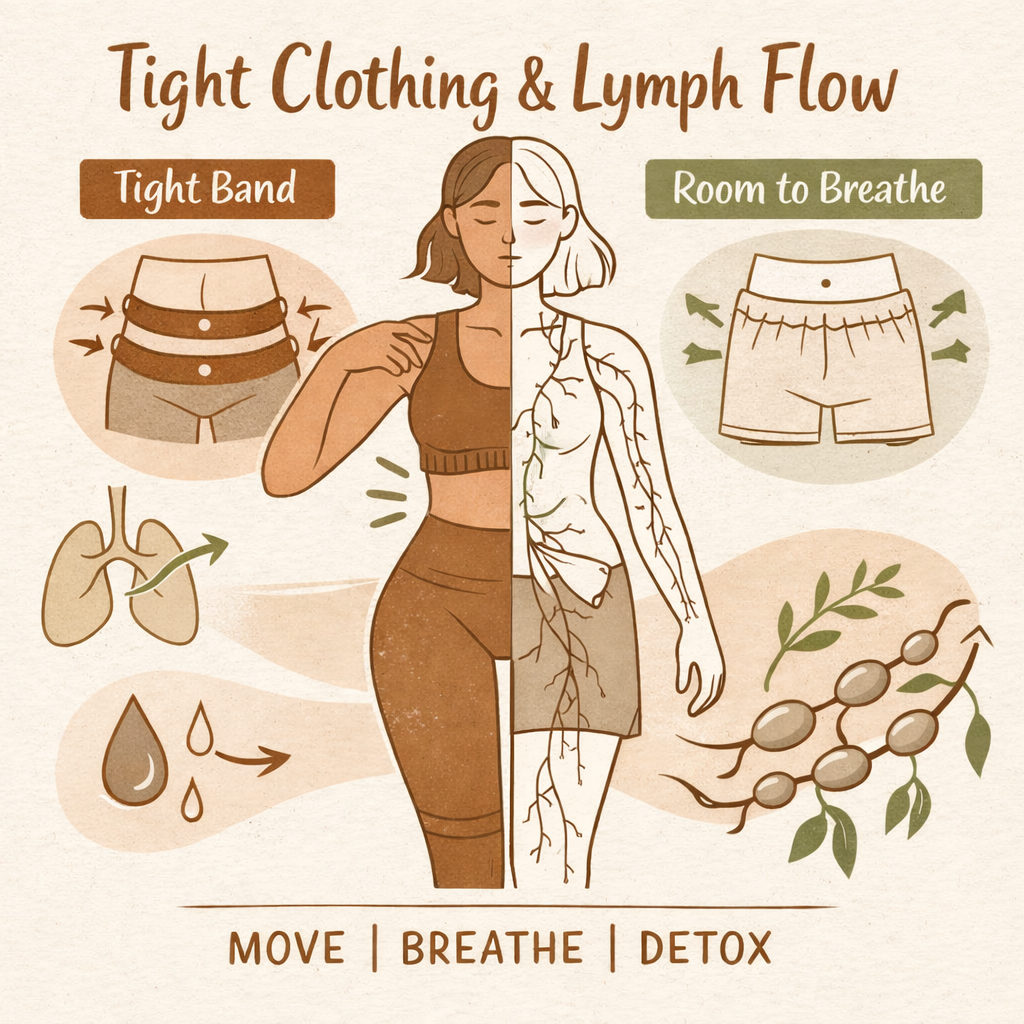
If you peel off a tight waistband at the end of the day and feel instant relief — less puffiness, easier breathing, like your body can finally exhale — that is not just comfort.
That is your body responding to restored movement and space.
Tight clothing, especially at key pinch points like the waist, hips, ribcage, and ankles, can interfere with the pressure changes, tissue movement, and circulation your lymphatic system depends on. And because your lymphatic system plays such an important role in fluid balance, immune support, and overall ease in the body, that is worth paying attention to.
This is not about fear or perfection. It is about understanding what your body may be responding to, and giving it a little more support.
Lymph needs movement and space, not just time
Your lymphatic system moves fluid, proteins, and immune cells through a network of vessels and nodes throughout the body. Unlike your cardiovascular system, it does not have a central pump.
Lymph flow depends on a few key things:
muscle contractions, especially in the calves and legs
breathing mechanics, including the pressure changes created by your ribcage and diaphragm
soft-tissue mobility, with skin and fascia layers moving freely against each other
When those inputs are reduced, lymph does not stop moving entirely, but it can move less efficiently. Over time, that can show up as heaviness, puffiness, pressure, or a general sense that your body feels a little stuck.
Learn more: The Lymphatic System: Your Body’s Hidden Cleanup Crew and How Fascia Helps It Flow
Where tight clothing tends to interfere
Compression is not automatically a problem. Certain forms of compression are used intentionally in the right context.
The issue is more often constant, uneven compression at narrow points, especially when it is combined with long periods of sitting, shallow breathing, or limited movement.
Think of it like a garden hose with a kink in it. Flow does not stop completely, but it is reduced right at the point of restriction.
Common pinch points include:
waistbands and shapewear around the lower belly, pelvis, and hip crease
bra bands and underwire zones around the ribcage and upper trunk
tight socks with deep elastic at the ankles and lower calves
tight jeans or leggings at the hip crease and glute fold
At these spots, tight clothing can reduce the soft-tissue glide and subtle motion that help lymph vessels do their work. Add sitting, stress, or a braced ribcage on top of that, and the body may start to feel more congested by the end of the day.
Learn more: Fascia: The Hidden Web That Shapes Your Movement, Posture, and Health
The Fascia–Lymph Connection: Why Tight Tissue Blocks Drainage, Detox, and Natural Glow
Tight clothing can change your breathing, too
One of the most overlooked effects of tight clothing is what it does to your breath.
A tight bra band or high-compression waistband can limit how fully your ribcage expands. When that happens, breathing often shifts upward into the chest — shallower, less rhythmic, and less mechanically supportive.
That matters because your diaphragm and ribcage create some of the most important internal pressure changes in the body. Those pressure changes do not just help you breathe. They also help move fluid.
So if your clothing changes the way you breathe, it can also change how much support your body gets from one of its built-in movement systems.
This is one reason breathing mechanics matter so much for lymphatic health. When your ribs can expand well and your diaphragm can move more freely, your body has a better internal rhythm to work with all day long.
Learn more: 360 Breathing: The Key to Optimal Pressure Management and Pain-Free Movement
Your skin is a second kidney — and tight clothing gets in the way
Your skin is not just a barrier. It is an active elimination organ.
Sweat is not simply water. It contains urea, ammonia, lactic acid, minerals, and other metabolic byproducts that your body is actively moving outward. Your skin also plays a real role in heat regulation, microbiome balance, and barrier function — all of which affect how efficiently your body manages its internal environment.
This is why the idea of skin as a second kidney is more than a wellness metaphor. Your kidneys and liver are your primary filtration organs, but your skin contributes to that same system in a meaningful, daily way. When it is working well, it helps your body regulate cleanly. When it is chronically compressed, overheated, or trapped under synthetic fabric, that process gets disrupted.
Tight clothing, especially in non-breathable fabrics, can trap heat and moisture against the skin for hours at a time. That creates a cycle of irritation, dampness, and friction that makes it harder for the skin to do its job. The result often shows up as that heavy, stuck, congested feeling that builds through the day and does not fully resolve until you finally change clothes.
Giving your skin more airflow, less friction, and more room to regulate is a simple way to support the whole system — not just lymphatic flow, but your body's broader elimination work.
I will cover synthetic fabrics, common textile finishes, and how to choose better options in a dedicated article.
Signs your clothes might be working against you
Your body usually tells you when something is off.
Some common signs include:
deep sock marks that take a long time to fade
puffiness or heaviness that builds through the day
a trapped or pressured feeling at the waist, ribs, or hips
difficulty expanding your ribs or belly comfortably
tingling, numbness, or pressure discomfort
If any of those feel familiar, your body may be asking for more room, more movement, or less constant compression.
If swelling is sudden, one-sided, painful, hot, or unexplained, please get it checked by a healthcare provider.
A quick reset to restore flow
After sitting for long stretches or spending a day in compressive clothing, one of the fastest ways to help your body is to restore rhythm and motion.
You do not need a full workout. You do not need to change clothes. You just need to give your body a few minutes of better input.
A simple reset might include:
lymphatic hops: soft, springy hops in place, or fast heel raises for a lower-impact option
hip hinges: smooth folding and unfolding at the hips with the arms swinging naturally
trunk rotations: ribs turning over the pelvis in a rhythmic, controlled way
knee tap march: marching in place while staying tall and alternating knee taps
A good movement snack brings together joint motion, gentle pumping, and soft-tissue flow all at once.
Even two minutes can make a difference.
After one round, notice what shifts:
warmer hands or feet
easier breathing
less heaviness
clearer focus
Small changes are the point.
Learn more: Movement Snacks: A 4–6 Minute Reset for Stiffness, Puffiness, and Low Energy
Simple clothing shifts that can help right away
You do not need to overhaul your wardrobe. You just need to stop treating tight compression as your everyday default.
A few practical changes:
choose softer waistbands without hard seams at the narrowest point
size up on long sitting days or travel days
alternate compressive pieces with looser layers throughout the week
if you want support, look for distributed compression rather than pinch-point compression
if a garment noticeably changes your breathing, it is too restrictive for all-day wear
when possible, choose fabrics that breathe and manage moisture more comfortably
The goal is not to avoid every snug piece of clothing forever.
The goal is to notice how your body responds, and stop ignoring the signals.
If this article felt familiar, your body is asking for more than a wardrobe adjustment.
Tight clothing is often the most visible layer of a bigger pattern — restricted breathing, reduced movement, tissue that stopped gliding well, and a lymphatic system that never fully gets to clear.
The 28-Day Lymphatic Reset is a complete daily structure built around all of it. A 7-minute morning routine that opens the vessels before moving lymph through them. A 4-minute movement snack. Rotating massage and breathing sequences. A nourishment plan that reduces the acidic load your body has been quietly buffering — so your cells can actually rehydrate.
One payment. Lifetime access. Use it every time your body needs a reset.
Closing
If tight clothes make you feel worse, that is not vanity. That is your body communicating with you.
Give your tissues more room. Give your ribs more movement. Give your legs more rhythm.
Your lymphatic system is always working for you. The least you can do is give it a little space to do it well.