Your Body Remembers Every Spiral It Ever Made
I veered left in swimming lessons as a kid.
Every time. Without fail.
My instructor would correct me, I would straighten out, and a few strokes later I would drift left again. Nobody could figure out why.
On the ice, it was my right foot.
It would miss the ice every couple strides, lose the edge, and disconnect from the surface in a way my left foot never did. I learned to compensate. I learned to grip harder with the right side. I learned to brace.
I crossed my legs the same way every single time I sat down. Right over left. It felt so natural that it took me years to notice I was doing it.
And my right temple and jaw were always tight.
Always there. A low hum of tension that climbed into headaches I could not fully explain. Nobody connected any of it. Not to each other. Not to a pattern. They were separate things happening in separate places.
But they were not separate at all.
They were the same spiral, showing up everywhere it could.
Your Body Is Built to Spiral
Your body is not meant to move like a stack of blocks.
It is meant to spiral.
Every time you walk, reach, turn, breathe, swim, skate, or shift your weight, your body uses rotation. One leg loads while the other reaches. The pelvis rotates. The ribcage counter-rotates. The arms swing in response to that cross-body rhythm. The spine organizes between all of it.
This is not a flaw in the design. It is the design.
When that spiral is working well, it has an elastic quality. The body winds and unwinds. It loads and returns. It absorbs force and gives it back. It can rotate without getting stuck there.
That is what we want.
Not a perfectly straight body. Not a perfectly symmetrical body. Not a body that never twists.
A body that can spiral and return.
The problem is not that your body spirals. The problem is when it gets stuck in one spiral and keeps returning to it as the only available option.
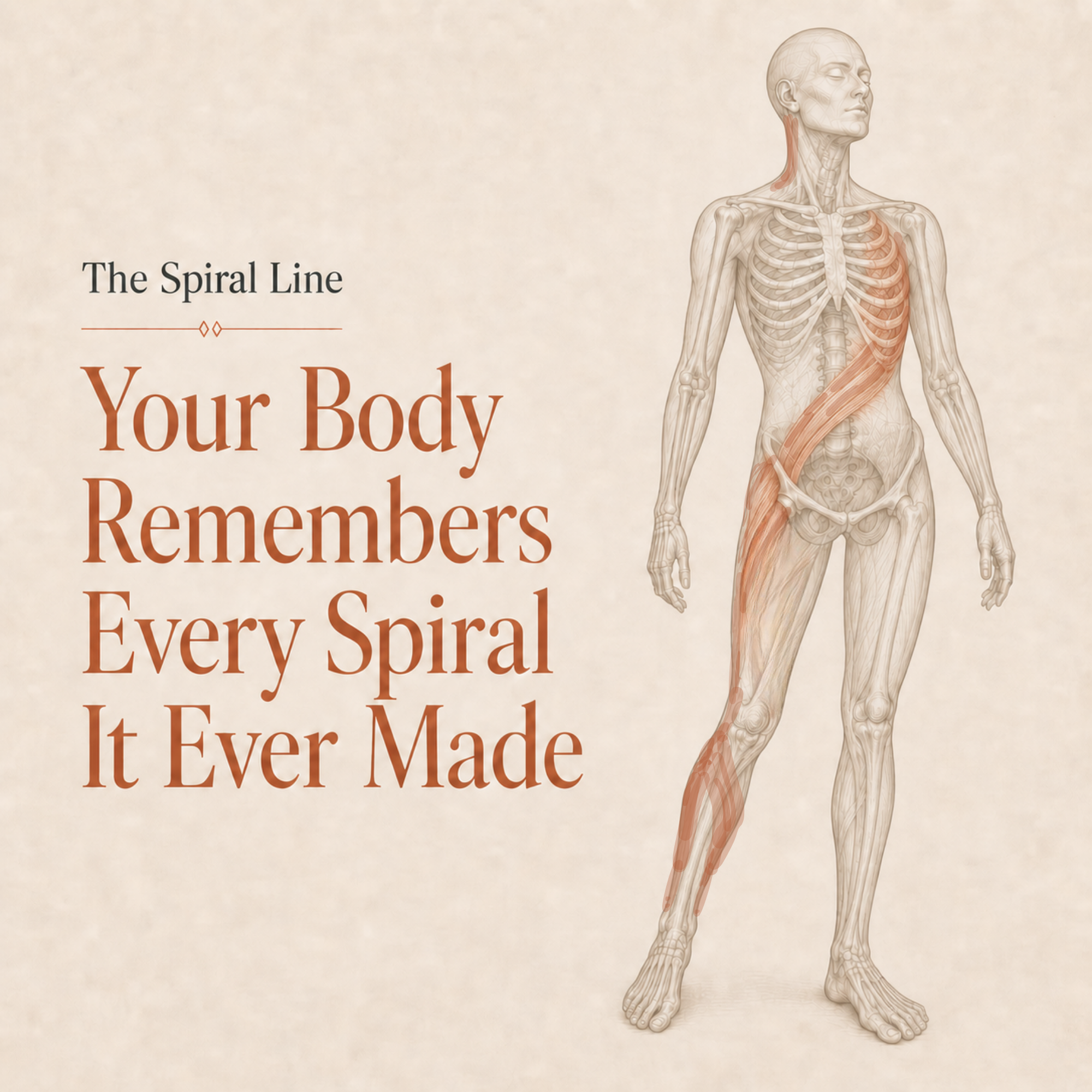
Fascial pathways wrap through the body in diagonal and rotational patterns, connecting the foot to the hip, the hip to the ribcage, the ribcage to the shoulder, the shoulder to the neck. The Spiral Line, one of the fascial lines described in the Anatomy Trains model, gives us a map for understanding how tension and compensation can travel through these rotational chains. When restriction lives anywhere in that chain, the whole system reorganizes around it.
This is why one-sided tension is rarely as isolated as it feels.
When the Spiral Stops Being Elastic
There is a difference between moving through a spiral and holding one.
Think of a spring. It coils and recoils. It stores energy and releases it. It has life in it.
Now think of a bent piece of wire. It also has a curved shape, but it does not bounce back. It holds the bend.
A body stuck in a spiral pattern is not truly spiraling. It is frozen mid-spiral.
An elastic spiral loads and returns. A braced spiral locks. It holds its position because the body is using that shape as structure. And over time, that braced shape begins to feel like neutral.
The foot that does not connect becomes normal. The hip that sits slightly rotated becomes normal. The ribcage that does not expand well on one side becomes normal. The neck that grips becomes normal. The jaw that joins in becomes normal.
That is when people start saying things like:
"This is just my bad side." "My right hip is always tight." "My body is just crooked."
But often, the body is not broken. It is rehearsed.
The Spiral Shows Up Long Before It Becomes Pain
The pattern usually announces itself in small daily habits long before it becomes a symptom.
Think about your automatic movements.
Which leg do you always cross when you sit? Which side do you sleep on? Which shoulder carries your bag? Which foot do you shift into when you stand? Which arm reaches first? Which direction do you rotate your chair to look at a screen? Which foot leads when you climb stairs? Which side of your jaw clenches when you concentrate?
These may feel like random preferences. But they are often the spiral making itself at home.
Every time you cross the same leg, you reinforce a familiar pelvic rotation. Every time you sleep on the same side, you compress the same ribcage tissues for hours. Every time you carry weight on the same side, you ask one hip to stabilize while the other rests.
Your body is always listening. It listens to your training, your posture, your habits, your injuries, your stress, and the way you brace when life feels like too much.
Eventually, what started as a preference becomes a groove. The body practices that spiral thousands of times a day across years of repetition. By the time it shows up as chronic tension, the pattern is not new.
It is deeply familiar. It lives in the tissue.
Tracing the Pattern: From the Ground to the Jaw
Let's trace one example so you can feel how connected this actually is.
Start with the foot.
If one foot does not fully connect with the ground, if the arch collapses, if the big toe does not engage, if the push-off is incomplete, the leg above has to adapt. The hip compensates. Then the pelvis. Then the ribcage. Then the neck.
And sometimes, the jaw.
To be clear, the jaw is not technically part of the Spiral Line itself, but it can become one of the places where a larger spiral compensation shows up.
So we can ask a series of better questions.
If the jaw is gripping, what is the neck doing? If the neck is bracing, what is happening at the ribcage? If the ribcage is compressed or rotated, how is the pelvis organizing underneath it? If the pelvis is shifted or rotated, how is the leg loading? If the leg is not loading well, what is happening at the foot?
This is how one small disconnection becomes a whole-body pattern. A foot that does not quite connect to the ground can become part of a chain that influences the pelvis, ribcage, neck, and jaw.
The jaw may not be the origin of the pattern. It may be the alarm bell. The place where the body finally runs out of room to compensate quietly.
That was true in my body. The headaches were not a jaw problem. They were a message from a system that had been bracing since childhood and had simply run out of slack.
The Body Does Not Hold Patterns by Accident
The body does not land in a braced spiral randomly. It gets there through accumulation.
An old ankle sprain that changed how the foot loaded. A period of sitting for long hours in the same position. A shoulder injury that made you guard one side. Years of a sport that loaded one diagonal more than the other. A posture habit picked up in adolescence and never examined. Not to mention that our organs hold an asymmetrical load that naturally twists the body and can compound over time.
But there are other layers too.
The body also braces in response to things that are not purely physical.
Chronic stress has a shape in the body. So does grief. So does a long season of feeling like you had to hold yourself together without much support. The jaw that grips. The shoulder that stays slightly raised. The hip that never fully opens. The ribcage that does not quite expand on one side. Sometimes these are mechanical. Sometimes they are protective. Often they are both.
This is not weakness. It is the body doing what bodies do: adapting to the full range of what life asks of them.
The pattern became a home base. A known shape. A predictable way of organizing that felt more manageable than the alternative.
The problem is not that the body learned this.
The problem is when the protective pattern outlasts what it was protecting against.
The ankle healed but the foot still does not fully push. The hard season ended but the ribcage still does not expand freely. The thing that made bracing necessary is gone but the body has not received enough new input to organize differently.
And so the spiral holds.
Why This Takes Time
A pattern that has been living in your body for ten or twenty years is not a tight muscle. It is tissue that has been loaded, over and over, in the same direction. A body that has practiced one version of the spiral so many times that it has become the default.
This changes what real change actually requires.
Stretching the tight side may feel good. Massage may offer relief. A single session of careful movement work may open something. But if those approaches are not followed by consistent new loading, the body tends to return to what it knows. The old pathway is still the most familiar one. The body has no reason to reorganize permanently around one good session.
Real change happens when fascial tissue is asked to work under new conditions, repeatedly, over time. Not forced. Not aggressively stretched. Loaded differently. The body needs to push, carry, reach, rotate, resist, and stabilize in patterns that are genuinely different from the ones it has been rehearsing. That is what gives the tissue a reason to adapt. Not a cue to relax. A new demand.
What is worth understanding is that this works in both directions.
When you load the body in a new pattern, you are not only changing tissue. You are also changing the felt experience of being in that body. A foot that learns to push into the ground fully does not just create better force transfer up the chain. It creates a new experience of being supported. A ribcage that learns to expand on both sides does not just improve mechanics. It changes what it feels like to take up space. A hip that finally loads through its full range does not just improve gait. It can shift something about how grounded and stable you feel in your own body.
The mechanical and the emotional are not separate tracks running in parallel. They are the same system being reorganized.
That said, it is also worth being honest about the other direction. A pattern that formed partly as a protective response does not always dissolve from mechanical input alone. Sometimes the body needs to accumulate enough new experiences of safety and support before it is willing to let the old strategy go. The tissue may be capable of moving differently before the body feels ready to trust that movement. That is slower still.
This is worth naming because many people have worked hard on their bodies for years and felt like they were failing when the pattern kept returning. They were not failing. They were working with something more layered than a tight muscle. The body is not being stubborn. It is being careful. It learned this pattern for a reason and it will release it on its own timeline, with enough consistent input and enough accumulated evidence that something different is safe.
That is slow work. But slow does not mean nothing is happening. It means the body is learning something real.
What Elastic Actually Feels Like
The goal is not simply less tension. The goal is more recoil.
An elastic spiral has a quality of potential. You can feel the body wind and release. A step has a push-off that returns energy. A breath expands and lets go without effort. A rotation comes back to center without the body gripping to control it.
In daily movement this might feel like:
Walking with a sense that the ground gives something back to each step
Breathing into the ribs in all directions without forcing it
Turning your head without your ribcage needing to follow
Reaching across your body without the opposite hip tightening
Carrying weight without the same shoulder automatically hiking
Feeling both feet participate instead of one doing all the work
This is not a perfect body. This is not a symmetrical body. This is a body that has enough options that it does not have to keep choosing the same one.
The braced spiral narrows your options down to one familiar strategy. Elastic movement is about widening them.
A Small Check You Can Try Right Now
This is not a correction. It is an observation.
Stand with your feet about hip-width apart and let your knees stay soft.
Notice which foot feels heavier into the ground. Notice whether one hip feels slightly forward. Notice whether one side of your waist feels shorter.
Take a slow breath and notice where it goes. Does one side of your ribcage expand as easily as the other? Does the back of your ribcage move at all, or does the breath mostly travel through your chest and belly?
Now slowly turn your head and ribcage to the right. Notice how far you go, whether your jaw shifts, whether your breath changes, whether one foot grips more.
Come back to center. Turn slowly to the left.
Notice which direction feels easier. Notice what changes between the two sides.
That difference is information. It is your body showing you where it has options and where it is relying on a familiar strategy.
There is nothing to correct right now. There is only something to listen to.
If the Ribcage Is the Piece You Keep Coming Back To
For many people working through ingrained spiral patterns, the ribcage is where the most important foundational work lives.
When the ribcage cannot expand fully on one side, rotate freely, or manage internal pressure well, the structures above and below it compensate. The neck grips. The jaw may follow. The hip braces. The foot loses its push.
Before the body can begin loading new patterns effectively, it often needs a more mobile and responsive ribcage to work from.
The 360 Breathing course is built around restoring that foundation. Not as a relaxation practice, but as a way to help the ribcage access fuller expansion, better pressure management, and a more responsive base from which the rest of the body can begin to reorganize under load.
If your body feels like it is always bracing, always returning to the same grip no matter what you try, this is a strong place to begin.
Ready to Work on Your Specific Pattern?
If you have been living with one-sided tension for a long time and you want support understanding what your body is actually doing, this is exactly the kind of work we do inside a RootForce assessment.
I look at your posture, gait, breath, and movement as a whole system. I identify where your body has options and where it is locked into one strategy. Then I build a plan that loads new patterns into the tissue consistently enough that a different organization becomes available.
This is not a quick fix. But it is real work that goes somewhere.
Fill out the Fit Form here to start working together.