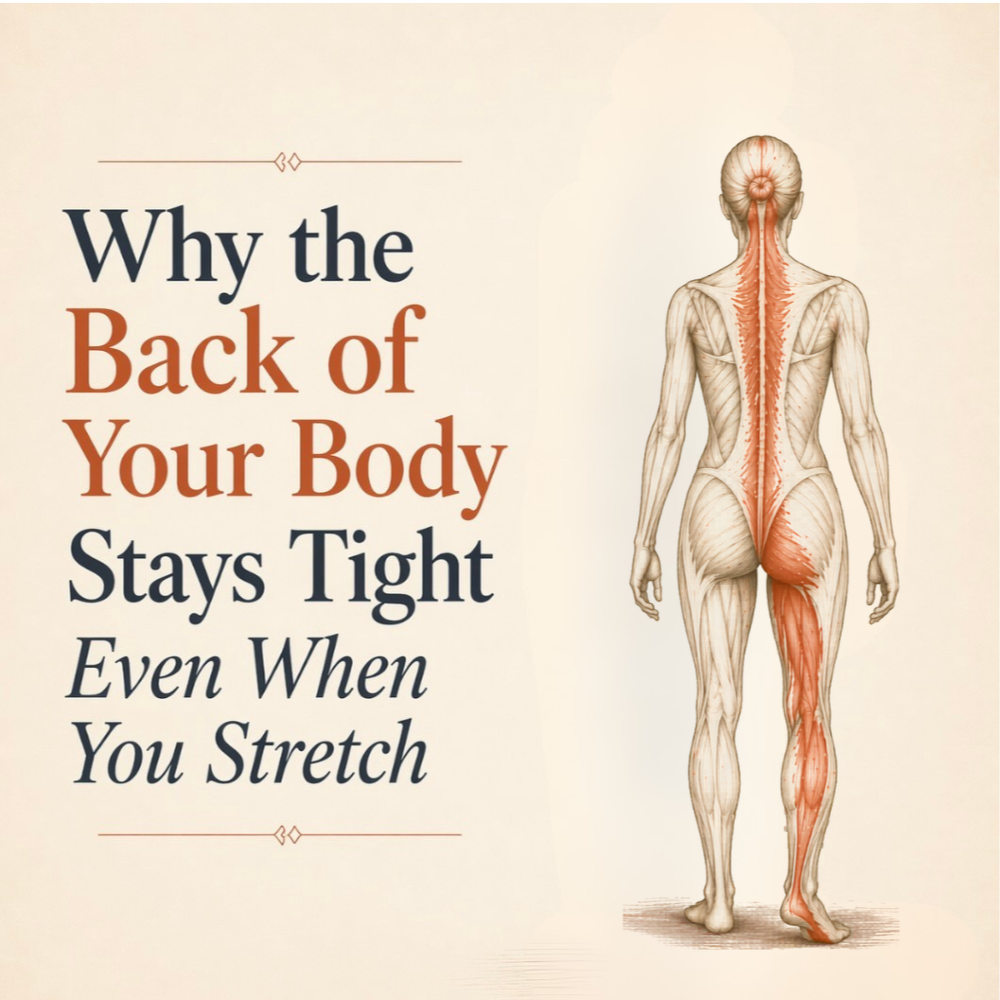
If your calves, hamstrings, or lower back always feel tight no matter how much you stretch, you are not alone.
A lot of people spend years trying to loosen the back of their body, only to feel like the tension keeps coming back within hours or days of working on it.
That pattern is worth paying attention to. Because in most cases, it is not a sign that you have not stretched enough. It is a sign that the back of your body is doing something other than just being tight.
If you missed last week's piece on the lateral line, this article is part of a series exploring how fascial relationships shape the way tension moves through the whole body. You can start there: Why Side-Body Tension Affects Breathing, Posture, and Lymph Flow
What back-body tension can feel like
Sometimes this pattern is obvious. Other times it is subtle and hard to pin down.
It might look like calves that tighten up again right after you stretch them, hamstrings that never quite release, or a constant pull through the back of the legs. It can feel like lower back tension that comes and goes without a clear reason, stiffness when bending forward, or a persistent sense that something is being held or pulled from behind.
Some people describe it as an inability to fully let the back body go, even in rest. They can lie down, breathe, and still feel like the back of the body is gripping.
That last one is important. Because that is not a flexibility problem. That is a nervous system pattern.
The back of your body works as one connected line
Instead of thinking about your calves, hamstrings, sacrum, and lower back as separate areas, it helps to understand them as part of one continuous fascial relationship.
This pathway begins at the plantar fascia on the sole of your foot. From there it moves up through the calves and into the hamstrings. It continues through the sacrotuberous ligament and up along the sacrum and thoracolumbar fascia, then travels up the full length of the spine through the erectors. At the top, it continues through the suboccipital muscles at the base of the skull and carries all the way up through the connective tissue of the scalp to the eyebrows.
Sole of the foot to the top of the skull. One continuous pathway.
Anatomy researchers and educators often refer to this as the superficial backline: a fascial relationship that helps your body extend, stand upright, and maintain posture against gravity. It is not a single muscle or a single structure. It is a through-line of connected tissue that behaves as a system.
You do not need to memorize any of that to use this information. You just need to understand that when one part of that system is under load, the rest of it feels it.
That is why tension does not stay in one place. It distributes. And it is why working on one area often does not change the overall pattern.
If you want more background on how fascial relationships shape movement, this pairs well with: Fascia: The Hidden Web That Shapes Your Movement, Posture, and Health and Why I Build Training Around Fascia and Elastic Recoil, Not Just Muscles
Tight does not always mean short
One of the most important shifts in understanding back-body tension is this: something can feel extremely tight without actually needing more length.
Tightness is not always a message that a tissue is short or restricted in a structural sense. It can also be a message that a tissue is overworking, guarding, or trying to create stability where the system is not managing load well.
In those cases, pulling harder on the tissue does not solve the problem. The tissue is already doing something on purpose. Stretching it can give temporary relief, but the body tends to restore the same tension fairly quickly because the underlying reason for it has not changed.
This is one reason people feel like they are always chasing tightness. They are working on the symptom. The pattern itself is still running.
Why Stretching Makes Tightness Worse: Understanding Fascial Release and Functional Movement
The nervous system lives in the back body
This is where the picture gets more complete.
Your posterior body is not just a structural pathway. It is also where your nervous system does a significant amount of its threat management work.
When the nervous system interprets a situation as unsafe, whether that is physical stress, emotional load, relational tension, chronic pain, or just the accumulated weight of a hard period of life, the body often responds by bracing. The erectors stiffen. The suboccipitals at the base of the skull contract. The jaw tightens. The sacrum compresses. The whole back body can lock into a low-level holding pattern that is not about flexibility at all. It is about perceived safety.
This is a protective mechanism. The body is doing something intelligent. But when that guarding becomes chronic, the back of the body can stay held even in moments that do not call for it. Rest does not fully release it. Stretching does not reach it. The tension keeps returning because the nervous system has not received a signal that it is okay to let go.
The suboccipitals are worth a special mention here. That small group of muscles at the base of the skull sits in close relationship with the upper cervical spine, where the vagus nerve and several cranial nerves run. Chronic compression in that region does not just produce neck tension. It can affect how the nervous system regulates tone, attention, and the felt sense of safety in the body overall.
This is one reason why combining whole-body loaded movement with 360 breathing practices tends to create more lasting change in the back body than stretching alone. When the fascial system is asked to work continuously under appropriate load, and the pressure system inside the trunk is being managed well through breath, the nervous system starts to receive different information. The back body does not need to hold as hard because the rest of the system is actually doing its job.
Neck Tension and Jaw Clenching: How Ribcage Position Changes the Whole Loop
How the backline connects to breathing
The back of your body and your ribcage are not separate systems. They are in constant conversation.
If the ribcage stays compressed, collapses forward, or cannot manage intra-abdominal pressure well, the muscles along the back of the spine often have to work harder to keep you upright and stable. That shows up as chronic erector tension, mid-back stiffness, and a lower back that never quite releases.
But it also runs in the other direction. When the back body is held and the erectors are chronically overloaded, posterior ribcage expansion becomes limited. The back ribs stop participating in breathing. Air tends to pool in the upper chest, the front ribs, or the neck. The body loses access to the kind of three-dimensional expansion that creates real pressure management through the trunk.
This is why breathing work so often changes how the back of the body feels, even though it does not look like a back exercise. When the ribcage starts expanding posteriorly and the pressure system inside the trunk starts working better, the back muscles often do not need to hold as hard.
If you want to understand that relationship more deeply: 360 Breathing: The Key to Optimal Pressure Management and Pain-Free Movement and Collapsed Ribcage and Serratus Anterior: The Missing Muscle Most People Never Train
What the backline does in walking
This is something that rarely comes up in conversations about stretching and tightness, but it is central to understanding why the backline behaves the way it does.
The posterior chain is built for gait. It stores and releases elastic energy on every step. When your heel strikes the ground, the plantar fascia loads. The calf and Achilles store tension. The hamstrings and sacrotuberous ligament carry that load upward. The whole system is designed to act like a spring, taking in force and giving it back as propulsion.
When that system is not working well, either because of poor foot mechanics, reduced hip extension, or a trunk that cannot rotate and transfer load efficiently, the body stops using the backline as a spring and starts using it as a brace. Instead of loading and releasing, the tissues stay loaded. They do not get to recoil. They stay tense because they are still waiting to complete a movement that never fully happened.
This is one reason that how someone walks can tell you a great deal about where their backline tension is coming from. And it is one reason that improving gait mechanics often changes chronic posterior tightness more reliably than stretching alone.
How back-body tension may affect lymph flow
The backline runs through territory that matters significantly for fluid movement through the body.
The thoracic duct, which is the primary lymphatic vessel returning fluid to circulation, runs along the anterior surface of the spine. The posterior thorax and sacral region are areas where lymph drainage depends on pressure changes, ribcage movement, and tissue mobility to keep fluid moving efficiently through the body.
When the erectors are chronically held, posterior ribcage expansion is reduced, and the spine loses movement variability, the body has a harder time creating the conditions that support healthy fluid movement through those deeper channels. Breathing becomes less adaptable. The tissues stop gliding as freely. The trunk can begin to feel dense, heavy, or stuck rather than responsive.
People can be hydrating, dry brushing, and doing self-massage consistently and still feel like the body is not fully opening up. When the back body is held in a chronic guarding pattern, fluid movement through the posterior thorax is one of the things that tends to suffer quietly.
The Fascia-Lymph Connection: Why Tight Tissue Blocks Drainage, Detox and Natural Glow
A simple place to start: supported posterior breathing
One of the most useful ways to begin exploring back-body tension is a supported prone breathing variation that helps bring expansion into the posterior ribcage.
Most people have never consciously breathed into their back ribs. This is partly because the nervous system patterns described above make that area difficult to access, and partly because most breathing instruction focuses entirely on the front of the body. This exercise asks the body a different question.
How to do it
Lie face down with a folded blanket or thin pillow under your lower abdomen. This takes some compression off the lower back and allows the pelvis to settle.
Rest your forehead on your hands or a folded blanket. Let the neck be long and the jaw soft.
Bring your attention to the back of your ribcage: the space between your shoulder blades, the mid and lower back ribs, the sides of the thorax behind you.
Take a slow, easy inhale and simply notice whether the back ribs can widen and rise, or whether the breath stays in the chest and shoulders.
On the exhale, let everything soften. Do not force the breath out. Just release.
Continue for six to eight breaths without trying to control what happens. You are gathering information, not trying to force a result.
What to notice
Does the back of the ribcage move at all, or does the breath stay entirely in the front?
Does one side of the back ribs expand more than the other?
Does the area feel braced, numb, or hard to sense?
Does the breath feel easier or more restricted after a few rounds?
You do not need a dramatic sensation. Even a small shift in awareness here begins to change the relationship between the nervous system, the ribcage, and the tissues along the back of the body.
This kind of posterior expansion work is something I build on inside both my 360 Breathing course and my 28-Day Lymphatic Reset, depending on whether ribcage mechanics or a fuller daily rhythm for tissue support and flow is the better starting point for you.
Why one exercise is not the whole answer
Even a useful exercise is still just one input.
If your body has been organizing around guarding, chronic load, reduced movement variability, or a nervous system that has been running a long-term protection strategy, it usually takes more than one drill to create real change. That is why I think in terms of patterns and daily environments rather than isolated fixes.
Working the backline directly is part of what I do with clients. But it works best when it is happening inside a larger system: breathing work that restores posterior ribcage expansion, loaded movement that asks the full fascial line to work continuously rather than in isolated pieces, better walking mechanics, less chronic compression through sitting and clothing, and a more consistent daily rhythm rather than occasional intense recovery sessions. One good exercise inside a fragmented day only goes so far.
When back-body tension is the door into something bigger
Chronic posterior tension rarely travels alone.
It often shows up alongside jaw clenching, persistent suboccipital headaches, pelvic floor bracing, shallow breathing, chronic fatigue, and a body that always feels like it is preparing for something. When those patterns stack, it stops feeling like a mobility problem and starts feeling like the whole system needs a different kind of support.
That is exactly why I built my programs around daily rhythm, breath, movement, and tissue support instead of isolated fixes.
If you are ready to work on the whole pattern
If ribcage restriction and learning how to access real posterior expansion feels like the clearest starting point, that is exactly what 360 Breathing is built around. It works directly with pressure management, three-dimensional ribcage expansion, and the breathing mechanics that influence how the whole back body holds and releases tension.
If you are looking for a broader daily rhythm that supports fluid movement, tissue hydration, and lymphatic flow through the body, the 28-Day Lymphatic Reset is designed for that. It is a practical, repeatable structure for building the kind of consistent daily environment where the body can start to drain, recover, and feel less stuck overall.
One payment. Lifetime access. Return to it whenever your body needs a reset.
If this pattern keeps showing up for you and you want more individualized guidance, this is exactly the kind of thing I help clients work through in assessment and coaching.
Final thoughts
If the back of your body always feels tight no matter how much you stretch, that is worth paying attention to.
It does not always mean you need more length. It often means the back body has stopped sharing load well, stopped adapting well, or started holding on behalf of a nervous system that has been managing more than it can easily release.
When that happens, the same tension keeps returning. Not because you are doing something wrong. Because the body is doing something purposeful, and stretching alone does not change the purpose.
These patterns can change. Not usually through forcing, but through better inputs.
Better breath. Better movement. Better awareness. Better daily rhythm.
That is where real change starts.
Read next:
Why Side-Body Tension Affects Breathing, Posture, and Lymph Flow
Why Stretching Makes Tightness Worse: Understanding Fascial Release and Functional Movement
Neck Tension and Jaw Clenching: How Ribcage Position Changes the Whole Loop
The Fascia-Lymph Connection: Why Tight Tissue Blocks Drainage, Detox and Natural Glow