You can look upright and still feel restricted.
A lot of people with front-body tension are not dealing with something that needs to be stretched harder. They are dealing with a system that has lost its ability to expand, soften, and respond.
Understanding why starts with understanding the actual structure involved.
What the superficial front line is
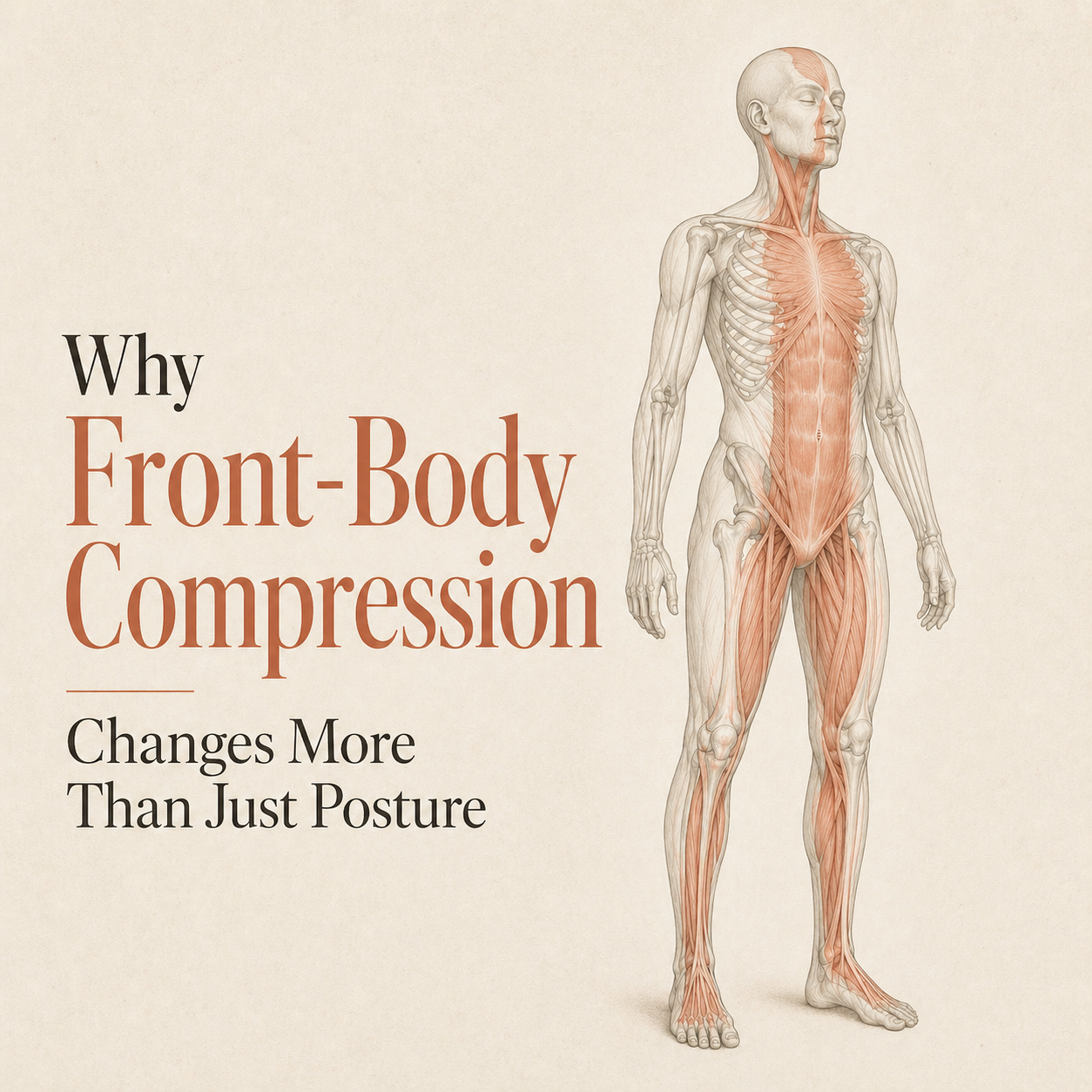
The superficial front line is a continuous chain of fascia, muscle, and connective tissue that runs along the entire front of the body, from the tops of the toes all the way up to the skull.
It is not a single muscle. It is a linked system.
The tissues that make up this line include:
the toe extensors and anterior shin muscles that lift the foot the quadriceps running up the front of the thigh the hip flexors at the front of the pelvis the rectus abdominis running vertically up the abdomen the sternal fascia across the chest the sternocleidomastoid up the front of the neck and the scalp fascia at the top
Each of these areas is in direct fascial communication with the others. What happens at one point in the chain affects everything above and below it.
What this line is designed to do
The superficial front line has a few primary jobs.
It helps flex the trunk and hips. It extends the knee. And it works as a counterbalance to the back of the body, allowing your structure to organize itself between front and back, compression and expansion.
When this system is working well, the front of your body can open, adapt to load, and respond to movement and breath without bracing or holding.
When it is not, the whole system shifts.
What happens when the superficial front line compresses
Compression in this line does not just mean tightness in one spot.
It means the entire anterior chain has shortened and stopped responding the way it should.
When the sternal fascia and abdominal tissues pull the ribcage down and forward, nothing moves in isolation:
The abdomen stays braced instead of responding to pressure changes during breath
The hips stay slightly flexed even at rest
The neck and chest take over the respiratory work the ribcage cannot do
Posture requires effort rather than happening naturally
You might feel this as tightness. But more often it feels like restriction, like the front of you cannot fully open no matter what you try.
A simple way to notice it
Try this now.
Sit or stand comfortably. Place your hands lightly on the front of your ribs. Take a slow breath in.
Notice: does your chest lift more than it expands? Do your shoulders start to take over? Does your abdomen stay braced instead of softening and responding?
You are not trying to change anything yet. You are just observing how your body is organizing the breath.
What you notice there tells you a lot about how the whole front line is functioning.
Where breathing becomes the clearest signal
The connection between the superficial front line and breathing is direct.
The sternal fascia and upper abdominal tissues sit right at the center of your respiratory mechanics. When those tissues are compressed or cannot expand, the ribcage cannot move in the multiple directions it is designed to move.
When the ribcage is restricted:
pressure builds in the wrong places the neck and shoulders step in to assist with breathing the front of the body stays guarded and the whole anterior chain stays in a shortened state
This is why front-body compression and breathing issues almost always show up together. They are not separate problems. They are two expressions of the same pattern.
Why stretching the front body usually does not resolve this
Stretching can create temporary space.
But the superficial front line is not just a set of muscles that need more length. It is a continuous system that needs to be able to manage pressure, coordinate movement, and respond to breath throughout the day.
If the body cannot manage pressure through the ribcage, and the abdomen cannot coordinate the front and back of the body together, the change doesn't hold. Without a daily movement environment that supports expansion, the system returns to the same compressed pattern, often within hours.
There is also a mechanical reason for this.
Fascia does not reorganize primarily through passive lengthening. It reorganizes through load. When the superficial front line is loaded through movement, that mechanical stress signals the tissue to adapt and remodel over time.
But the load also has to be distributed evenly across the full chain. When the system is compressed, load concentrates in certain areas and bypasses others. The same compensations that created the pattern end up repeating themselves inside the movement. So even well-intentioned exercise can reinforce the restriction if the load is not reaching the right places.
This is why the goal is not just more movement. It is movement that loads the whole system and teaches it to distribute force across the anterior chain from foot to skull.
How this connects to back-body tension
This is where the pattern starts to make more sense as a whole.
When the superficial front line stays compressed, the back of the body often takes on more tension to compensate. What feels like tight hamstrings, a stiff lower back, or constant pulling through the posterior chain is often the back body doing extra work because the front cannot.
These two systems are meant to work in balance. When the front compresses, the back holds. Addressing one without the other is why so much work on this pattern produces only partial results.
If you have not read it yet, this pairs directly with: Why the Back of Your Body Stays Tight Even When You Stretch
What actually changes this pattern
Because the superficial front line is a system, it responds to systemic inputs.
The tissue needs to be loaded, and that load needs to be distributed across the whole chain. Not just stretched at the chest. Not just strengthened at the hips. The entire anterior chain needs to experience and adapt to force moving through it in a coordinated way. This is what teaches the fascia to reorganize rather than temporarily release and return.
That requires better pressure management starting with the ribcage and breath, expanded movement options that train the front and back of the body to work together, and a consistent daily rhythm that gives the tissue time to respond and adapt between sessions.
That is exactly why I built my programs around daily rhythm, breath, movement, and tissue support rather than isolated fixes.
If your main limitation is breathing, ribcage restriction, or pressure management, 360 Breathing gives you the foundation and daily structure to start shifting this pattern.
If you want a more complete approach that supports movement, tissue quality, and whole-body flow, the 28-Day Lymphatic Reset builds that structure from the ground up.
And if this pattern keeps showing up and you want more individualized guidance, this is where one on one work makes the biggest difference.
Part of what an assessment makes possible is identifying where in your anterior chain the load is actually concentrating and where it is being bypassed. From there, the movement programming can be built to progressively load the system in a way that distributes force more evenly across the full line. That specificity is hard to replicate without someone observing how your body actually organizes under load.
Fill out the Fit Form to get started
Final thoughts
The superficial front line is not just a list of muscles. It is a connected system that runs the entire front of your body and shapes how you breathe, how you move, and how your structure organizes itself under load.
When it compresses, the solution is rarely more stretching. The tissue needs to be loaded, and that load needs to travel the full chain. When movement reaches the right places and distributes force from foot to skull, the fascia gets the signal it needs to reorganize.
That is where real change starts.
Read next
Why the Back of Your Body Stays Tight Even When You Stretch
Collapsed Ribcage + Serratus Anterior: The Missing Muscle Most People Never Train
Why Side-Body Tension Affects Breathing, Posture, and Lymph Flow