Why Side-Body Tension Affects Breathing, Posture, and Lymph Flow
If one side of your body always feels tighter, more lifted, more compressed, or harder to breathe into, it is easy to assume that side just needs more stretching.
But side-body tension is usually more complex than that.
What feels like tightness through the ribs, waist, hip, shoulder, or neck often reflects a larger pattern of compression, bracing, and reduced movement through the tissues that help your body expand, rotate, and transfer force. And that pattern matters for more than comfort.
Your side body plays a major role in how your ribcage expands, how your pelvis and trunk coordinate, how easily you rotate and walk, and how fluids move through the body. When that area stays chronically stiff or compressed, breathing often becomes less adaptable, posture can grow more rigid, and the body may start to feel heavy, puffy, or stuck.
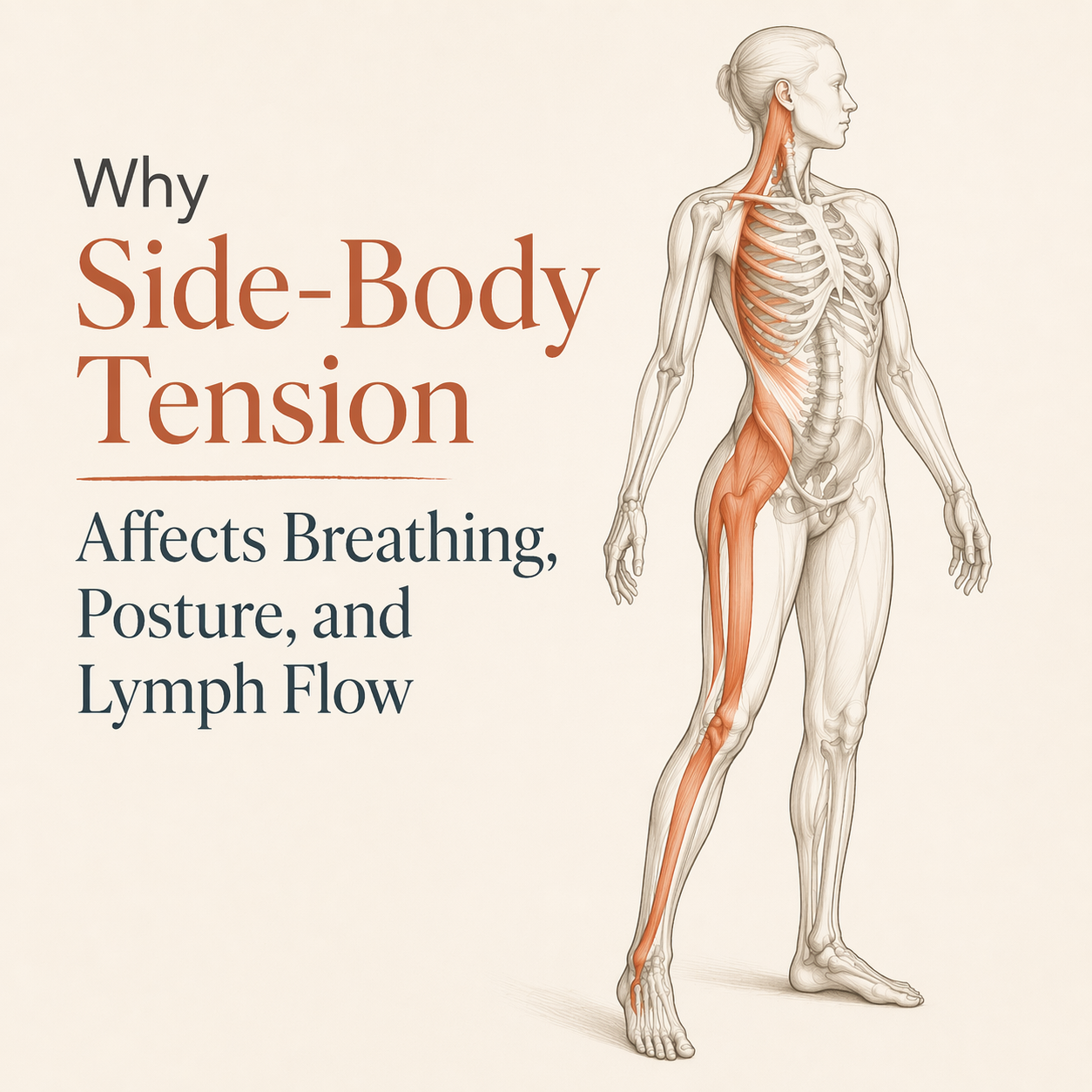
One useful way to understand this is through what anatomy trains often call the lateral line: a broad fascial relationship running from the outer foot and ankle, up through the outer leg and hip, continuing through the side of the trunk and ribs, and connecting into the shoulder and neck region. It is not a single muscle or structure. It is more like a continuous band of tissue that helps organize lateral stability, side bending, and load transfer across the whole side of the body.
You do not need to memorize the anatomy for this to be useful. You just need to understand that when the side body loses movement, a lot of other things start compensating.
If you want more background on how fascial relationships shape movement patterns, this article pairs well with Why I Train Through Fascia and Elastic Recoiland Fascia: The Hidden Web That Shapes Your Movement, Posture, and Health.
What side-body tension can look like
Sometimes side-body tension shows up as obvious stiffness through the ribs or waist. Other times it is more subtle.
It might look like one side of the ribcage that feels harder to expand, a shoulder that always wants to lift or grip, or neck tension that keeps returning no matter what you do. It can feel like a hip that is jammed or pulled upward, side bending that is noticeably uneven, or walking that feels heavier on one side. Some people describe one side of the torso as compressed, dense, or hard to reach into. Others notice puffiness or stagnation that seems worse when the trunk feels stuck.
This is one reason I do not look at the body as a collection of isolated muscles. I am always paying attention to how tension is being distributed through fascial relationships, pressure patterns, and compensation strategies.
Why the side body matters for breathing
When people focus on breathing better, they often look at the front of the body. They try to relax the belly, lower the shoulders, or stop breathing into the upper chest.
But healthy ribcage expansion is not just front and back. It also includes the sides.
If the side body stays chronically braced or compressed, creating true three-dimensional expansion through the trunk becomes much harder. The body tends to keep pulling air into the upper chest, neck, or front ribs instead of allowing the sides and back of the ribcage to participate. Breathing starts to feel more effortful, less adaptable, and less connected to the rest of the body.
This is why side-body tension so often overlaps with jaw clenching, neck strain, serratus weakness, a ribcage that feels collapsed or hard to move, and difficulty expanding evenly into both sides.
If you are noticing that pattern in your own body, it is usually not coming from just one place. It is a loop.
The ribcage influences the neck and jaw.
The shoulders and serratus influence how the ribs move.
Breathing patterns reinforce everything.
If you want to understand that loop more clearly, these articles may help: Neck Tension and Jaw Clenching: How Ribcage Position Changes the Whole Loop, Collapsed Ribcage + Serratus Anterior: The Missing Muscle Most People Never Train and 360 Breathing: The Key to Optimal Pressure Management and Pain-Free Movement
Side-body tension is not just a breathing issue
The side body also matters for posture, gait, and movement efficiency.
When the tissues along the side of the trunk stay stiff, the body often loses some of its ability to shift load, absorb force, and rotate smoothly. Instead of distributing work well through the ribs, trunk, pelvis, and legs, people start gripping in the shoulders, lower back, hips, or outer legs.
This creates a body that can feel upright but rigid, strong but not fluid, stable but not adaptable, or stretched but still tight.
That is why side-body tension does not always respond well to more pulling, more mobility drills, or more stretching. If the larger pattern is still running, the same areas keep taking over.
This is something I explored in more depth in Why Stretching Makes Tightness Worse: Understanding Fascial Release & Functional Movement and Strong Doesn’t Always Mean Connected: 7 Signs Your Body Wants a Different Kind of Strength Training.
How side-body tension may affect lymph flow
This is where things get especially interesting.
Lymph does not have a central pump the way blood does. It depends on pressure changes, muscle activity, tissue glide, and movement variability to keep fluid moving through healthy pathways.
When the ribs, trunk, shoulders, or hips stay chronically compressed, the body may have a harder time creating those conditions. Breathing often gets smaller. The tissues stop gliding as well. The trunk can begin to feel dense or stuck instead of responsive.
That does not mean side-body tension is the only reason someone feels puffy, heavy, or stagnant. But it can absolutely be part of the picture.
People can be walking, hydrating, dry brushing, and doing self-massage consistently, yet still feel like the body is not fully opening up. That is one reason I keep coming back to fascia, breath, and movement together. The body often needs more than one helpful tool. It needs a better daily environment for flow.
Sometimes the missing piece is not more effort. It is a body that can create better pressure change, tissue movement, and flow throughout the day.
If lymph support is part of your healing work, these may help you connect the bigger picture: The Fascia–Lymph Connection: Why Tight Tissue Blocks Drainage, Detox & Natural Glow and Lymphatic Self-Massage Basics: Pressure, Direction, and Common Mistakes
A simple place to start: side-lying breathing
One of my favorite ways to explore side-body expansion is a side-lying breathing variation that helps bring more air into the upper side ribs.
By placing a block or rolled towel under the lower ribs, you create a gentle barrier at the bottom of the ribcage. That can make it easier to notice whether the upper side ribs are actually able to expand, or whether the body keeps defaulting into the same lower areas.
This is not about inhaling harder. It is about changing the shape of the breath and seeing what the body has access to.
How to do it
Lie on your side with support under your head if needed.
Place a yoga block or rolled towel between the lower ribs and the floor.
Let the knees stay comfortably bent.
Keep the neck relaxed and the jaw soft.
Breathe gently into the upper side ribs without straining.
Notice whether the side body can widen and respond above the block.
What to notice
Does one side feel much harder to expand than the other?
Do you feel more effort in the neck than in the ribs?
Does the body keep trying to push into the lower ribs instead of opening higher up?
Does the body want to brace instead of receive the breath?
You do not need a perfect sensation here. You are just gathering information.
This variation tends to be especially helpful when one side of the ribcage feels compressed, the neck and shoulders keep overworking during breathing, or upper side-rib expansion feels difficult to access.
This kind of side-lying expansion work is something I build on more deeply inside both my 360 Breathing course and my 28-Day Lymphatic Reset, depending on whether your main goal is ribcage expansion and pressure management or a broader daily rhythm for movement, tissue support, and flow.
Why one drill is not the whole answer
Even a good exercise is still just one piece.
If your body has been living in a pattern of asymmetry, compression, shallow breathing, or chronic guarding for a long time, it usually takes more than one drill to create change. That is why I think in terms of patterns and daily inputs rather than isolated fixes.
The goal is not to become obsessed with one fascial line. The goal is to notice where the body has lost options and start creating better ones. That may include breathing work, movement that restores ribcage and pelvic coordination, better walking mechanics, less chronic gripping in the shoulders and neck, softer clothing around high-compression areas, gentle self-massage, and a more consistent daily rhythm instead of random recovery efforts.
When side-body tension is the door into something bigger
If side-body tension is part of your picture, it is probably not the whole picture.
Chronic compression through the trunk rarely travels alone. It often shows up alongside jaw clenching, persistent neck tension, pelvic floor gripping, shallow anxiety-driven breathing, and a body that always feels like it is bracing for something. When those patterns stack, the body starts to feel less like one isolated movement issue and more like a system that needs a reset.
That is exactly why I built my programs around daily rhythm, breath, movement, and tissue support instead of one isolated fix.
If one side always feels more stuck, it's usually not just about that side.
Chronic compression through the trunk, shallow breathing, and asymmetrical tension patterns create exactly the kind of internal environment where lymph slows down — regardless of how much you stretch or massage one area.
The 28-Day Lymphatic Reset is built for this. A 7-minute morning routine that opens the lymphatic vessels before driving fluid through them. Rotating self-massage and breathing sequences that address the body progressively. A nourishment plan that reduces the acidic load your tissues buffer daily. And a movement snack that keeps flow going through the whole system — not just the stuck side.
One payment. Lifetime access. Return to it whenever your body needs a reset.
If ribcage restriction, pressure management, and learning how to access real three-dimensional expansion feels like the better starting point, begin with 360 Breathing.
If this pattern keeps showing up for you and you want more individualized guidance, this is also the kind of thing I help clients work through in assessment and coaching. Fill out the Fit Form to get started.
Final thoughts
If one side of your body always feels more tight, more compressed, or harder to breathe into, that is worth paying attention to.
It does not always mean you need more stretching. It often means the side body has stopped moving well, stopped adapting well, or stopped sharing load well with the rest of the system. When that happens, breathing gets smaller, posture gets more rigid, compensation increases, and the body starts to feel more stuck overall.
These patterns can change. Not usually through forcing, but through better inputs.
Better breath. Better movement. Better awareness. Better daily rhythm.
That is where real change starts.
Read next: