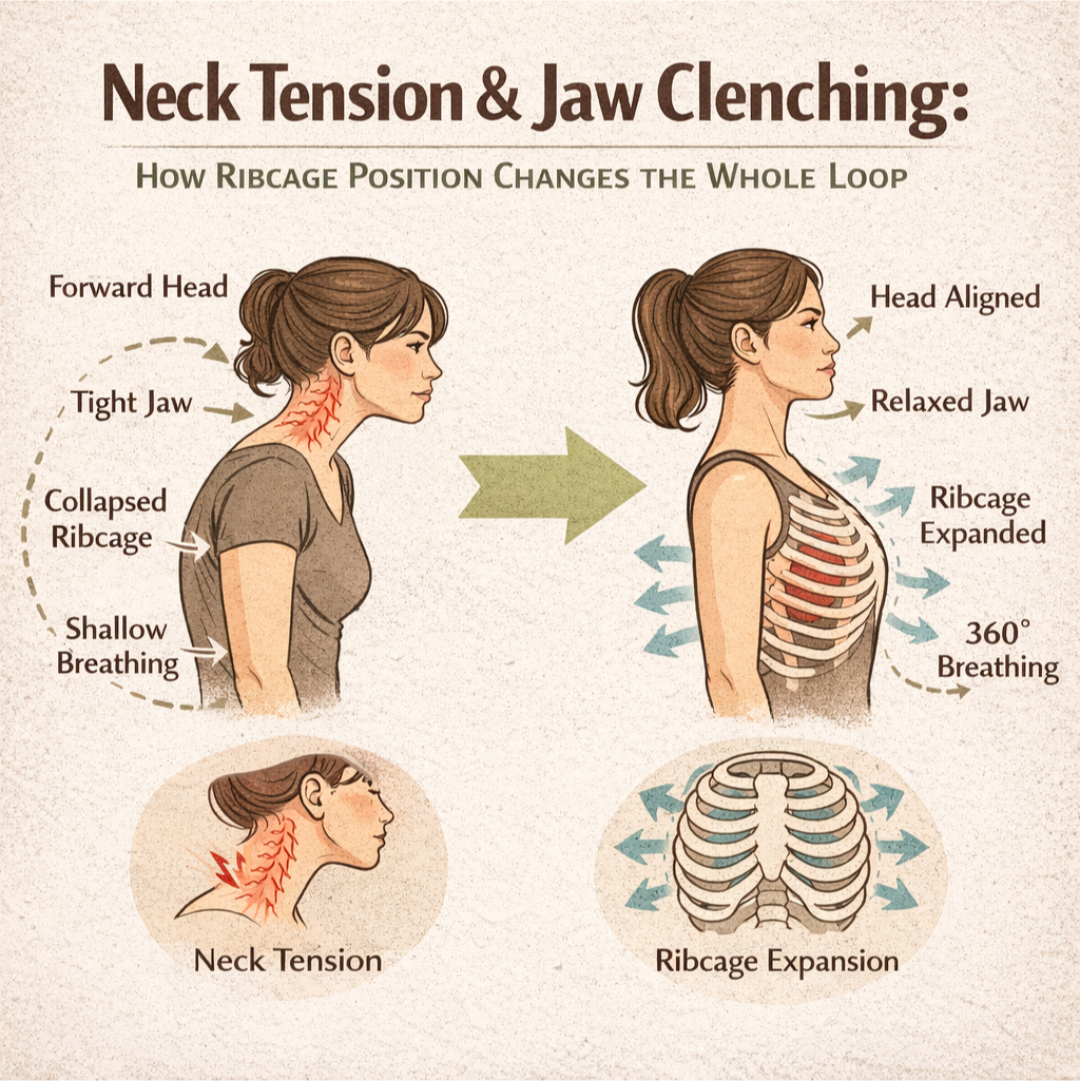
After three tongue-tie releases, two rounds of palate expansion, and myofunctional therapy, my tongue still felt tight and my neck still felt compressed.
In the comparison photo below, I could see my head sitting forward and the compression through my neck. I had done considerable work inside my mouth, but I still needed to address what was happening beneath it.
What helped me was working on ribcage expansion, breathing mechanics, fascial release, and integrated movement training. My jaw tension decreased, my tongue position improved, and my neck felt better supported.
That experience changed how I approach tension that keeps returning. I look at the jaw and neck, but I also look at how the ribcage, abdominal wall, pelvis, and breathing pattern are participating.
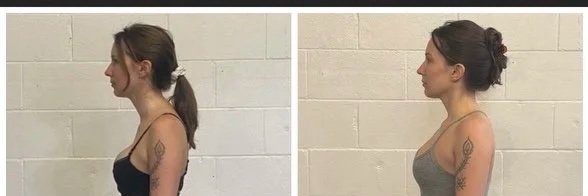
Left: Head and neck position after three tongue tie releases, two palate expanders, and myofunctional therapy. Still compressed and forward. Right: Added focus on breathing mechanics, fascial release, and functional movement training. This helped expand the ribcage, reduce jaw tension, and improve tongue position.
Why releasing the tight spot may not be enough
You can massage your jaw, stretch your neck, and feel relief, then find yourself gripping again when you return to your desk or pick something up.
The relief is important, but what happens afterward deserves attention too.
If your body repeatedly recruits the jaw and neck when you breathe or create support, those areas keep returning to the same work. Releasing them does not necessarily change the demands that bring the tension back.
In my own practice, I started watching when my jaw joined the effort. Could I reach or rotate without pressing my teeth together? Could I inhale without lifting through my neck?
Those observations gave me something to train beyond repeatedly loosening the same muscles.
How the ribcage changes the demands on the neck
When the ribcage is held rigidly or compressed, breathing can feel restricted. You may try to get more air by lifting the upper chest, raising the shoulders, or tipping the head back.
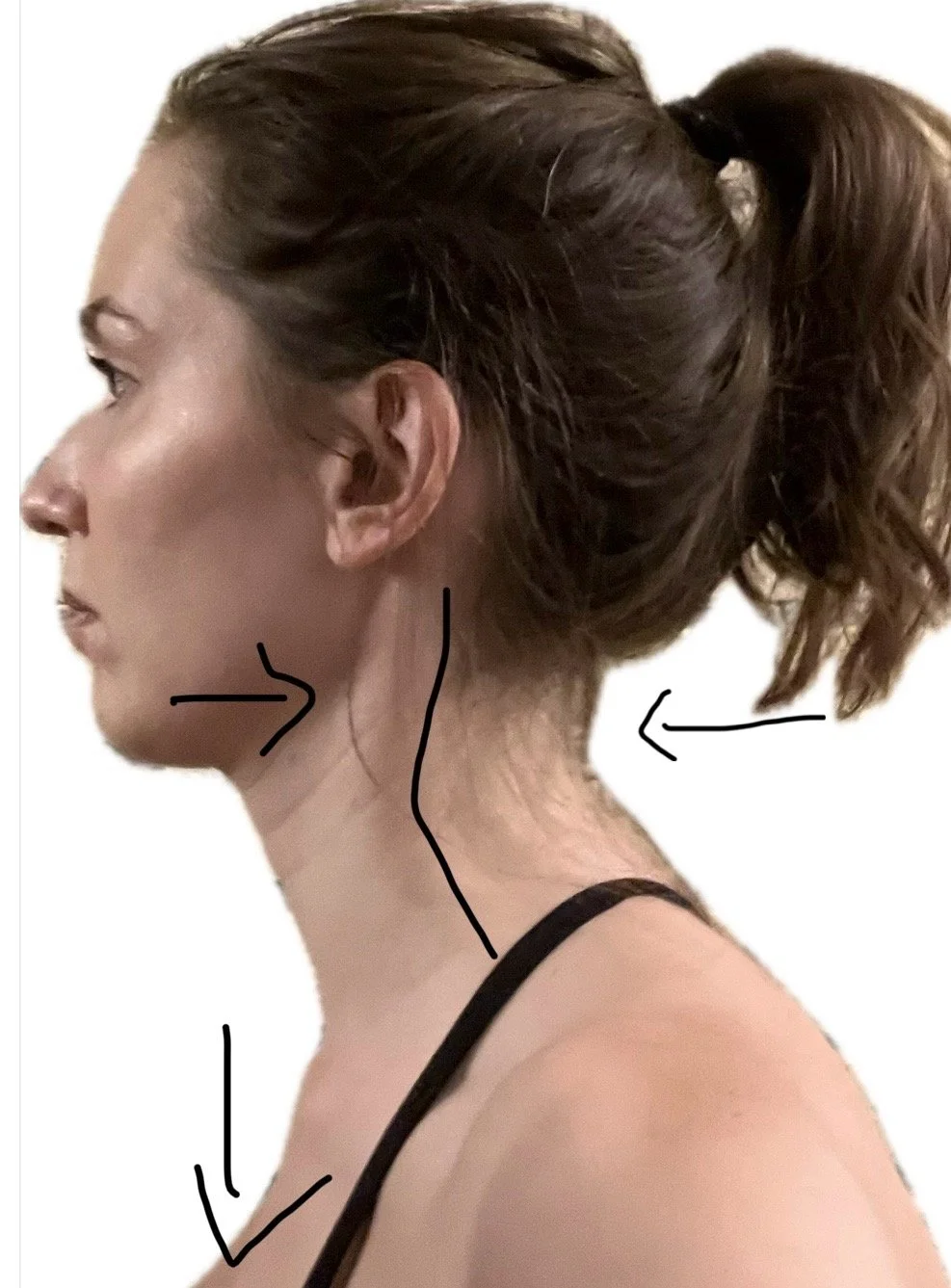
The neck muscles participate in breathing. The goal is comfortable coordination, with an amount of effort appropriate to the task.
A forward head position can add another demand. The lower neck may bend forward while the upper neck extends to keep the eyes level. Now the neck is supporting the head and maintaining your view while also helping with an effortful inhale.
This is why I watch the ribs beneath the neck. I want to know whether they can move as the person breathes and whether the head remains supported when the arms begin working.
In my own photo, my head position was easy to see. Understanding the support beneath it took longer, and led me to look beyond my neck at the jaw, breathing, and pelvis together.
The jaw, tongue, and pelvic floor are connected
When I look at jaw clenching, I also watch the breath and trunk. Teeth pressing together, breath-holding, abdominal bracing, and pelvic gripping can become parts of the same effort.
There are several reasons to look at these areas together.
Shared stress responses. Stress can increase muscle activity and guarding across multiple regions, including the jaw, neck, shoulders, and pelvic floor. Tension in these areas can reflect a shared response rather than separate problems. Research has also identified associations between the orofacial and pelvic regions.
Breathing and pressure coordination. The throat helps regulate airflow, while the respiratory diaphragm, abdominal wall, and pelvic floor coordinate breathing and internal pressure. Holding the breath or bracing changes the demands on that system. In coaching, I watch whether someone can create support without tightening their throat, pressing their teeth together, or gripping through the pelvis.
Connective-tissue relationships. Anatomy Trains’ Deep Front Line maps relationships from the tongue and jaw through the trunk, pelvis, and legs. I use that model as a reason to examine connected regions, rather than assuming that the place someone feels tension is the only place involved.
These connections are why I look beyond the area that feels tight. If releasing the jaw gives only temporary relief, I want to understand what brings the gripping back.
What changed in my own practice
My tongue and palate work addressed real concerns. But my neck still felt compressed afterward, and my tongue still carried tension.
Adding breathing and movement work gave me another way into the problem. I began developing expansion through my ribcage while learning to support my trunk through reaching, rotation, and loaded movement.
That combination was the key for me. I needed access to movement and enough strength to use it without falling back into the same gripping patterns.
As I developed more support through my trunk, my jaw felt less tense. That experience is why I look at breathing and movement when someone tells me their jaw keeps tightening, including when they wake with it already clenched.
How this work can help when you clench at night
A reader recently emailed me after finding this article. She had been waking with headaches and neck pain and suspected she was clenching her jaw while asleep. She wanted to know whether breathing work could help when she wasn’t awake to control it.
There is useful work we can do without asking you to consciously monitor your jaw overnight. Breathing and movement practice can help reduce jaw and neck tension and address the gripping you carry into bedtime.
I look at how the ribcage, respiratory diaphragm, abdominal wall, and pelvic floor work together. We practice more comfortable breathing and build support through the trunk so the mouth and neck do not have to join every effort.
For someone who wakes with a clenched jaw, this work can complement dental and sleep care by addressing breathing and movement habits that contribute to tension. Persistent morning headaches, jaw pain, or tooth wear also deserve professional evaluation.
Create breathing options, then strengthen them
I begin by finding a position where the breath can move with less effort.
From there, we explore expansion through the front, sides, and back of the ribcage. Different positions give different areas an opportunity to move; every breath does not need to expand equally everywhere.
Then we build support through the shoulders, spine, pelvis, and hips.
I learned to pay attention to the exhale as well. Pulling my ribs down and tucking harder had become familiar, but it could leave me feeling shorter and more compressed. I now look for ribs that move inward while I maintain useful length through my trunk.
If the exercise makes my jaw tighten or my neck take over, I adjust the position, range, or effort. The aim is a pattern I can use when movement becomes more demanding.
Explore what happens beyond your jaw
Practice with the updated 360 Breathing course
My own breathing practice changed when I realized that finding expansion was only the beginning. I also needed to support that space when I reached, rotated, and added load.
The updated 360 Breathing course brings those pieces together through 70+ exercises, progressing from awareness and release into mobility, strength, and integrated movement.
Inside, you will explore:
Expansion through the front, sides, and back of the ribcage without forcing a bigger breath
How ribcage, spinal, and pelvic position influence your breathing options
Common compensations such as neck lifting, rib flare, tucking, and gripping
Supported positions and release work that help you access restricted areas
Exercises that build support through the shoulders, trunk, pelvis, and hips
The posture and breathing map helps you choose a starting point. You can build shorter practices from the course and revisit the lessons as your movement and breathing develop.
$27. Lifetime access.
Start 360 Breathing to recognize your breathing compensations, explore more comfortable expansion, and build the strength to support it in movement.
Work with me on the pattern that keeps returning
If you have already spent months stretching your neck or releasing your jaw, an individualized assessment can help us decide what deserves attention next.
I watch how you breathe, reach, rotate, and create support. We look at when the jaw joins the effort, how the ribcage moves beneath the shoulders, and what happens through the trunk and pelvis as demand increases.
From those observations, we choose a starting point and build a progression around your response.
Complete my Fit Form to tell me what you’re experiencing and what you’d like help with, so we can determine whether 1:1 coaching is a good fit.
When I look at that first photo, I remember how much work I had already done inside my mouth. What finally helped me move forward was learning how to support it from the rest of my body.