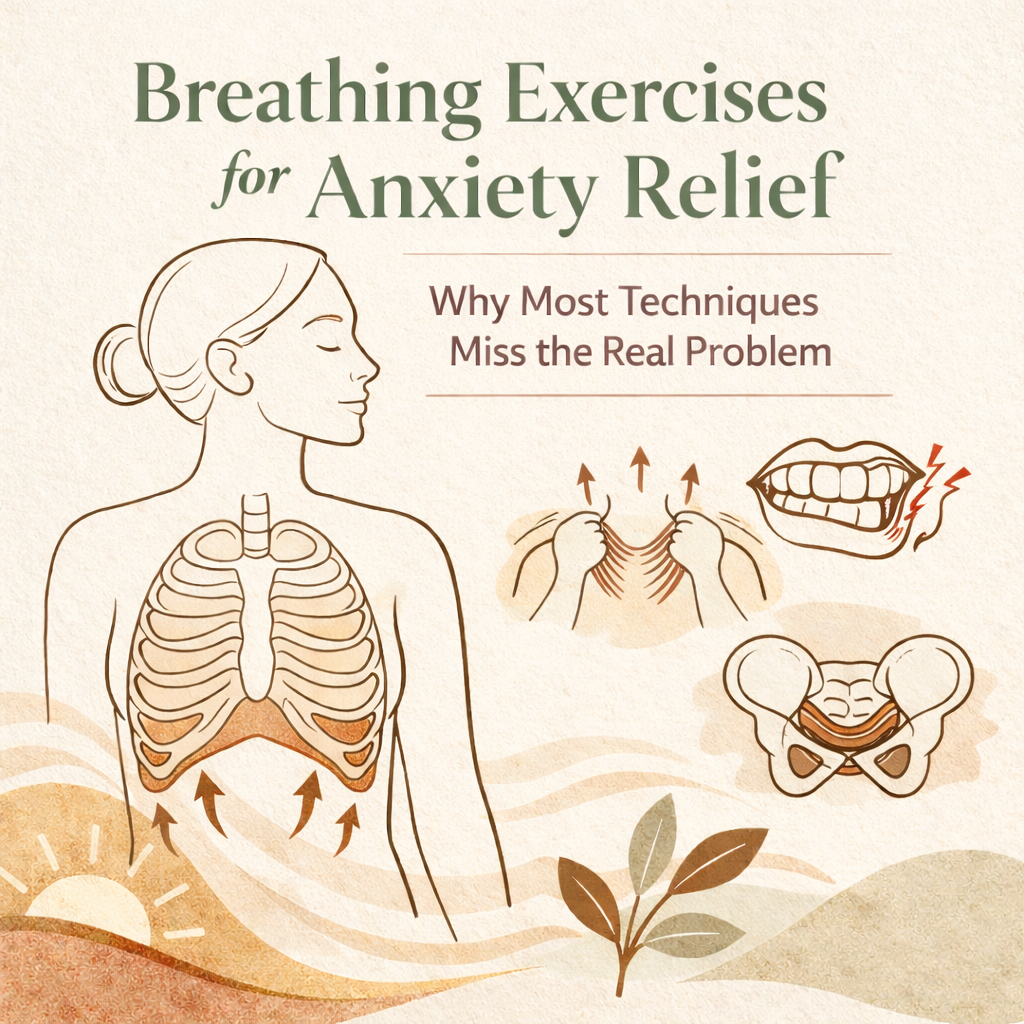
How rib bracing, fascia restriction, and nervous system patterns keep you stuck in shallow breathing
When anxiety hits, the most common advice is to take a deep breath.
For many people, that does not work. The ribs barely move. The diaphragm feels braced. The torso feels rigid from years of stress breathing. Forcing a bigger inhale into a tight container can even make anxiety feel louder.
Most breathing exercises fail because they treat breath as something separate from the rest of the body. They do not address why the breath became shallow in the first place.
How anxiety changes your breathing pattern
When your nervous system shifts into a protective state, your body often moves into a survival-style breathing pattern. It can look like:
pulling breath high into the chest
limiting rib expansion
bracing through the abdomen and diaphragm area
tightening through the jaw, neck, and upper chest
holding the pelvic floor and low belly rigid
using shoulder and neck muscles to help the inhale
Over time, this pattern becomes automatic. Your tissues adapt to the shape of protective breathing. Fascia and muscle tone begin to reinforce it.
Eventually, you are not breathing shallow only because you feel anxious. Shallow breathing can also keep your system in a more vigilant state.
Anxiety is not only mental, it is physical
Anxiety is often experienced as sensation: tight ribs, a braced belly, a heavy chest, a clenched jaw, a throat that feels closed.
When you understand the physical pattern behind anxiety, breath work stops being about forcing relaxation. It becomes about restoring movement and internal space so your system has a clearer path to downshift.
If you want a deeper explanation of how emotions show up as posture and tension, read:
How Emotions Affect Your Spine and Physical Alignment
The problem with most breathing exercises
Many popular anxiety breathing tools focus on:
taking bigger breaths
counting inhale and exhale lengths
belly breathing without rib movement
box breathing or strict rhythms
These can be helpful in the moment.
But if your ribs are braced and your torso cannot expand well, these methods often stay superficial. They may calm you briefly, but they do not change the structure underneath your breathing pattern.
The real problem is not air, it is expansion
Breathing is not just air. It is pressure, movement, and shape.
If the ribcage cannot expand, the nervous system often keeps using the same protected strategy because it is the only option available.
That is why trying to breathe deeper sometimes backfires. You are asking your body to create a bigger inhale without giving it the space to do it.
A better approach: gentle 360 breathing
360 breathing is not about inhaling more air. It is about creating expansion in all directions of the torso: front, sides, and back.
When 360 breathing is practiced consistently, you are building mechanics that support a calmer baseline over time:
better rib mobility
more diaphragm movement
less upper chest dominance
improved ability to exhale fully
less jaw and neck gripping
more internal space to downshift
This is not willpower. This is anatomy and pressure dynamics.
Learn more in: 360 Breathing: The Key to Optimal Pressure Management and Pain-Free Movement
Try this now (60 seconds)
Sit or lie down comfortably.
Inhale: expand into the ribs in all directions (front, sides, back).
Exhale: slow and soft. Let the ribs move down and in as the belly gently narrows and supports the breath.
Repeat for 5 to 8 breaths. Keep it easy. You are not trying to force depth. You are training space.
If this feels challenging, that is useful information. It usually means the structure of your breath needs support.
Why anxiety does not change with breath alone
A lot of people learn a breathing method, feel some relief, then the anxiety returns.
That does not mean the technique failed. It usually means the body still does not have enough support for a new pattern.
Common reasons breathing relief does not stick:
rib mobility has not returned
tissue tone is still gripping
the torso still feels compressed
the nervous system still associates shallow breath with vigilance
Real change tends to happen when breath practice is paired with mobility, support, and time.
If your body still can't access expansion no matter how hard you try, this is why.
Most breathing exercises fail for people with anxiety because they skip the structural piece — the ribcage is braced, the diaphragm has no room to move, and the whole system is still organized around protection. No counting technique fixes that.
The 360° Breathing Course is built around exactly this problem. It walks you through how to restore rib mobility and create internal expansion progressively — so your nervous system finally has a structural reason to downshift, not just a counting cue to follow.
One hour of content. $27. Lifetime access.
Keep exploring
If you want to keep learning the breath, fascia, and nervous system connection, here are a few next reads: