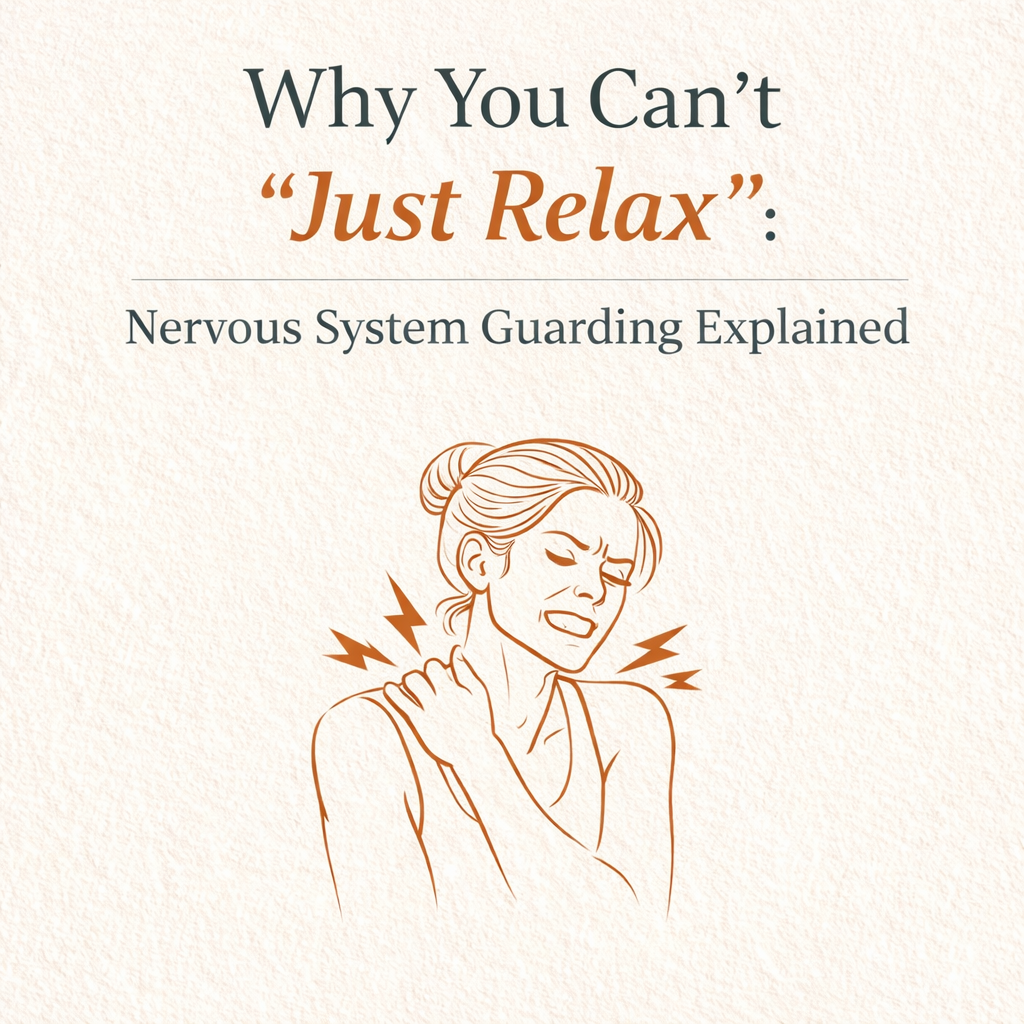
You’ve been told to “just relax” a thousand times.
But when your shoulders stay glued to your ears, your jaw stays clenched, and your breath stays shallow, it is not a willpower problem.
It is often your nervous system doing its job: protecting you.
That automatic protection can show up as nervous system guarding, a pattern where your body stays braced because it does not feel safe enough to let go. When you understand what is happening underneath the tension, you stop fighting your body and start giving it the signals it actually responds to.
In this guide, you’ll learn:
What nervous system guarding is and why it happens
5 signs your body may be stuck in protective mode
Why stretching and “trying to relax” can backfire
4 practical steps that help your nervous system release chronic tension
Common mistakes that keep guarding patterns in place
What Is Nervous System Guarding?
Nervous system guarding is your body’s automatic protective response to perceived threat or instability.
When your brain senses that something feels unsafe or unsupported, it can tighten muscles and restrict movement to create stability. This can be triggered by things like pain, a past injury, stress, feeling unsteady, or movement patterns your body no longer trusts.
Think of it like an internal splint. A cast protects a broken arm by limiting motion. Guarding protects you by creating stiffness and control.
The problem is that guarding often outlasts the original reason it started.
Your ankle healed years ago, but your hip still braces with every step.
Your posture shifted after an old back injury, and now your neck stays tight.
The tension that once protected you has become the source of pain and fatigue.
This is why chronic tightness is not something you can simply “relax” away. Your nervous system tends to release only when it receives enough safety signals to do so.
5 Signs You're Stuck in Nervous System Guarding
Not sure if this applies to you? Here are common signs that can show up when your system is guarding.
1) You Can’t Fully “Turn Off” Tension
Your shoulders, jaw, or neck stay tight even when you try to relax. It may feel like your body keeps snapping back into brace mode.
2) Stretching Makes You Feel Tighter
You stretch regularly, but the tightness returns quickly. Or you feel more tense afterward. For some people, intense stretching can feel like a threat to stability, so the body responds by gripping harder.
3) You Hold Your Breath During Simple Tasks
You catch yourself holding your breath while lifting, concentrating, typing, driving, or even standing up. Breath holding is a classic sign your body is bracing.
4) You Wake Up Feeling Stiff or “Locked”
You wake up tight, stiff, or restricted and need time to feel normal. Your body may be staying guarded even during rest.
5) Tension “Moves Around”
You address one area, but discomfort shows up somewhere else. This can happen when the bigger pattern stays the same and the body shifts the workload to a new area.
If several of these sound familiar, your system may be using guarding as a default strategy.
Why "Just Relax" Doesn't Work for Chronic Muscle Tension
When someone tells you to relax, they are asking you to override a protective reflex.
Your nervous system is not being difficult. It is being protective.
Here are three reasons that “just relax” usually fails.
Your Body Doesn’t Feel Safe Letting Go
If your structure feels unstable, your breathing is braced, or your tissues feel compressed, relaxing can feel like losing the only stability you have.
Even if the stability is uncomfortable, it is familiar. Your system chooses familiar over unsafe.
Guarding Is Largely Subconscious
You cannot always think your way out of it. Many guarding patterns happen below awareness, especially when they have been running for years.
Forcing Change Can Increase Guarding
Aggressive stretching, deep pressure, or forcing a “good posture” position can sometimes make your system clamp down more.
A helpful rule: the body releases when it feels supported, not when it is forced.
Your body is not broken. It is protecting you with outdated information.
How to Release Nervous System Guarding: 4Practical Steps
The way out of chronic tension is not to force relaxation.
It is to give your nervous system clear reasons to trust your body again.
Step 1: Rebuild Real Stability
Guarding often fades when your system feels stable during real life movement.
What this can look like:
Improving how you stand so your weight feels more evenly distributed
Cleaning up how you walk so you are not constantly bracing through your hips, ribs, or neck
Building strength that transfers to life: standing, stepping, rotating, carrying
When your structure can handle load more efficiently, your body has less reason to clamp down.
Ready for personalized guidance? 1:1 Training addresses the root causes of nervous system guarding: structural alignment, fascial health, and intelligent movement. Let's work together to release chronic tension for good.
Step 2: Decompress and Rehydrate Fascia Gently
When tissues feel compressed or restricted, your nervous system often reads that as a safety issue. Fascial stiffness can contribute to the “danger signals” that keep guarding active.
Gentle, consistent tissue work can help your system feel more spacious and supported.
Options include:
Slow foam rolling with light pressure
Floor rolling and soft tissue decompression
Gentle myofascial release that improves glide rather than forcing a stretch
Quick check:
Can you pinch and lift skin in different areas, or does it feel stuck down?
Does gentle pressure on your ribcage feel tender or restricted?
When you rotate, does one side feel significantly more limited?
If yes, tissue restriction may be part of the picture.
Want to go deeper? Read: The Fascia–Lymph Connection and Fascia: The Hidden Web That Shapes Your Movement, Posture, and Health.
Step 3: Use Breath to Signal Safety
Breathing is one of the fastest ways to change what your nervous system thinks is happening.
If you breathe in a braced, shallow pattern all day, your body tends to stay “on.”
A more regulated breath pattern usually includes:
Expansion through the lower ribs, not just the upper chest
A smooth inhale that does not feel like a gasp
An exhale that helps you feel grounded and supported
Try this simple check:
Place one hand on your upper chest and one hand on the lower ribs
Take three normal breaths
Do your lower ribs expand at all, or is it mostly chest lift?
This is not a diagnosis, just an awareness check. Many people who guard breathe high and tight without realizing it.
Breathing is one of the fastest ways to signal safety to your nervous system. But not if the ribcage is still braced.
If your lower ribs don't move when you breathe, your body is still guarding — regardless of how calm you're trying to feel. The 360° Breathing Course teaches you how to create real expansion through the front, sides, and back of the ribcage progressively, so your nervous system finally has a structural reason to release rather than just a cue to try harder.
One hour of content. $27. Lifetime access.
Step 4: Move With Intention Instead of Compensation
Guarding is reinforced by chaotic, compensatory movement.
It is often released through slow, organized movement that your body can trust.
The goal is not “harder workouts.” The goal is better signals.
Random exercises can feel intense but not change your daily movement pattern
Intentional standing, stepping, and rotation teaches your body it can move without bracing
Over time, your system learns it does not need to grip to stay safe.
What This Looks Like in Real Life
Instead of: Forcing your shoulders down
Try: Creating more ribcage and upper back space so the shoulder blades have somewhere to settle. Many shoulders stay tight because the ribs stay compressed and the upper back stays stuck.
Instead of: Stretching your “tight hip flexors”
Try: Improving walking mechanics and pelvis organization so the hip stops needing to brace with every step.
Instead of: Trying to “relax your core”
Try: Building real support through your trunk with standing and stepping patterns that help your low back feel stable.
This is the difference between fighting your body and teaching it.
Common Mistakes That Keep Guarding in Place
Mistake 1: Forcing Relaxation Through Willpower
Your nervous system responds to safety signals, not commands.
Mistake 2: Only Treating the Symptom
If you only massage the tight spot without changing the pattern creating it, the tightness usually returns.
Mistake 3: Going Too Aggressive
Deep pressure, intense stretching, or aggressive drills can sometimes increase guarding. Gentle consistency often works better than intensity.
Mistake 4: Ignoring Breathing All Day
If you brace your breath throughout the day, your body tends to stay braced everywhere.
Mistake 5: Skipping the Basics
Walking, standing, and daily movement patterns matter. This is where your nervous system decides whether to brace or release.
Your Action Plan
Start here (5 minutes)
Body scan: Where are you bracing right now?
Breath check: Do your lower ribs move at all, or is it mostly chest lift?
Movement audit: Walk around. Do you feel balanced, or are you compensating?
This week
5 minutes of gentle tissue work daily
3 short walks focusing on even weight distribution
Set a reminder to check your breath 3x/day
This month
Download the Nervous System Guarding Self-Assessment
Choose one main compensation pattern to work on
Build a sustainable movement practice that signals safety
Frequently Asked Questions
How long does it take to release nervous system guarding?
It depends on what is driving it and how long it has been there. Some people feel shifts within days when breath and tissue restriction improve. Structural changes and deeply embedded patterns often take months of consistent work.
Can I release guarding on my own?
You can make real progress with the right tools and consistency. Guidance can speed things up by helping you identify what your body is protecting and where to start.
Why does tension come back after massage or bodywork?
Bodywork can reduce symptoms temporarily. If the underlying drivers remain, your nervous system often returns to the same strategy. Long-term change usually requires movement, breath, and stability to change.
Is nervous system guarding the same as anxiety?
They are related but not identical. Anxiety is a mental and emotional experience. Guarding is a physical protection strategy. They can influence each other.
What is one of the fastest ways to signal safety?
Breathing is often the quickest lever. A smoother inhale with lower rib expansion and a steady exhale can help your body shift out of brace mode.
Why can’t I relax my shoulders?
Shoulder tension often has deeper drivers such as ribcage compression, upper back stiffness, and braced breathing patterns. Forcing the shoulders down usually does not change the reason your body is guarding.
The Bottom Line
If you cannot “just relax,” it is not your fault.
Your nervous system is doing its job. It is protecting you based on what it has learned.
The path forward is not forcing relaxation. It is creating the conditions where your body feels safe enough to release.
That usually means:
Rebuilding real stability
Decompressing and supporting fascia
Regulating your breathing pattern
Moving with intention instead of compensation
Gentle, consistent work adds up. Your nervous system is listening. Give it better information, and it can let go.
If chronic guarding has left your tissues feeling compressed, congested, or stuck, lymphatic stagnation is often part of the picture. The 28-Day Lymph Reset creates the daily rhythm of breath, movement, and drainage your body needs to start moving fluid and releasing the protective patterns that have built up over time.
Continue Reading: Deepen Your Understanding
Want to explore the root causes of nervous system guarding further? These articles will help you address the structural, fascial, and emotional layers:
The Fascia-Lymph Connection - Understand how compressed fascia blocks lymph flow and creates the "danger signals" that trigger guarding. Learn simple practices to hydrate your fascia and support natural drainage.
Fascia: The Hidden Web That Shapes Your Movement, Posture, and Health - Go deeper into how fascial restrictions create the structural instability that your nervous system is trying to protect. Learn what fascia is, why it matters, and how to care for it.
How Emotions Affect Your Spine and Physical Alignment - Explore the emotional component of guarding. Learn how unprocessed emotions get stored in your fascia and create chronic tension patterns that won't release until you address both the physical and emotional layers.