This week, wildfire smoke overtook Minneapolis and much of the midwest.
The sky looked hazy. The air smelled like we were engulfed in a bonfire and going outside did not feel as restorative as it normally does.
For some people, the change was immediately noticeable through irritated eyes, coughing, chest tightness, headaches, fatigue, or heavier breathing. Others may not have experienced obvious symptoms but still found that their usual walk or workout felt harder. Wildfire smoke can affect anyone, although children, pregnant people, older adults, and people with heart, lung, kidney, or metabolic conditions may face greater risk.
It raises an increasingly relevant question:
What do we do when an outdoor environment that normally supports our health temporarily becomes another load the body has to manage?
I believe sunlight, outdoor movement, and contact with nature are important.
I do not want concern about air pollution to become fear of going outside. I also do not think we should ignore what is in the air simply because being outdoors is usually healthy.
If recurring wildfire smoke becomes part of more of our summers, we will need to balance two realities:
The outdoors still support our health.
The quality of the air still matters.
Air Is One of the Most Constant Inputs the Body Receives
We often think about health through food, water, movement, sleep, and stress.
But breathing is happening all day.
The air around us is one of the most consistent environmental inputs the body has to process.
Wildfire smoke is a mixture of gases and particles, including fine-particle pollution known as PM2.5. These particles are small enough to travel deeply into the lungs. Exposure can irritate the eyes, throat, and respiratory system and may contribute to coughing, wheezing, trouble breathing, headaches, chest discomfort, fatigue, or a faster heartbeat.
A smoky day may show up as obvious respiratory irritation.
It may also feel more general:
Your breathing feels heavier.
Your eyes or throat feel irritated.
Your normal walk feels harder.
Your body feels more tired or guarded.
Your thinking feels less clear.
Your recovery feels slower.
That does not mean every headache, tired afternoon, or tense muscle is caused by poor air quality.
It means the environment may be adding another demand to a body that is already adapting to movement, digestion, heat, stress, sleep loss, and everything else happening in daily life.
The Answer Cannot Be to Abandon the Outdoors
I still believe getting outside matters.
Light and dark are the strongest environmental influences on circadian rhythms, which help organize daily patterns involving sleep, alertness, appetite, metabolism, and other body functions.
The answer to recurring wildfire smoke cannot be living permanently inside.
But “being outside is healthy” cannot become a rule we follow without considering the conditions.
Health is not doing the same thing every day regardless of context.
It is responding to the environment in front of us.
On a clear-air day, a long walk outside may support movement, light exposure, energy, and emotional well-being.
On a heavily polluted day, that same walk may increase the amount of fine-particle pollution reaching the lungs, especially if you are moving quickly and breathing heavily.
The benefit of sunlight does not erase the exposure from smoke.
The presence of smoke does not erase every benefit of being outdoors.
We have to work with the trade-off.
Let Air Quality Guide the Dose
The Air Quality Index gives us a practical way to adjust rather than treating outdoor time as all or nothing.
An AQI of 0 to 50 is considered good.
An AQI of 51 to 100 is considered moderate.
At 101 to 150, air quality is considered unhealthy for sensitive groups.
At 151 to 200, it is considered unhealthy for everyone, although sensitive groups may experience more serious effects.
Levels above 200 move into very unhealthy or hazardous territory.
AirNow recommends reducing the duration and intensity of outdoor exercise when smoke is present because heavier breathing increases the amount of polluted air inhaled.
Depending on the conditions, that may mean:
Choosing the cleanest window of the day for outdoor light.
Sitting outside briefly instead of taking a long walk.
Walking slowly instead of running.
Moving a strenuous workout indoors.
Using bright daylight near a closed window as a temporary compromise when the air is hazardous, knowing it does not fully replace being outdoors.
Spending time in an area with meaningfully cleaner air when the trip is practical or can be combined with necessary errands. Making an additional drive solely to chase a small AQI difference may add to local air pollution.
Taking greater advantage of clear-air days rather than assuming every summer day will offer the same conditions.
People with asthma, heart or lung conditions, older adults, children, pregnant people, and anyone experiencing symptoms may need to reduce exposure sooner and more aggressively.
The goal is not to become afraid of the air.
It is to recognize when the environmental cost has become greater than the benefit of staying outside longer.
How Masking Fits My Philosophy
In general, masking is not the foundation of my breathing philosophy.
I would rather improve the surrounding environment and breathe freely whenever conditions allow.
A respirator adds warmth and resistance. It changes the sensory experience of breathing. I do not see it as a permanent substitute for clean air or as a daily wellness practice.
Wildfire smoke creates a different trade-off.
When particle pollution is elevated and going outside cannot be avoided, the temporary inconvenience of wearing a properly fitted respirator is smaller than the burden of breathing polluted air directly into the lungs.
A NIOSH-approved N95 or P100 can reduce exposure to smoke particles when it fits closely around the face. Loose cloth masks, bandanas, and many basic face coverings are not designed to provide the same protection.
N95 and P100 respirators filter particles. They do not protect against the gases or vapors that may also be present in smoke. That is another reason a respirator should support exposure reduction rather than become permission to remain outside indefinitely.
I see a respirator as temporary protective equipment.
Not the foundation.
Not permission to perform a hard outdoor workout during hazardous air.
Not a substitute for reducing exposure.
It is a bridge through an unhealthy environmental condition.
Support natural breathing whenever the environment allows it. Protect the lungs when the environment does not.
Respirators to Consider for Wildfire Smoke
When outdoor exposure cannot be avoided, a well-fitting, NIOSH-approved N95 or P100 can reduce inhalation of smoke particles. Fit matters, so the best option is the one that seals securely around your face.
3M Aura 9205+ N95: Practical non-valved option for general use.
3M 8511 Valved N95: May feel cooler during warm-weather exposure.
3M 8293 P100: Higher particle-filtration option, but bulkier and more expensive.
Use both head straps, shape the nose clip, and check for gaps around the edges. Facial hair beneath the sealing surface can prevent a reliable fit.
Breathing Exercises Cannot Filter a Polluted Room
Good breathing mechanics still matter during a smoke event.
A supported ribcage, adaptable diaphragm, and lower level of unnecessary guarding may help you breathe more comfortably and prevent additional tension from developing around the chest, neck, and jaw.
But breathing exercises cannot remove PM2.5 from the room.
You cannot out-breathe polluted air.
This distinction is important because wellness culture sometimes treats every environmental stressor as something the body should simply become resilient enough to handle.
Resilience is valuable.
Reducing exposure is also valuable.
Sometimes the healthiest step is improving the body’s capacity.
Other times, it is reducing what we are asking the body to process.
Create One Cleaner-Air Room
You do not necessarily need to filter every cubic foot of your home immediately.
Start with one room.
Choose your bedroom or the room where you spend the most time.
Close the windows and exterior doors while outdoor air quality is poor.
If your HVAC system has an outdoor-air intake, close it or switch the system to recirculation when appropriate.
Use a properly sized portable air cleaner and run it continuously.
Avoid adding more particles to the room through candles, incense, smoking, fireplaces, aerosol products, heavy frying, or unnecessary vacuuming during the worst smoke periods.
The EPA recommends creating a cleaner-air room during wildfire events. It also recommends using a MERV 13 or higher HVAC filter when the system can safely accommodate it and running the fan more consistently so indoor air continues moving through the filter. An HVAC professional can help determine the highest-efficiency filter your system can handle.
Keep windows closed while outdoor air quality is poor, but do not allow the home to become dangerously hot. If you cannot keep your indoor space both cool and reasonably smoke-free, consider spending time in an air-conditioned public building or designated clean-air or cooling center.
Houseplants Support the Space, but They Do Not Filter Wildfire Smoke
I love having plants in the home.
They add life and visual softness. They can make an indoor room feel more connected to nature when outdoor time has to be reduced.
But I would not recommend plants as the primary solution for wildfire smoke.
Laboratory experiments have shown that plants can interact with certain pollutants under controlled conditions. There is currently no evidence that a realistic number of houseplants removes significant quantities of pollution from an ordinary home or office.
That is especially important during a wildfire-smoke event.
Fine particles need meaningful mechanical filtration, not foliage.
Keep plants because they make the space feel more restorative.
Use mechanical filtration because wildfire smoke requires actual particle removal.
Plants may support how you experience the room.
A purifier changes what is circulating through it.
How to Choose an Air Purifier for Wildfire Smoke
Do not choose a purifier based only on the largest square-foot number printed on a listing.
Those large coverage claims are often based on cleaning the room only once per hour. During wildfire smoke, you generally want the room’s air cleaned much more frequently.
Instead, look at the purifier’s smoke CADR, or Clean Air Delivery Rate.
Smoke CADR reflects how much filtered air the machine delivers against smaller airborne particles.
For general use, AHAM often recommends a smoke CADR equal to at least two-thirds of the room’s square footage.
For wildfire smoke, AHAM recommends the more conservative standard of choosing a smoke CADR approximately equal to the room’s square footage. A smoke CADR of 200 would therefore be used for a room of roughly 200 square feet during a smoke event.
The room sizes used below follow that conservative wildfire-smoke guideline, not the much larger once-per-hour coverage numbers commonly used in product marketing.
Wildfire smoke also includes gases and odor-producing compounds.
HEPA or other high-efficiency particle filtration addresses smoke particles.
Activated carbon or another sorbent material may help with some gases and odors, but the result depends on the type and amount of material used. A very thin carbon sheet should not be expected to perform like a deep bed containing several pounds of carbon.
Prioritize:
A verified smoke CADR appropriate for your actual room.
HEPA or other high-efficiency mechanical particle filtration.
Activated carbon if smoke odor and gas-phase pollutants are a concern.
A washable pre-filter.
Replacement filters that are easy to find.
Enough airflow to run continuously.
A noise level you can tolerate while sleeping.
A design that does not intentionally generate ozone.
I prefer mechanical filtration over machines marketed primarily through ozone generation, ionization, or vague “active purification” claims. The EPA identifies ozone as a lung irritant and warns that some ion generators and electronic air cleaners may produce it indirectly.
Air Purifiers to Consider for Wildfire Smoke
I have not personally tested every purifier below.
I selected these based on published filtration design, verified or listed CADR, room-size usefulness, carbon content, and replacement-filter availability.
Best Budget Value for Wildfire Smoke
The Winix 5510 offers strong particle-cleaning output for a budget-oriented machine.
Its published smoke CADR is approximately 253 CFM. Using the conservative wildfire-smoke guideline, I would use it in a closed room of approximately 250 square feet, even though the company advertises much larger coverage when the air is cleaned less frequently.
It includes a washable pre-filter, activated-carbon filter, HEPA filter, air-quality sensing, automatic fan control, and smart features. Winix also lists replacement Filter Q sets specifically for the 5510.
The unit includes Winix’s PlasmaWave electronic feature. The manufacturer’s manual confirms that the feature can be enabled or disabled with its own button. I would turn it off and rely on the mechanical filtration.
Best Compact Bedroom or Home-Office Option
Coway Airmega AP-1512HH Mighty
The Coway Mighty is a compact, well-established option for a bedroom, office, or other closed room.
Its official smoke CADR is 233. Using the wildfire-smoke guideline, I would size it for a room of approximately 230 square feet.
The unit contains a washable pre-filter, odor filter, HEPA filter, air-quality sensor, automatic fan control, and energy-saving Eco mode.
It also includes an optional bipolar or ion feature. I would use the machine with that feature disabled and rely on its filters.
Best for a Larger Closed Room
The Core 600S-P is designed for larger indoor rooms and has a listed CADR of 391 CFM.
Using the conservative wildfire-smoke guideline, I would size it for a closed room of approximately 390 square feet, rather than the much larger once-per-hour coverage advertised on many listings.
It uses three-stage filtration, including a pre-filter, a high-efficiency particle filter, and a carbon-pellet layer for smoke, fumes, odors, and VOCs. It also provides PM2.5 monitoring, automatic fan adjustment, app control, and scheduling.
The standard Core 600S-P product page describes mechanical three-stage filtration and does not list an ionizer or plasma stage. Be careful not to confuse it with separately named PlasmaPro models.
Specialty Option for Smoke Odor and Gas-Phase Pollutants
Most consumer purifiers contain a relatively thin carbon layer.
The full-size Austin Air HealthMate uses a much deeper carbon and mineral-based filter alongside HEPA particle filtration. Austin Air states that its standard-size filters use approximately 15 pounds of activated carbon and zeolite.
That makes it an option to consider when lingering smoke odor, gases, VOCs, or chemical sensitivity are major concerns in addition to particles.
Austin Air does not publish an AHAM smoke CADR for the HealthMate, so I would not compare its advertised room coverage directly with the CADR-rated products above. I would treat it as a specialized, carbon-heavy option rather than assume it can clean an entire 1,500-square-foot home during heavy smoke.
The unit uses no ionization or intentional ozone-producing stage, according to the manufacturer.
Place the Purifier Where You Will Actually Benefit From It
A good purifier cannot clean a room effectively when its intake or outlet is blocked behind furniture.
Place it:
In the room where you spend the most time.
Away from walls and large furniture according to the manufacturer’s instructions.
With the air intake and outlet unobstructed.
Away from open windows and exterior doors during smoke.
On a fan setting high enough to move meaningful air.
Run it continuously during a smoke event rather than turning it on briefly and assuming the room is clean.
If it is too loud at full speed while sleeping, run it on high before bed and then use the highest setting you can comfortably tolerate overnight.
Automatic modes can be useful, but some sensors respond more strongly to certain particles or odors than others. During a known outdoor smoke event, manually choosing a higher fan speed may provide more consistent filtration.
Check the filters more frequently during prolonged smoke periods. A purifier cannot move air efficiently through a heavily loaded filter.
A Lower-Cost Emergency Option
A commercial purifier is not the only way to reduce indoor smoke particles.
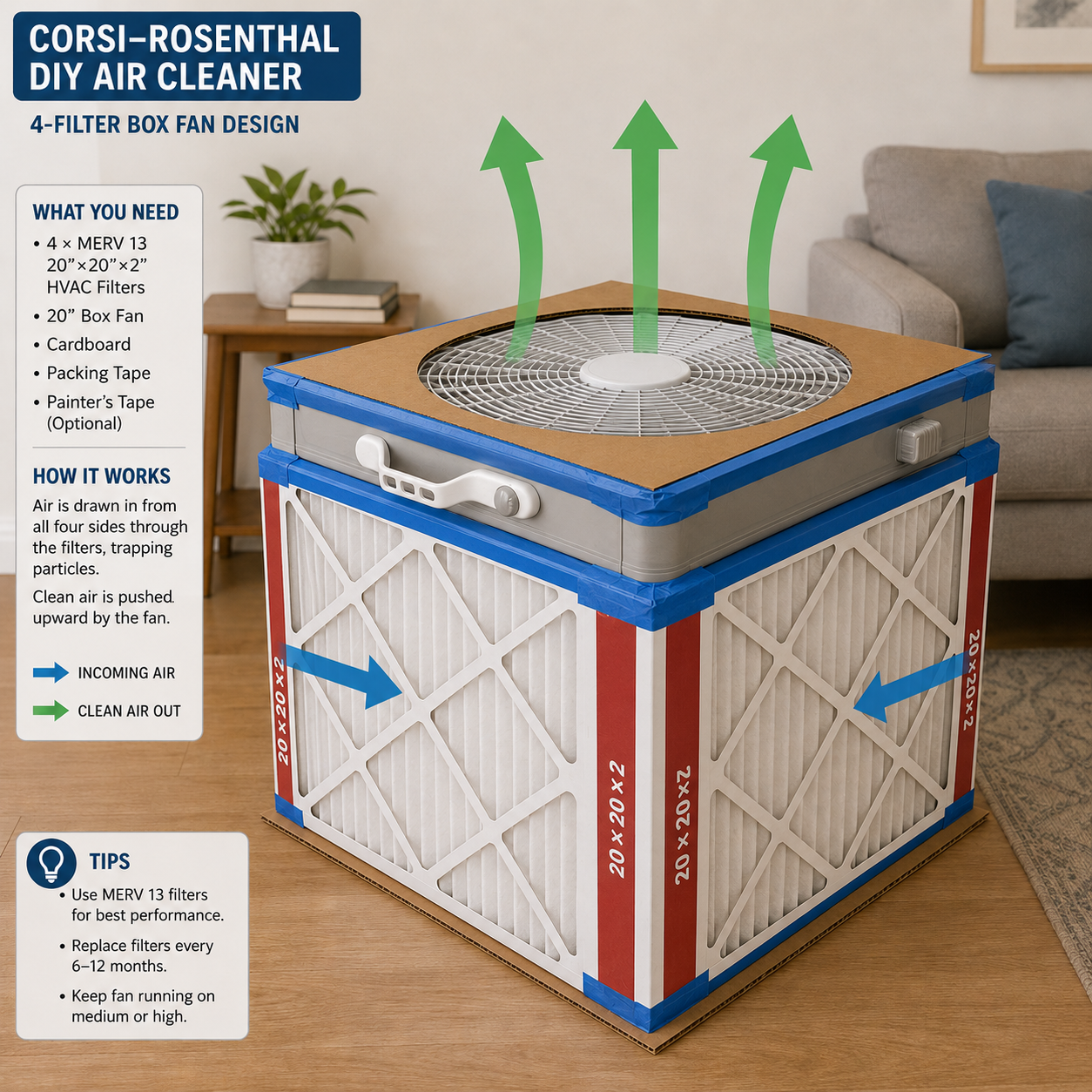
A DIY cleaner made from a newer box fan and one or more MERV 13 filters can be a useful lower-cost option when a commercial purifier is unavailable or unaffordable.
The EPA describes box-fan and MERV 13 designs as a cost-effective way to reduce indoor smoke concentrations. It recommends using a newer, safety-certified fan, ideally manufactured in 2012 or later. Adding a cardboard shroud, using a thicker filter, or building a multi-filter Corsi-Rosenthal-style box can improve performance.
Keep a DIY unit stable and somewhere it cannot be tipped, covered, or blocked by children or pets.
Do Not Accidentally Make the Indoor Air Worse
Closing windows is only one part of protecting indoor air.
When outdoor smoke is high, avoid creating additional indoor pollution through:
Candles.
Incense.
Smoking or vaping.
Wood-burning fireplaces.
Heavy frying or broiling.
Aerosol sprays.
Unnecessary vacuuming without a HEPA-filtered vacuum.
These activities can add more particles or gases to a home that is already receiving some smoke infiltration from outdoors.
A cleaner-air room works best when you both filter the air and reduce what is being released into it. The EPA specifically recommends avoiding activities such as smoking, burning candles, and cooking methods that create additional particles inside a cleaner-air room.
Return Outside When Conditions Improve
The purpose of this article is not to convince you that the outdoors are unsafe.
It is to help you remain connected to the outdoors without ignoring what your body is being asked to manage.
When the air improves:
Open the house when outdoor conditions are genuinely cleaner.
Return to outdoor light.
Resume walking and training outside.
Spend time around trees, plants, and varied natural terrain.
Allow your daily rhythm to reconnect with the environment.
I do not want filtration, closed windows, and respirators to become our permanent relationship with the world.
They are tools for the times when environmental conditions make protection the greater trade-off.
This Is About Adaptation, Not Fear
We cannot remove every environmental stressor.
We also should not pretend every exposure is harmless.
The body is adaptable, but adaptation still requires resources.
If wildfire smoke continues appearing more often during our summers, the solution will not be hiding indoors indefinitely.
It will be learning how to respond to changing conditions.
Get outside when the air supports you.
Shorten exposure when conditions are questionable.
Move strenuous activity indoors when the air is unhealthy.
Create a cleaner space at home.
Use filtration before your body begins showing how hard it is working.
Wear a respirator when necessary exposure makes it the better trade-off.
Return to outdoor light, movement, and nature when conditions improve.
The goal is not a perfectly controlled life.
It is reducing unnecessary environmental load while preserving the inputs that help us remain strong, connected, and well.
The outdoors still matter.
So does the air we breathe while we are there.
This article is educational and is not a substitute for individualized medical care. Contact a healthcare professional if you experience persistent trouble breathing, shortness of breath, wheezing, a cough that will not stop, or other symptoms that do not improve. Seek urgent help for severe breathing difficulty, chest pain, or signs of a heart attack or stroke.
This article contains paid affiliate links. As an Amazon Associate I earn from qualifying purchases with no cost to you.