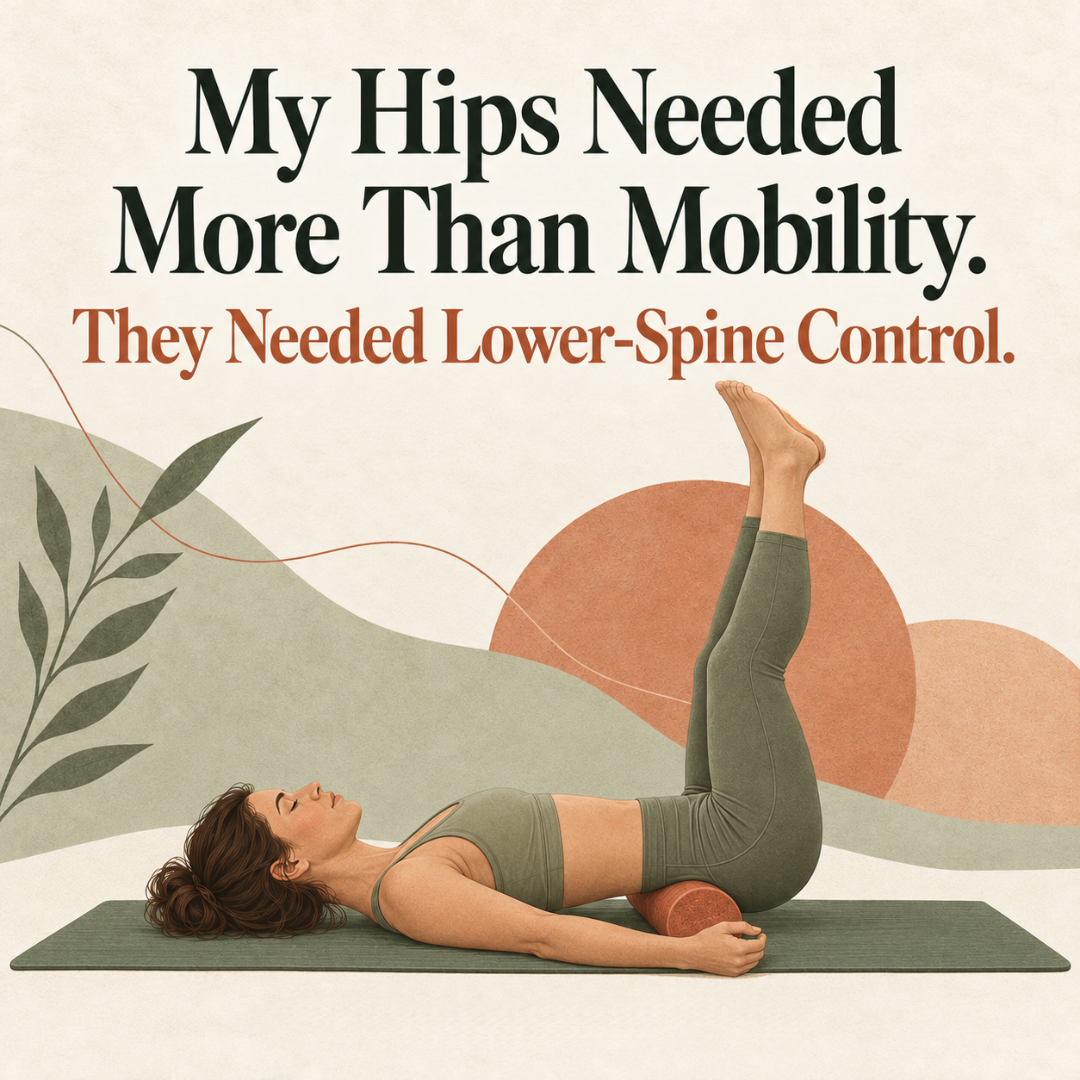
I was lying on my back with my pelvis supported on a foam roller, slowly trying to curl and uncurl my lower spine.
I could tuck by squeezing my glutes. I could return by letting my lower back fall into an arch. Moving between those positions while keeping my abdominal wall involved was much harder.
For years, I had known that I wanted my ribs stacked over my pelvis. But in my already compressed body, that instruction often became upper-ab gripping, glute squeezing, and pushing my pelvis forward.
You could see that something was not right. Those were the movements my body had available when I tried to follow the cues.
The roller gave me a way to explore movement through my lower spine and the softer part of my belly without trying so hard to shape my ribcage. As I developed control there, I began finding hip movement that stretching alone had not given me.
How I was creating the stack mattered
“Ribs down” became pulling harder through my upper abdominals. “Tuck your pelvis” became squeezing my glutes and translating my pelvis forward. My lower abdomen shortened, and I felt more compressed.
I understood the instructions. Repeating them with more effort kept bringing me back to the same pattern.
When I talk about stacking, I mean bringing my ribcage and pelvis into a relationship that supports breathing and movement.
To find that relationship differently, I needed to change my pelvic orientation without immediately pushing my pelvis forward. I also needed to feel my abdominal wall participate beyond the upper-ab grip I knew so well.
On the roller, I could practice letting my pelvis move around my thigh bones, with the movement beginning through my belly. I still felt my glutes participate, but I was learning to connect that effort to the abdominal movement instead of using a hard squeeze to force the tuck.
The return required me to let my abdominal wall lengthen while staying involved. I wanted enough movement to explore both directions, with control through the transition.
Finding movement through my belly
What surprised me was how much movement I could begin to feel through the fleshy part of my belly, between my ribs and pelvis.
Before that, I kept trying to create a curl by shaping my ribcage. Pulling down and forward through my upper abs made my ribs flare more, even though I was trying to bring them into a better relationship with my pelvis.
With the roller supporting me, I could pay attention farther down. I felt my abdominal wall change shape as my pelvis and lower spine moved. My belly could shorten into the curl and lengthen as I returned, with support continuing through the transition.
That gave me somewhere more useful to direct my effort. I did not have to keep pulling harder on my ribs to search for movement through my lower spine.
Why this changed what I could do at my hips
A sumo squat made the difference clear.
I could take a wide stance and turn my thighs outward, but lowering my pelvis between them felt restricted. Trying to stretch farther into the position did not resolve it.
The hip sockets are part of the pelvis. Changing the pelvis’s orientation changes how those sockets relate to the femurs, which can affect the range available in different directions.
My pelvis sat forward in a swayback-looking posture, which could make it appear tucked underneath me. But shifting forward was different from changing its tilt. My lower back stayed held in an arch, and I struggled to move out of that anteriorly tilted position without squeezing my glutes and pushing my pelvis farther forward.
Once I could allow my lower back to round while keeping my hips back, my pelvis could change orientation relative to my femurs. Suddenly, I could lower between my outward-turned thighs with much more freedom. The sumo squat became accessible through a movement I had struggled to find by stretching alone.
Watch: Lower-spine and pelvic articulation on the roller
This is the movement I explore in Day 3 of my 21-day Unstick Your Hips challenge.
As you watch, notice how the pelvis changes orientation around the thigh bones. In my clients, I often see the movement stay so small that the pelvis barely moves. Give yourself room to explore the curl and return within a comfortable range, beginning with abdominal participation rather than trying to manufacture the curl by pulling your ribs down.
You may feel your glutes working too. Notice whether they contribute to the movement your belly helps initiate, or whether a hard squeeze takes over before you find movement through your lower spine and pelvis.
On the return, allow your abdominal wall to lengthen while staying involved. Use a range you can guide in both directions. If you lose control, slow down or reduce the range enough to recover it, then explore farther as that control develops.
Follow the setup and pacing in the video, and keep the movement comfortable. Stop if it causes pain or other increasing symptoms.
Carrying that control into hip movement
The roller gives me a supported place to practice. Then I need to use what I find when my legs move and the demands change.
In a single-leg adductor rock-back, I explore length through the inner thigh and back of the hip while maintaining abdominal support. During weight transfers and side bends, I practice keeping that relationship as the load moves from one side to the other.
My 21-day Unstick Your Hips challenge begins with lower-spine and pelvic control, then builds into hip rotation, inner-thigh work, weight shifting, and side bending. Each movement gives you another way to practice coordinating your trunk, pelvis, and legs.
I want more than a collection of stretches. I want to develop movement I can control and continue building on.
Follow the 21-day Unstick Your Hips challenge on Instagram, TikTok or YouTube
Find your stack without gripping
Explore the breathing work behind the movement
These relationships are also central to my 360 Breathing course.
When I was trying to stack by pulling my ribs down and squeezing my glutes, I needed more ways to create space and develop support through my trunk. Practicing a bigger breath within the same compressed strategy did not address everything I was experiencing.
We work on creating expansion around the ribcage and pelvis while developing the support to maintain that space as movement becomes more demanding.
With more than 70 exercises and posture-based starting points, the course helps you explore where to begin, recognize familiar compensations, and build more coordinated support through your ribcage, abdominal wall, and pelvis.
I still return to the roller to feel my belly initiate and my pelvis follow. My glutes can join in without having to drive the whole movement. That coordination helped me lower into the squat I had spent years trying to stretch into.