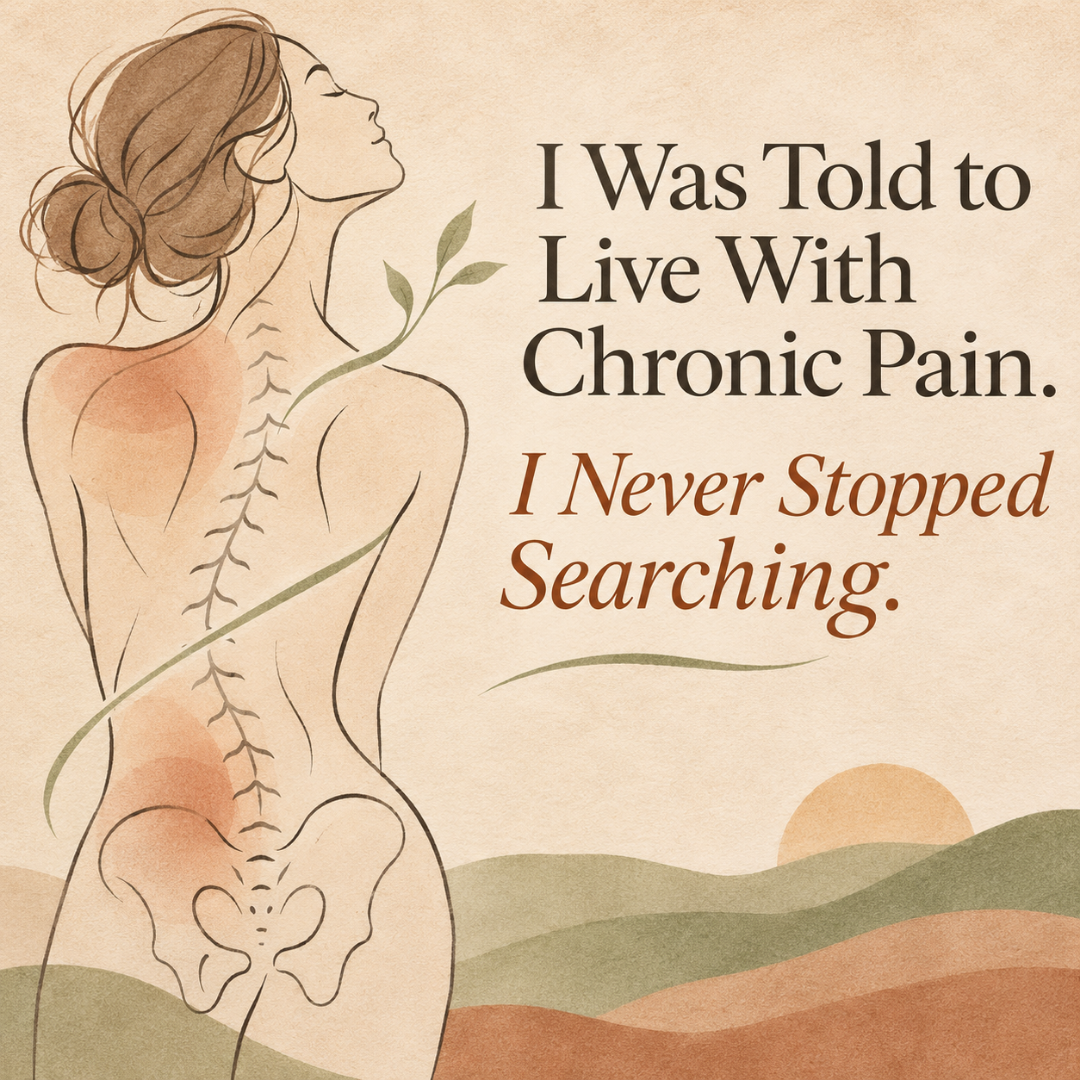
At a Rolfing session the other day, something finally changed around my left sit bone.
I've been working with the same practitioner for about two years. Rolfing is traditionally organized around a ten-session series, but I kept going because I could feel changes happening in my body. Some were obvious. Others took months of working through different areas before I began to understand what was going on.
This particular area around my left sit bone had been stubborn for as long as I could remember. I've spent much of my life feeling pulled toward my left side, struggling to find my center, and even noticing myself veering left when I move.
As he worked through that attachment, I started wondering how much of my lifelong asymmetry might have been influenced by the tension there. I can't know that one restriction explains everything, but the change gave me another piece of information about a pattern I've been trying to understand for years.
And I couldn't help thinking about how many opportunities I've had to give up on my body.
How many times I'd been told that the pain was something I was just going to have to deal with.
How many times I'd questioned whether I was making it worse in my own head.
And how different my life might look today if I'd accepted that nothing else could change.
I Spent Most of My Life in Pain
My headaches started when I was fourteen. They became such a regular part of my life that I barely remembered what it felt like to exist without one.
Over the years, the problems spread beyond my head and neck. I experienced pain in my hips, knees, shoulders, and other areas of my body. There were times in college when even walking across campus felt incredibly difficult.
I was young, active, and doing many of the things I'd been told were supposed to keep my body healthy. Yet I felt trapped inside it.
I tried physical therapy. I tried different exercises, treatments, movement systems, and approaches to understanding pain. I spent an enormous amount of time and money trying to figure out why my body felt the way it did.
Some things helped temporarily. Others made very little difference.
What became especially frustrating was how often the conversation seemed to reach a dead end. When the conventional approaches didn't work, the next explanation was sometimes that I needed to manage my stress, learn to relax, or accept that chronic pain was simply part of my life.
I don't dismiss the relationship between stress, emotions, and physical pain. I've experienced that connection myself. But being told that my nervous system or mental state might be contributing didn't explain everything I was physically experiencing or give me any direction on how to fix it.
I knew how restricted my movement felt. I could feel how certain areas of my body seemed to be holding on for dear life while others moved far too easily. I could feel the uneven pressure and the constant effort it took to hold myself together.
I didn't have the language or understanding to explain all of it at the time.
And when you can't explain something happening inside your own body, it becomes incredibly easy to question yourself.
For years, I trusted other people's explanations more than I trusted what I was feeling.
Sometimes I Kept Going When I Should Have Changed Direction
One of the biggest lessons I've learned is that persistence and progress aren't necessarily the same thing.
I spent a long time studying and practicing Postural Restoration. The theory made sense to me. I appreciated its explanation of asymmetry, breathing, and the relationship between the ribcage and pelvis.
I could understand what I was supposed to be accomplishing.
But I wasn't experiencing the changes I was looking for.
Instead of giving that feedback enough weight, I kept assuming I needed more practice, more understanding, or more time. I was so invested in the theory that I discounted my own experience when it wasn't matching what I expected.
Looking back, I wish I'd been willing to question the approach sooner.
That doesn't mean the method doesn't help other people. It means that, for me, understanding an explanation intellectually wasn't enough to demonstrate that the exercises were helping my body.
My experience with Functional Patterns has been different, although it certainly hasn't been a straight line.
There have been phases when things became more uncomfortable before they improved. I've had to reassess what I was doing, how I was loading my body, and whether the changes I was experiencing were taking me in a useful direction.
But there was a difference I could recognize.
Even during difficult periods, I could identify areas of progress. I began finding movement and connections that had previously felt inaccessible. I could observe changes in how my body handled tension, coordinated movement, and distributed effort.
Those changes gave me reasons to continue, while still paying attention to what wasn't working.
I want to be careful here because experiencing discomfort doesn't automatically mean an approach isn't helping, but it doesn't prove that you're healing, either. I've learned to look at the bigger picture of how my body responds, paying attention to both the progress I'm making and the signs that something needs to be modified or stopped.
And over time, those improvements accumulated into something I had spent years hoping to experience: a body that could move with strength, coordination, and ease.
Learning to Trust My Body Was Harder Than Learning Anatomy
I think this is the part of my experience that took the longest to recognize.
When you've spent most of your life in pain, you can become disconnected from your ability to interpret what your body is telling you.
I don't mean you stop feeling things. Sometimes you feel everything, all the time.
But knowing what to do with that information is another story.
I spent years questioning whether my sensations were accurate. I'd try to follow a movement cue and feel something completely different from what I was supposed to feel. I'd be told an exercise was targeting one area, yet experience the effort somewhere else entirely.
For a long time, I assumed I was doing something wrong.
The more I learned about anatomy, fascia, breathing, and whole-body movement, the more I began to understand that my sensations were useful information, even when I didn't yet know how to interpret them.
My body had developed movement habits over decades. Some areas were extremely restricted while others had far more mobility than I knew how to control. I had spent years finding ways to move around those limitations without necessarily understanding them.
It took time to recognize those patterns. It took even longer to learn how to change them.
And sometimes the best information came from realizing that something I'd believed for years wasn't actually helping me.
That's an uncomfortable place to be, especially when you've invested time, money, and hope in an approach.
Intuition can be scary when you don't trust your body.
I'm still learning the difference between a familiar sensation, a genuine improvement, and something that simply feels different because it's new. I use my understanding of anatomy to investigate what I'm experiencing, and I keep reassessing whether the changes hold up over time.
I no longer want to follow an approach indefinitely just because someone can explain why it should work.
I want to recognize what is actually changing.
Start Recognizing Your Own Patterns
Two Years Later, Another Piece of the Puzzle
That's part of why the recent Rolfing session meant so much to me.
I could have stopped after the traditional ten sessions. I could have decided I'd received whatever benefit I was going to get and moved on.
Instead, I continued because the work was giving me meaningful changes, even when progress was slow.
Two years later, we're still finding areas of restriction and relationships I hadn't fully understood.
What's particularly interesting is that my mechanics are already functioning incredibly well compared to where I started.
I can move with a level of strength, coordination, and freedom that I spent much of my life searching for. I'm no longer navigating the same constant physical limitations that once made ordinary activities so difficult. My body feels connected in ways I never knew were possible.
That's an enormous change, and I don't want to minimize it by constantly focusing on what I could still improve.
But having a well-functioning body doesn't mean there aren't deeper patterns left to explore.
The work around my left sit bone is a perfect example. I've made significant progress in how my pelvis and spine function, yet we were still able to identify and work through an area that may have been influencing my movement for decades.
I don't know whether the change around that attachment will hold or exactly how it will affect my movement over time. I'll continue observing and testing what feels different.
But I'm grateful I continued investigating.
The same is true of my movement training. Many of the things I once struggled with have become natural parts of how I move. I have a much stronger foundation now, which gives me the ability to explore details that would have been difficult to address when I was simply trying to get through the day without pain.
I used to think that if I could just find the right practitioner, the right exercise, or the right explanation, someone would finally give me the answer.
What I've learned is that progress often requires a much more active relationship with the process.
I have to observe. I have to ask questions. I have to notice what changes and what doesn't. Sometimes I need to stay with something long enough for meaningful progress to emerge. Other times I need to admit that an approach I've invested in isn't getting me where I want to go.
Both require trust.
And learning that trust after spending most of my life feeling trapped in my body has been one of the most difficult parts of this entire experience.
Why I Still Believe in Looking for Answers
I've been thinking a lot about how we talk about chronic pain and chronic illness, particularly online.
I see people sharing experiences of being dismissed, struggling to work, losing parts of their independence, and learning to live with symptoms that affect nearly every aspect of their lives.
I understand some of that exhaustion firsthand.
I also recognize that not everyone has the same resources, access to care, or physical capacity to keep experimenting with different treatments. Some conditions are progressive. Some don't have effective treatments yet. And some people have spent decades searching without finding meaningful relief.
I would never want someone to read my story and feel that their continued pain means they haven't worked hard enough.
There were plenty of times when I was trying incredibly hard and getting nowhere.
I also understand why acceptance can be necessary. There are circumstances we cannot change, and sometimes making peace with the present is what allows us to get through another day.
But I struggle with the idea that accepting our current circumstances should require us to stop believing that something might improve.
I wish more people who are suffering were encouraged to remain curious about their bodies, to ask for another opinion when something doesn't add up, and to recognize that an unsuccessful treatment doesn't necessarily mean they've exhausted every possibility.
I wish I'd heard more of that when I was younger.
I wish someone had told me that I could respect a practitioner's knowledge while still questioning whether their approach was helping me.
That I could change direction without having wasted everything I'd learned.
And that I didn't have to understand every detail of my pain before taking my own experience seriously.
My life would have been very different if I'd stopped searching at fourteen, twenty, or even thirty.
Today, my body functions better than I ever expected it could. The physical limitations that once dominated my life no longer define how I move through the world. I have strength, freedom, and a level of control over my movement that I genuinely didn't know was possible when I was younger.
There is still room for growth, and I expect there always will be. But I'm not spending my days waiting for some future version of my body to finally feel good. I get to experience the benefits of all those years of work right now.
That's a large part of why I teach and why I started the Regenerative Roots Blog.
I know what it's like to feel trapped in a body you can't seem to understand. I know how discouraging it is when the people you're looking to for help don't have the answers. And I know how much it can mean to finally experience a change after years of feeling stuck.
I can't promise that everyone who keeps searching will find the same kind of relief I have. I wouldn't pretend to know what another person's body is capable of recovering from.
But I can share what happened when I kept asking questions, learned to recognize progress, and became willing to reconsider the things I thought I knew.
A few days ago, after two years of working with the same Rolfing practitioner, we made progress in an area around my left sit bone that may have been influencing how I experienced my pelvis for as long as I can remember.
At thirty-six, I'm still discovering things about a body I've lived in my entire life.
And after all those years of being told to accept the pain, I'm incredibly grateful I never stopped looking for answers.
Work With Me: Explore What's Possible for Your Body
My own experience with chronic pain has shaped how I work with clients today.
I know how frustrating it can be to spend years searching for answers, especially when you've tried different treatments and still don't understand why your body feels restricted.
One of my clients, Candice, came to me after years of dealing with slipping ribs, hypermobility, and difficulty finding stability in her body. Through our work together, she began experiencing changes in her breathing, movement, and ability to feel supported without constantly bracing.
She shared that she'd gone more than three months without a slipping-rib incident after previously experiencing them regularly.
Her experience is her own, but helping someone discover new possibilities after years of frustration is exactly why I love this work.
Through one-on-one movement coaching at RootForce, we look at how your breathing, posture, fascial connections, and movement patterns work together. We test, reassess, and build strength and coordination based on how your body responds.
If you've been dealing with persistent tension, restricted movement, or the feeling that your body isn't working together, I'd love to help you investigate what's possible.