What I misunderstood about my hip joints, and how seeing my anatomy differently changed the way I experienced movement.
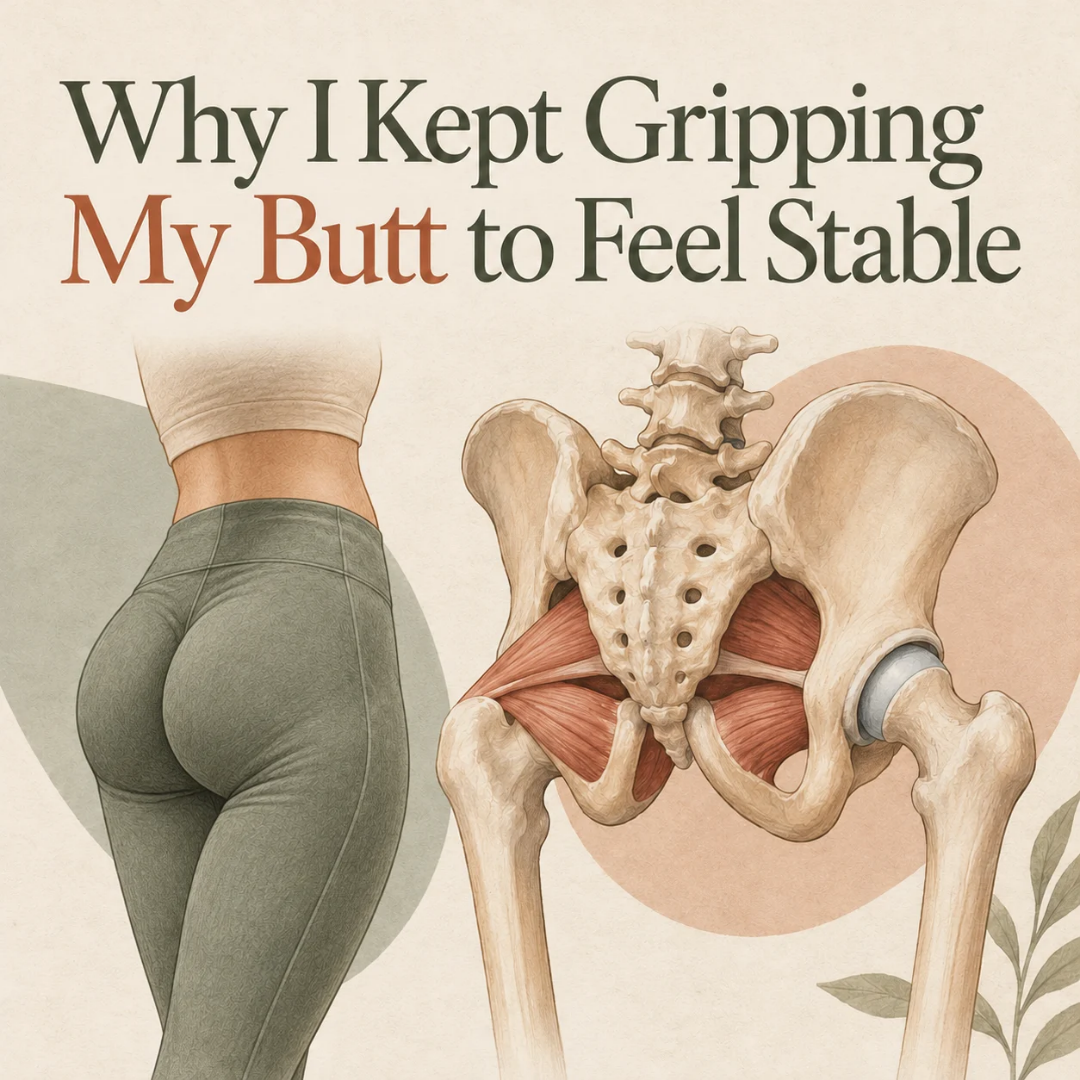
I was holding a model of the pelvis, looking at the sit bones and the sockets where the femurs attach.
For years, I'd felt like my legs connected somewhere near the back of my pelvis.
I'd learned where the hip joints were anatomically years ago. But when I stood, hinged, or shifted my weight, the strongest sensation of connection came from squeezing the muscles around my sit bones. That familiar sensation had become so dominant that I rarely stopped to consider what the pelvis actually looked like.
As I turned the model around in my hands, something became much clearer.
My hip sockets were farther forward than the place I'd spent years trying to create stability.
The acetabula, the cup-shaped sockets that hold the femoral heads, sit on the sides of the pelvis and face outward, somewhat forward, and downward.
I'd looked at pelvic anatomy countless times before. But the sensations I'd reinforced through years of my compensations were often more convincing than the images I'd studied. This time, something clicked, and movement cues I'd struggled with for years suddenly started making more sense.
When squeezing feels like stability
My pelvis was habitually shifted forward, my knees tended to collapse inward, and I relied heavily on gripping through the back of my pelvis to feel supported.
When I squeezed, I could feel myself working. It felt like I was creating a connection between my pelvis and legs.
But the harder I gripped, the less stable I felt when I needed to move.
Looking back, I think my forward-shifted pelvis and tendency to tuck created the sensation that my sit bones were resting against the backs of my femurs.
They weren't actually bearing weight there, but squeezing around the back of my pelvis gave me such a strong sense of connection that it became my reference for stability.
My study of the Postural Restoration Institute (PRI) helped me understand that even though I felt myself tucking, there were signs that parts of my pelvis remained oriented forward relative to my sacrum.
I'd become very good at gripping the back of my pelvis to feel supported. What I struggled with was finding that same sense of support through my legs without squeezing.
How this changed the way I understood hip movements
Consider a hip hinge.
When you hinge forward in standing, your pelvis rotates relative to your femurs. The hip sockets move around the femoral heads while your sit bones travel backward through space.
For years, I focused almost entirely on sending my sit bones backward. Then, to return upright, I'd strongly tuck my pelvis.
I could perform the movement, but I struggled to sense the rotation happening around my actual hip joints.
This also influenced how I interpreted a familiar cue: expand the posterior hip capsule.
I knew the muscles and tissues at the back of my hips needed more length. But because I sensed my femurs connecting somewhere near my sit bones, I pictured the leg bones pushing backward into those muscles, which needed to expand to make room.
The posterior hip capsule surrounds the back of the actual hip joint, located farther forward than my sit bones. As the pelvis rotates relative to the femoral heads during a hinge, the surrounding muscles and tissues accommodate the movement through changes in length and tension.
I still needed that posterior expansion. What changed was my understanding of where the joint was and how the surrounding tissues were responding.
The same discovery helped clarify my hip shifts.
When I tried to move one side of my pelvis forward, I would sometimes push from the front of my ilium. Other times, looking back, I think I was almost trying to shove the back of my pelvis forward.
Those were the landmarks I knew how to feel.
But seeing how far forward the acetabula were positioned, and how their openings faced outward and somewhat forward, helped me visualize how my pelvis could translate and rotate relative to my femoral heads.
Pelvic positioning also changes how those sockets are oriented in space, even though the shape of the bones remains the same.
Once I could picture that relationship, something remarkable happened. The movements became smoother. I could feel my pelvis moving around my femurs without searching for the familiar gripping sensation at the back.
My Functional Patterns training had already been developing the lower-spine control, abdominal support, and coordination I needed. Seeing the anatomy so clearly helped me connect those changes to what I was actually trying to accomplish.
The movements that had required so much conscious effort began to flow more naturally.
Why the back of my pelvis felt so connected
Looking at the muscles around the posterior pelvis added another piece.
The piriformis, obturator internus, and other deep hip rotators connect regions of the pelvis to the femur. Nearby pelvic floor muscles contribute to the support and coordination of the pelvis.
Seeing those muscular connections helped me understand why squeezing around the back of my pelvis could create such a strong sensation of attachment to my legs.
I had relied on that posterior grip for stability, even when it limited my ability to move.
I also suspect it affected my breathing and pressure management.
The pelvic floor coordinates with the diaphragm and abdominal wall. During relaxed inhalation, it normally lengthens and descends as the diaphragm moves downward. Its activity then adapts to the demands of movement and load.
When muscles are habitually held in a strong contraction, they can have difficulty lengthening and responding to those changing demands.
Glute engagement is an important part of movement. What I was missing was the ability to vary that contraction rather than relying on the same squeeze for everything.
I could generate plenty of muscular effort, but that effort wasn't always giving me the control I was looking for.
This relationship between breathing, pelvic floor movement, and abdominal support is something I explore more deeply in my 360° Breathing course. Learning to create space and manage pressure without constantly gripping has been an important part of developing more adaptable support in my own body.
We interpret movement cues through what we already know
This is the part of the experience I find most fascinating.
We interpret movement instructions through the sensations, habits, and experiences we've already developed. Even when we're given an accurate cue, we may unknowingly use the same compensations we've practiced for years to carry it out.
I've spent so much time learning movement rules. Which direction should my pelvis rotate? Which hip should internally rotate? Where should I feel muscular engagement?
I could understand the instructions and still return to the same familiar sensations when I tried to apply them.
Our nervous system continually builds an understanding of where our body parts are using information from movement, touch, vision, and previous experiences. One aspect of this internal representation is called the body schema.
That representation isn't fixed. It can change as we experience movement differently and incorporate new information.
This is one reason I find visual learning so valuable.
Sometimes we need to see what we're trying to feel
Anatomical images give me something to compare against my own sensations.
A skeleton shows me where joints actually articulate. Muscle illustrations help me understand how different structures connect and influence movement. Fascial pathways give me a way to visualize how tension and movement can involve multiple regions of the body.
I can take those images back into my practice and explore whether what I'm feeling matches what I'm seeing.
Sometimes an illustration doesn't mean much the first time. But after more movement practice, I might return to that same image and suddenly recognize a relationship I couldn't make sense of before.
Each experience gives me another opportunity to connect what I'm learning with what I'm feeling.
This is where neuroplasticity becomes relevant. Our nervous system can update how it represents and coordinates the body through new sensory information and repeated experiences.
A clearer visual can change what we pay attention to during movement. When we return to physical practice and experience something differently, we give the nervous system new information to learn from.
I've noticed that the more often I revisit anatomical images alongside my movement practice, the easier it becomes to recognize relationships that once seemed confusing.
Sometimes the anatomy we've looked at a hundred times finally makes sense because our bodies have developed enough new experiences to understand what we're seeing.
What if you're a habitual butt-gripper?
If you constantly tuck your pelvis to feel upright, squeeze your glutes for stability, or struggle to hinge without tension through the back of your hips, you might recognize some of this experience.
The same goes for people whose knees tend to collapse inward or whose pelvis shifts forward when standing.
These patterns can have different causes, but the way you perceive your hip joints may still be worth exploring.
The next time you're standing at the kitchen counter, notice where you feel yourself creating support.
Are you shifted forward and squeezing through the back of your pelvis?
Before trying to correct anything, consider where your femoral heads actually sit.
They're higher and farther forward than your sit bones, within sockets that face outward and somewhat forward.
See whether picturing that relationship changes how you experience the pelvis over your legs.
And when you hinge, consider the pelvis rotating relative to those hip joints while the tissues at the back of your hips accommodate the movement.
You don't need to force a different sensation. Start by observing the one you already know, then see whether understanding the anatomy gives you another way to experience it.
When the anatomy finally clicked
In my previous article, My Hips Needed More Than Mobility. They Needed Lower-Spine Control, I explored how developing lower-spine and pelvic articulation changed my ability to move.
This discovery added another piece. Seeing where my hip joints actually sat within my pelvis changed how I experienced those same movements. The control I'd been developing finally felt more natural and intuitive.
The images we study, the sensations we experience, and the movements we practice all contribute to how we understand our bodies. When those pieces begin to connect, we have an opportunity to experience familiar movements in an entirely different way.
I keep thinking about that pelvic model in my hands.
I'd seen those bones before. But for years, the sensations I experienced every time I stood or moved had been reinforcing a different understanding.
This time, the image stayed with me.
And when I returned to my hip hinge, I could finally feel the pelvis moving around the joints I'd been looking at.
The movement was smoother, the posterior gripping wasn't dominating my attention, and I didn't have to work nearly as hard to find my way through it.