What Makes an Exercise Transfer to Real Life?
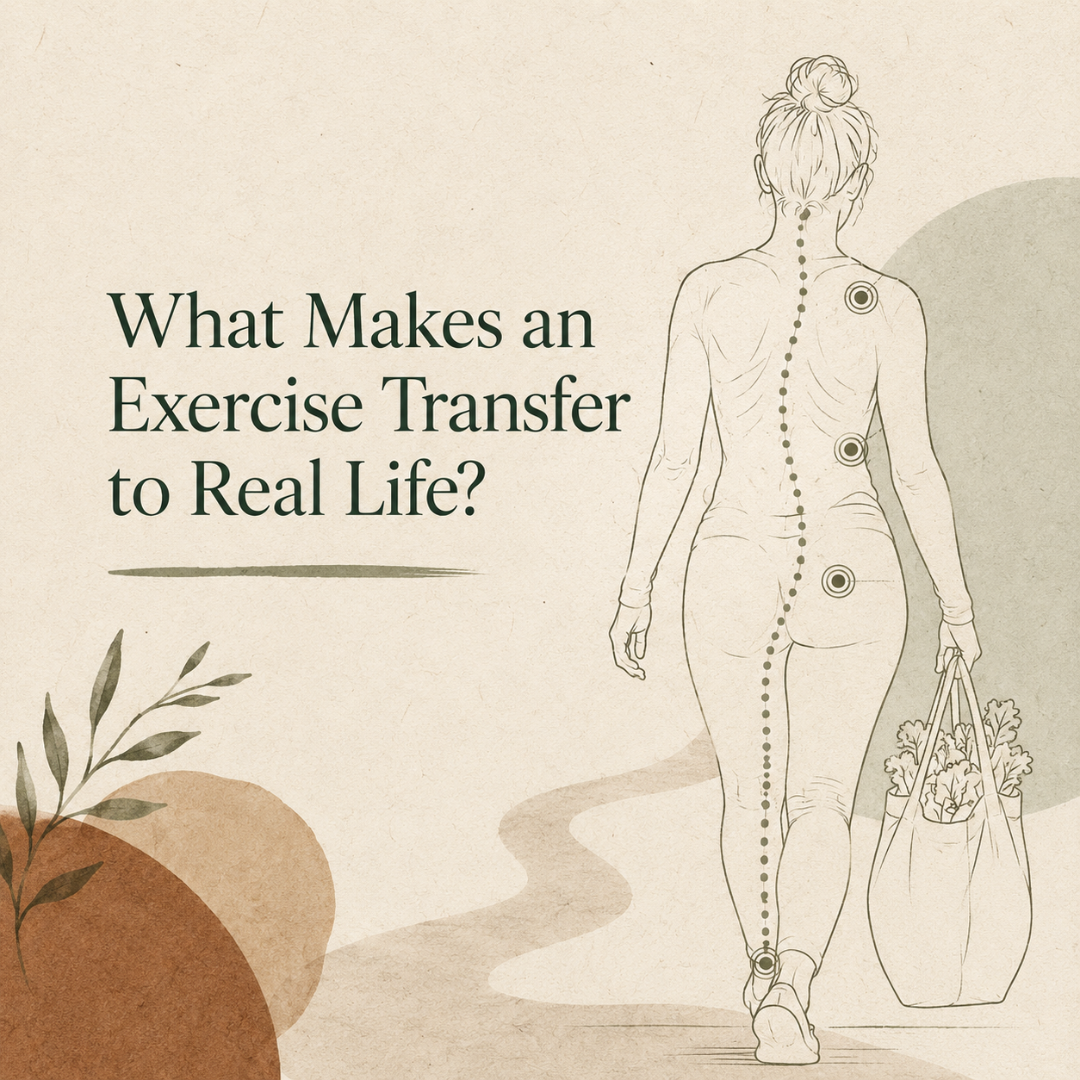
For years, I assumed that if an exercise made me stronger, more stable, or more flexible, that improvement would naturally carry into the rest of my life.
Sometimes it did. Other times, I could perform an exercise well in a controlled setting and still feel disconnected when I walked, rotated, carried something heavy, or moved at speed. I had strength, but I did not always know how to use it as part of a coordinated whole.
Gait training made that difference especially clear. As I began paying closer attention to walking, I realized that moving well was not simply a matter of having strong glutes, mobile hips, or an engaged core. My body had to organize pressure, rotation, balance, timing, and force transfer with every step. When those pieces worked together, walking felt easier and more powerful. When they did not, another area had to compensate.
That realization changed the question I ask about exercise.
Instead of only asking, “What muscle does this work?” I now ask:
“What human ability is this exercise helping me improve?”
Muscles Don’t Move Through Life in Isolation
Traditional exercise is often organized around individual muscles or body parts: leg day, arm day, core work, glute exercises. There is nothing inherently wrong with that. Isolated work can rebuild tissue capacity after an injury, strengthen a specific area, or bring attention to a part of the body that has been difficult to access.
But everyday movement does not happen one muscle at a time.
Carrying groceries requires your feet to interact with the ground, your legs to manage load, your pelvis and rib cage to respond to one another, your trunk to transmit force, and your arms to adapt to the weight. Your body has to coordinate all of that while you continue breathing and responding to the environment around you.
That is why strength in one position does not automatically become useful strength everywhere else. A muscle may be capable of producing force, but the body still has to know when, where, and how to use it.
Four Foundational Human Functions Behind Functional Movement
A framework that has strongly influenced how I think about movement comes from the Functional Patterns methodology, which places particular emphasis on four foundational human functions:
Standing
Walking
Running
Throwing
Standing requires us to organize our structure against gravity while maintaining a more uniform distribution of tension. Walking demands rhythm, balance, rotation, and the ability to transfer force from one side of the body to the other without unnecessary energy leaks. Running increases the need for elastic recoil, timing, propulsion, and impact management. Throwing requires force to travel from the ground through the legs, pelvis, trunk, and arm in a coordinated sequence..
You do not have to literally walk, run, or throw during every workout. The more useful question is whether your training develops the qualities those functions depend on.
Does the exercise help you organize your body against gravity? Does it improve coordination between different regions? Does it challenge you to absorb, transmit, and redirect force? Can you rotate, stabilize, and continue breathing while managing load?
Those questions tell us more about real-world transfer than the name of the exercise alone.
Completing a Movement vs. Transferring Force
Two people can perform an exercise that looks nearly identical and experience it very differently.
One person may distribute force throughout the body. The other may complete the movement by hiking a shoulder, shifting the pelvis, collapsing through a knee, gripping through the neck, or holding the breath.
Both finish the repetition, but the strategy is not the same.
I think of the second pattern as an energy leak: a place where force does not travel through the body as efficiently as it could and is instead redirected through compensation or unnecessary movement.
Imagine pushing a shopping cart with one loose wheel. You can still move forward, but the task takes more effort because some of your energy is continually being redirected.
In the body, that might look like:
A shoulder that hikes whenever you carry something
A pelvis that shifts or hikes with each step
A knee that repeatedly collapses inward under load
A trunk that leans dramatically to maintain balance
Breathing that becomes strained during a relatively simple task
These observations are not diagnoses, and asymmetry alone is not necessarily a problem. Human movement is naturally variable. The goal is not to eliminate every difference between the two sides of the body or force yourself into a rigid idea of perfect alignment.
The more useful question is whether a strategy helps you manage the task comfortably and efficiently, or whether it repeatedly creates unnecessary effort, tension, or loss of control elsewhere.
Feeling an Exercise Is Not the Same as Transferring It
An exercise can create fatigue, soreness, or a strong muscular sensation without meaningfully changing how you move outside the workout.
That does not make the exercise useless. It simply means sensation and transfer are not the same thing.
A row does not look like walking, but it may improve coordination between the arm, rib cage, and trunk. A split stance does not perfectly recreate gait, but it can reveal how you manage weight between two legs. A loaded carry does not imitate every demand of daily life, but it challenges the body to organize itself while moving under an uneven load.
Transfer is not always about copying the exact movement you want to improve. It is often about developing the underlying qualities that movement requires, such as balance, timing, rotation, breathing, pressure management, and the ability to absorb and redirect force.
The exercise is only part of the equation.
How your body solves it matters just as much.
Try It: The One-Sided Carry Test
You can explore this idea using a grocery bag, backpack, dumbbell, or kettlebell.
Choose a weight that feels moderately challenging but still allows you to walk comfortably. Hold it in one hand and walk for 30 to 60 seconds at a natural pace.
Do not immediately try to correct your posture. Begin by observing what your body naturally does.
Notice:
Does the loaded shoulder rise in a way that seems driven mostly by the upper trap?
Does your torso lean toward or away from the weight?
Does one side of your pelvis hike or shift?
Does your stride become shorter on one side?
Can your opposite arm still swing naturally?
Can you breathe comfortably?
Does your head remain relatively level?
Does the task feel different when you switch hands?
If possible, record yourself walking from the front and the side. What we think we are doing and what we are actually doing are not always the same.
The goal is not to judge your movement or force yourself into symmetry. It is to become curious about how your body organizes force when the task becomes more demanding.
You may find that one side feels smooth and coordinated while the other feels awkward. You might notice that the weight changes your stride, pulls you into a trunk lean, or makes breathing more difficult. You may also discover that your body handles the task comfortably on both sides.
Every outcome gives you information.
This experiment does not tell you which muscle is weak, diagnose a movement problem, or prescribe the exact correction you need. It simply offers a clearer picture of how your body responds to load while moving.
Observation Should Come Before Correction
When we rush to fix every visible asymmetry, we risk applying a generic solution to an individual problem.
Observation allows us to ask better questions:
Does this strategy help me transfer force through my body, or does the effort seem to get stuck somewhere?
As the task becomes harder, does the pattern become more noticeable?
Does it affect my breathing, balance, or ability to stay supported?
Does the same strategy show up during other movements in my daily life?
A single observation is not a verdict. It is a clue.
The point is not to become hyperaware of every movement or search constantly for something wrong. It is to develop enough awareness to recognize where movement feels coordinated and where the body may be using more effort than the task requires.
Strength Is Only One Part of Capacity
Strength matters. We need tissues that can produce and tolerate force.
But real-life capacity also depends on timing, coordination, balance, breathing, elasticity, and the ability to adapt when the environment changes. A body can be strong in a controlled position and still struggle to organize that strength during a complex movement.
That is what gait training taught me.
I could become stronger in an exercise without automatically improving the way force traveled through my body when I walked. I had to learn how the pieces related to one another: how my feet interacted with the ground, how my pelvis and rib cage rotated, how my arms responded, and how pressure moved through my trunk.
As that coordination improved, I also started to experience my fascia differently. Instead of feeling like individual muscles were doing separate jobs, I could feel larger chains of tension working together across my body. The ground underneath my foot felt connected to what was happening through my leg, trunk, and even into the opposite arm. I don't experience that as one muscle contracting. I experience it as tension being distributed through a connected system.
This is an example of the kind of gait-based training I use to explore these relationships in my own body. I’m not sharing it as an exercise prescription. What I want you to notice is how many parts of the body have to coordinate at once: the relationship to the ground, rotation through the pelvis and rib cage, the arms responding to the trunk, and tension being distributed through the system.
Over time, that changed the way I experienced movement outside the gym. Walking began to feel less like a repetitive task and more like a full-body expression of timing, rotation, tension, and transfer. As those qualities improved, other activities began to feel more natural and less forced.
The lesson was not that traditional strength training had failed me completely.
It was that strength needed somewhere to go.
How to Evaluate Your Own Training
You can still ask which muscles an exercise trains. That information is useful, especially when you are trying to strengthen a particular tissue or rebuild capacity after an injury.
I would simply add a few more questions:
What movement quality is this exercise developing?
Does it help me coordinate multiple regions of my body?
Can I breathe comfortably while performing it?
Am I controlling rotation, falling through it or avoiding it altogether?
Does this strategy help me transfer force through my body, or does the effort seem to get stuck somewhere?
Am I becoming more capable, or only more fatigued?
Does this support something I want to do outside the gym?
Not every exercise needs to accomplish everything. A targeted rehabilitation drill has a different purpose from a loaded carry, sprint, or rotational exercise.
The point is not to divide movement into “functional” and “nonfunctional” categories.
The point is to understand what each exercise is preparing you to do.
The Real Purpose of Training
The most useful exercise is not necessarily the one that creates the biggest burn, the deepest stretch, or the most impressive performance inside a workout.
It is the one that develops a quality your body can use.
That may mean greater tissue strength. It may mean smoother rotation, better balance, more efficient breathing, stronger elastic recoil, or an improved ability to manage force without creating unnecessary tension elsewhere.
The best training does not stay trapped inside the exercise. It changes how you stand, walk, carry, reach, react, and move through the world.
The goal is not simply to become better at working out.
It is to build a body that is more capable in real life.
The standing, walking, running, and throwing framework discussed in this article is drawn from the Functional Patterns methodology. The explanations, observations, and practical example shared here reflect my own interpretation and teaching experience.