When the Days Get Shorter but Our Schedules Don’t: How Artificial Light Affects the Body
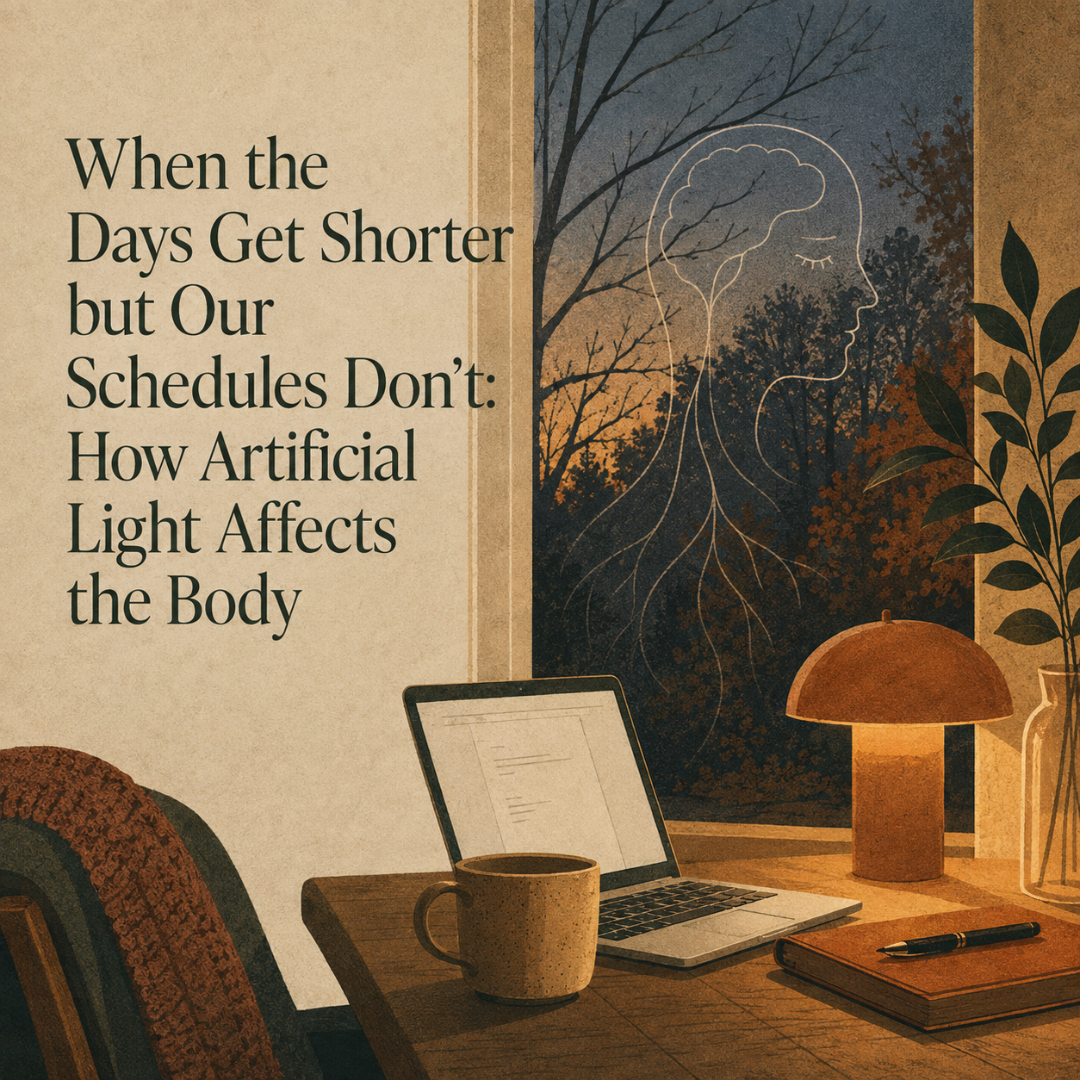
I often recognize fall at my computer before I feel it in the air.
I look up in the late afternoon and see my own reflection in the window. Only a few weeks earlier, there was still daylight behind the screen. Now the window has gone dark, the lights are on, and I am still asking my eyes and brain to work as if the afternoon never ended.
Nothing on my calendar changed when the sun began setting earlier. I still had articles to finish, emails to answer, classes to plan, and screens to look at. Artificial light made it possible to continue at the same pace, but I began to feel the mismatch in my body: tired eyes, a more fixed posture, and a mind that stayed alert after the rest of me was ready to stop.
Light helps us see, but it is also timing information. As natural daylight dwindles in the fall, the amount, timing, and quality of the light around us begin to matter in a different way.
Fall Changes the Light Around Us Faster Than We Change Our Routines
In Minnesota, the shift can feel abrupt. Morning light arrives later, sunset moves earlier, and more of the day takes place indoors. By the time winter approaches, it is possible to begin working before sunrise and finish after sunset.
Our electrical environment fills in the missing hours. Overhead LEDs, lamps, phones, televisions, and computer screens allow us to preserve roughly the same schedule throughout the year.
I am grateful that I do not have to stop working when the sun goes down. But convenience can obscure the size of the seasonal change. The body receives less bright natural light during the day while often receiving more artificial light after dark.
Research comparing natural and modern light environments suggests that the human circadian clock responds to seasonal changes in the light-dark cycle. Greater exposure to natural light can shift circadian and sleep timing closer to the solar day, while the combination of reduced daytime light and electrical light at night tends to push that timing later.
Indoors, electrical lighting can soften the contrast between day and night, even as the seasonal difference outside becomes more pronounced.
Light Is Part of the Body’s Clock
Circadian rhythm is the roughly 24-hour timing system involved in sleep, alertness, hormone release, body temperature, digestion, and many other physiological processes.
Light entering the eyes helps synchronize that system. The body responds to the timing, brightness, duration, and spectrum of the light around us.
Bright light earlier in the day helps communicate daytime. Light later in the evening can increase alertness, suppress or delay melatonin under certain conditions, and move sleep timing later. Shorter wavelengths, which include blue-rich light, can produce a particularly strong circadian response.
A group of researchers published recommendations for daytime, evening, and nighttime indoor light based on this principle: bright light during the day supports alertness and circadian timing, while evening light should become much dimmer.
Shorter Days Can Create a Confusing Light Pattern
During summer, I can receive outdoor light early in the morning, work beside a bright window, and still see daylight after dinner. In fall, that exposure becomes easier to miss.
If I move from my home to my car and then into another building, I may barely experience the brightest part of the day. Later, when the outdoor world becomes dark, I can remain surrounded by strong indoor lighting for hours.
This can create a pattern of dim days and bright nights.
I sometimes picture it as dimming the day and switching it back on after sunset.
The result may be feeling tired during the day but unusually alert at night. Some people notice that their sleep timing drifts later, falling asleep becomes harder, or waking in the morning feels more difficult. Light is rarely the only factor involved, but it is one of the environmental influences worth examining.
Blue Light and Flicker Are Different Parts of the Light Environment
Blue-rich light and flicker are often discussed together, but they describe different qualities of light.
Blue light refers to part of the visible-light spectrum. Daylight naturally contains blue wavelengths, and that daytime exposure helps support alertness and circadian timing. The timing of the exposure changes its effect. Blue-rich light is useful during the day, while the same exposure late at night may interfere with the transition toward sleep.
Flicker refers to rapid changes in a light source’s output over time. The technical term is temporal light modulation.
Old incandescent bulbs produced light differently from many modern LEDs. LED quality varies because the bulb, driver, dimmer, and electrical system all influence how steadily the light is produced. Some flicker is easy to see. Some happens too quickly to register as an obvious on-and-off flash, even though the light output is still fluctuating.
Eye movements can sometimes reveal that instability as trails or repeated images around a light source. The International Commission on Illumination calls these temporal light artifacts. Visible modulation has been associated with fatigue, visual discomfort, reduced performance, migraine episodes, and, at particular frequencies, seizure risk in susceptible people.
I do not treat flicker as a neutral feature of indoor lighting, although I am careful about the claim I am making. The evidence is strongest for visible modulation and its relationship with discomfort and fatigue. Research into modulation that happens too quickly to consciously perceive is still developing, but I personally suspect its effects may be more substantial and less obvious than current research can yet explain.
Vision is a nervous-system process either way. I would rather avoid asking my brain to process an unstable light source for hours when steadier options are available. That is the standard I use when choosing lighting for rooms where I work, recover, and prepare for sleep.
What I Notice Under Uncomfortable Lighting
I started paying attention to how different rooms and fixtures affect me before I consciously identify anything wrong with the light.
Do I squint when I turn on a particular overhead fixture? Do my eyes want to look away from it? Does the room feel harsh even though it is technically bright enough? Can I see a trail of repeated images when I move my eyes past the light? Does the bulb become more uncomfortable when dimmed?
A headache or tired eyes under one lamp could involve flicker, glare, brightness, dry eyes, prolonged near-focus, an uncorrected vision issue, the cognitive demand of the task, or several of those factors arriving together. I do not need to identify a single cause before deciding that the environment feels visually uncomfortable.
I also notice what the rest of my body does. Long periods of visual concentration can pull me toward the screen. I blink less, become physically still, and lose some awareness of the room around me. Sometimes my breathing becomes smaller or my posture becomes more fixed.
Those changes do not prove that artificial light caused a postural problem. They show me that my visual environment, attention, and body are interacting.
Looking into the distance, stepping outside, blinking, and moving can help interrupt the strain of concentrated visual work. But when one specific light consistently feels harsh or unstable, I change the bulb, reduce the glare, move the fixture, or leave the overhead light off.
Try a Fall Light Check
Before adding another supplement or complicated nighttime routine, I think it is worth observing the light already shaping the day.
For a few days, notice:
Morning light: When do you first experience outdoor light?
Midday exposure: Do you spend any time outside during the brightest part of the day?
Your workspace: How much natural daylight reaches it?
Screen contrast: Is your screen dramatically brighter than the surrounding room?
Overhead lighting: When do you turn it on?
After sunset: Does your home lighting change as the outdoor light changes?
Visual comfort: Which rooms help your eyes settle, and which make you want to squint or look away?
Dimming: Do any bulbs become more uncomfortable when dimmed?
Evening energy: Do you feel sleepy in the afternoon but alert again late at night?
One of the most useful distinctions is between being tired and being ready for sleep. Bright evening light can temporarily increase alertness without restoring the capacity used during the day. I recognize this as feeling physically tired while my visual attention is still being asked to remain switched on.
A few isolated observations cannot identify a circadian disorder or measure the flicker coming from a bulb. They can reveal whether the pattern is consistent enough to investigate.
Make Daytime Light Easier to Find
Reducing evening light is only one side of the equation. I also want bright daylight to have a clear place in my day.
Outdoor light is generally much brighter than indoor lighting, even on an overcast day. Sitting beside a window can help brighten the environment, but glass, distance from the window, weather, and the direction the room faces all influence how much light reaches the eyes.
During fall, I try to notice whether I have actually been outside rather than assuming a bright-looking room gave me the same exposure. A short period outdoors in the morning or during the day also gives my eyes access to distance, depth, motion, and a wider visual field.
Those visual changes are part of why stepping outside can feel different from looking through a window. The payoff extends beyond circadian rhythm. My eyes stop holding one close distance, my awareness expands beyond a rectangular screen, and my body begins responding to a larger environment.
Let Evening Look Different From Day
At night, I want the light in my home to recognize that the sun has gone down.
That may mean turning off overhead fixtures and using lamps placed lower in the room. I can reduce brightness, choose warmer light, and avoid holding a brilliant screen in front of my face while the rest of the room is dark.
Screen settings can change the color and brightness of a display, but they do not change everything about screen use. They cannot make me blink, widen my visual field, stop working, or restore hours of missing daylight.
Where Amber and Red Glasses Fit
There is an important difference between clear “blue-light glasses” intended for daytime screen use and the deeply tinted amber or red lenses designed for evening use.
Amber lenses can remove more short-wavelength light while preserving more color perception. Red lenses generally filter farther into the blue and green portions of the spectrum, creating a stronger change in the light reaching the eyes and a much more noticeable shift in color.
The exact filtering depends on the lens transmission data, not the color of the lens alone.
Research on blue-blocking glasses and sleep remains mixed overall, although a small randomized trial using amber lenses reported improved sleep quality among the participants wearing them in the evening. I see these glasses as one way to reduce the circadian effect of evening light I cannot control, particularly when I am around bright screens or fixtures after sunset.
These glasses make the most sense in the evening. During the day, I want my eyes receiving the bright exposure that helps support alertness and circadian timing.
Amber and red lenses also serve a different purpose from flicker-reduced lighting. A tinted lens changes the spectrum and intensity of the light passing through it, but it does not make a flickering bulb produce steady light. If a fixture itself feels unstable or uncomfortable, I still want to address the light source.
Red lenses significantly alter color perception, so I would not wear them while driving or doing anything that depends on accurately identifying colors.
The Lighting Tools I Use and Consider
I became interested in BlockBlueLight because the company offers several ways to change the evening environment. Its amber and red glasses reduce short-wavelength evening light, while its blue-light-free bulbs and flicker-conscious lighting products address the light coming from the room itself.
What interests me most is the ability to create a visible transition between the light I use during the day and the light I use after sunset. I can change the room itself and, when I cannot control the room, reduce the short-wavelength light reaching my eyes.
If you want to explore these options:
Affiliate disclosure: This section contains affiliate links for BlockBlueLight. If you purchase through my link, I may earn a commission at no additional cost to you. I only share products that fit the way I personally approach my home and health environment.
Let the Room Recognize Night
That dark window beside my computer now serves as a cue. When my reflection appears where daylight had been a few weeks earlier, I know the environment has changed even though my unfinished list has not.
I can lower the lights, move away from the overhead fixture, let my eyes look into the room, and decide whether the task in front of me still belongs in the day.
I cannot make a Minnesota fall hold on to another hour of sunlight. I can stop asking my home to pretend the sun never went down.