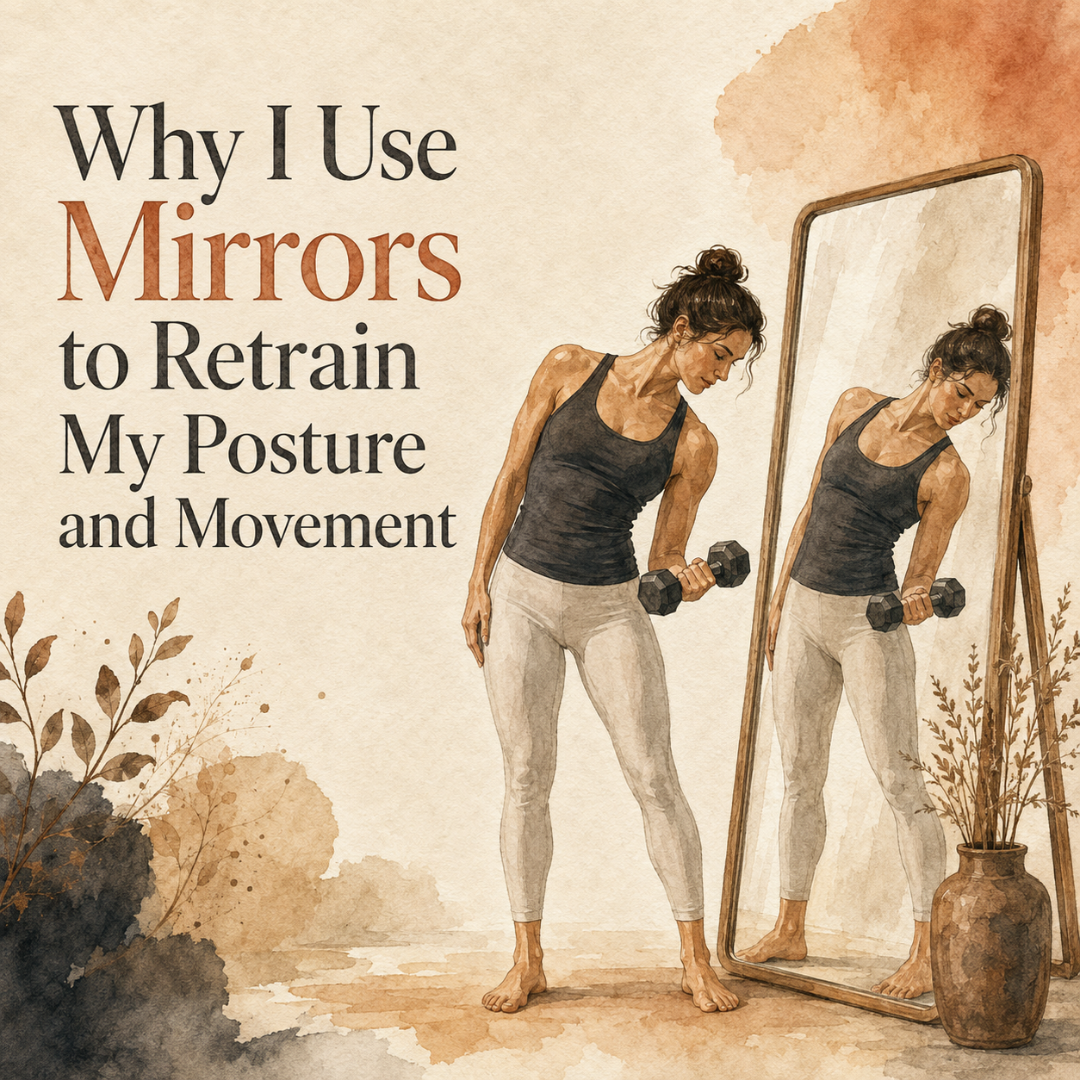
I was standing in front of the mirror doing a biceps curl when I saw something I had not been able to feel.
Without the mirror, I knew I was moving into a side bend with the curl. What I could not feel was where that curve stopped distributing through my trunk and turned into a shear.
Then I watched the repetition.
The side bend itself was intentional. In the reflection, I could see that the curve was not traveling evenly through my trunk. One area was shearing instead of sharing the bend. When I adjusted myself, I maintained the side bend while distributing the curve more smoothly, and the load traveled through me differently.
That comparison captured exactly why mirrors have become part of my movement practice.
What feels straight, centered, or evenly loaded to me is not always what I am actually doing. My internal sense of position was built through years of moving within my existing patterns. If a rotated or compressed position has become familiar, familiarity can register as “normal” even when I am visibly shifting or twisting.
The mirror gives me information I cannot reliably sense yet. Then tension and repetition help me do something with that information.
A Mirror Can Show Me What “Feel” Is Missing
The body uses proprioception to sense where it is in space. But proprioception is not a perfect camera recording the body from the inside. It is an ongoing interpretation built from signals coming from the muscles, joints, skin, vision, vestibular system, and nervous system.
My interpretation was not always accurate.
I could feel as though my pelvis was centered when it had shifted. I could think I had distributed weight evenly when one side was carrying much more. I could believe I was standing taller when I had actually created the appearance of height by extending or compressing somewhere else.
This is one reason the instruction to “just feel your body” never gave me the whole answer. Sensation matters, but I first needed a clearer reference for the position I was trying to feel.
A mirror gave me an external reference. It let me compare my intention with the visible result in real time:
Did my trunk stay organized as the weight moved?
Did I create height without thrusting my ribs forward?
Did one side collapse, shift, or rotate away from the task?
Could I maintain the shape I intended once tension increased?
I was using the mirror to correct my posture and movement. In that curl, I wanted my trunk to stay organized through the intentional side bend rather than shearing at one point as my arm moved the weight.
I Use the Mirror to Correct My Posture
Sometimes the correction really is to stand up straighter.
I may need to lift out of a collapsed area, bring my ribcage and pelvis into a cleaner relationship, distribute pressure more evenly through my feet, or hold more space through my trunk. In the beginning, that can take a lot of effort. The musculature needed to support the position may not be strong enough yet, and fascial restrictions may make the shape difficult to access or sustain.
I still train it. I use the mirror to find the posture, hold it under manageable tension, and give my body repeated experience supporting itself there. Over time, the strength and tissue capacity begin to match the position I am asking for.
The correct shape changes with the exercise. A biceps curl, split-stance press, rotation, and gait exercise place different demands on the body. During my curl, I wanted an intentional, distributed side bend without the ribs and pelvis shearing in opposite directions as my arm moved. During a rotational exercise, my pelvis and ribcage need to rotate. During a reach, my scapula and ribs need to adapt around each other.
I am correcting posture with a specific task in mind. The mirror shows me whether I am creating the shape I intend or falling back into the same shift, collapse, or shear I am trying to change.
Seeing the Position Is Only the First Step
If I use the mirror to find a better position and then immediately relax out of it, I have gathered information, but I have not given my body much experience organizing there.
I need tension to turn the visual correction into training.
Once I locate the position visually, I deliberately hold or move through it against an appropriate load. That might be a dumbbell, a band, pressure into a wall, contact with the floor, or the tension created by reaching in opposing directions.
The load makes the position consequential. My feet have to respond. My trunk has to transmit force. My breathing has to continue inside the shape. Instead of arranging myself for a photograph, I am asking my body to sustain that organization while doing work.
This is also why my posture training includes held positions. I deliberately practice standing taller and taking up more space, then hold that organization long enough for the supporting musculature to work. The effort is part of building the posture. I am not using a generic “shoulders down and back” brace. I am creating more internal space and teaching my body to produce tension without collapsing it again.
The sequence is simple:
I use visual feedback to locate the position I intend to train.
I add enough tension or load to make my body organize there.
I repeat the experience so the position becomes less foreign.
I gradually look away and practice maintaining the same organization without visual guidance.
The mirror does not perform the learning for me. It helps me make the repetitions more specific.
The Right Position Can Feel Right Before It Feels Easy
When I finally reach the position I have been trying to find, my body usually recognizes it. I feel more connected to the floor, the load travels through me more cleanly, and my brain clocks the organization as right.
The difficult part is often getting there and staying there.
A fascial restriction may keep an area compressed or make the needed shape difficult to access. The musculature may not yet have enough strength or endurance to hold the position once I add weight. I may find it for one repetition and lose it on the next.
The mirror helps me return to the same place instead of guessing. I can see when I have drifted, correct it, and spend more time building strength inside the posture. As the fascial restriction changes and the supporting musculature develops, I can access the position with less effort and maintain it for longer.
Repetition also makes the internal signals clearer. I learn how the right position feels through my feet, ribs, pelvis, breath, and the path of the load. Eventually I can reproduce that organization without needing the reflection to find it for me.
Why Visual Feedback Helps the Brain Learn
In motor learning, information added from outside the body is called augmented feedback. A mirror gives me information that my internal sense of position may not be able to provide yet. I can see the shift, compare it with what I thought I was doing, and make a more precise correction while the movement is still happening.
I repeat the corrected movement under tension while continuing to feel my feet, breath, ribs, pelvis, and the path of the load. The visual picture becomes connected to a physical experience rather than remaining an image I can only copy while I am watching.
Mirror-based rehabilitation, action observation, and motor imagery have all been studied as ways visual information can support the motor system. I use the reflection to give my brain a clearer picture of the action I am trying to produce.
After I have seen and felt the organized version enough times, I can begin recalling that picture when I look away. The difference now is that I am not asking visualization to replace movement. I am using the mirror to sharpen the movement I physically practice, then carrying that organization into the repetitions I perform without it.
The Goal Is to Look Away and Keep the Organization
The ultimate goal is to look away and keep the organization I first needed the mirror to find.
I might locate the position in the reflection, complete a few repetitions under tension, then turn my gaze and see whether I can maintain it. Looking away is both a test and part of the training. If I immediately return to the old pattern, I know I have not built enough experience in the new one yet.
Over time, I want the visual picture to become connected to an internal one. I want to recognize where my weight is, how my trunk is organizing, and whether I am maintaining space without needing to watch every repetition. I need that transfer while I am walking outside, carrying something through the house, or responding quickly in real life, when there is no mirror in front of me.
Reaching that goal does not mean I can never use a mirror again. Athletes return to video, dancers return to studio mirrors, and coaches provide external feedback when a pattern changes. Fatigue, a new exercise, or a heavier load can make the mirror useful again. I use it to recalibrate, then work toward looking away once more.
How I Use Mirrors for Precision
I decide what I want the exercise to look like before I begin. The target is specific: where I want my weight, how I want the curve to travel, how my pelvis and ribcage should relate, and what shape I need to maintain as the load moves.
Then I position the mirror, or multiple mirrors, so I can see those relationships without changing the exercise to watch myself. I use the reflection to correct the posture as precisely as I can. If the curve breaks into a shear, the pelvis drifts, the ribcage collapses, or the load changes my shape, I adjust it.
In the curl comparison, I was not trying to remove the side bend. I was making the side bend more precise. I wanted the curve to distribute through my trunk without my ribs and pelvis sliding away from each other. When I found it, I could feel the difference in my connection to the floor, my trunk, and the weight.
That level of specificity is what creates change. I do not want to repeat an approximation and hope my body eventually organizes itself. I want to find the exact position, build tension inside it, and repeat it until I can reproduce it without the mirror.
My mirror-feedback process:
Decide on the exact posture, curve, or relationship I intend to train.
Position the mirror or mirrors so I can see the relevant angles clearly.
Perform the exercise and compare the visible result with my intention.
Correct the shifts, collapses, rotations, or shearing that do not belong in the movement.
Hold or move through the corrected position under tension while continuing to breathe.
Repeat it until I can look away and maintain the same organization without live feedback.
If the exercise causes pain, dizziness, numbness, or symptoms you do not understand, stop and work with an appropriate health or movement professional.
See What Your Body Is Actually Doing
The Mirrors I Use at Home
Both mirrors are large enough to give me a clear full-body view. I can position one in front of me, move one to the side, or angle them together so I can see more than one direction without repeatedly turning my head and changing the exercise. The main difference between them is the reflective material, the weight, and how they look in the room.
71-by-40-inch rectangular rolling mirror
This mirror is made with a non-glass reflective surface. I love how lightweight it feels because I can move and angle it easily without worrying about breaking a large sheet of glass. It gives me a good full-body view and is the more practical option for frequent repositioning. The tradeoff is aesthetic: it looks more utilitarian and is not as visually pretty as the real-glass mirror.
80-by-40-inch arched rolling mirror
This is the real-glass option and the one I prefer aesthetically. The arched frame looks more finished in the room, and the large surface gives me the same clear full-body feedback. It is heavier and takes more care to move, but I would choose it when appearance matters as much as function.
Affiliate disclosure: This section contains Amazon affiliate links. If you purchase through one of my links, I may earn a small commission at no additional cost to you. These are the mirrors I use in my own home practice.
The Difference I See Now
When I return to that biceps-curl footage, the most important difference is not that one version looks prettier.
In the first version, my internal picture and the visible movement did not fully match. In the second, the mirror helped me close that gap. Then the weight asked me to hold the new organization long enough to experience it from the inside.
That is what mirrors give me: a way to see the position before I can reliably feel it, and enough clarity to begin training it until the reflection is no longer the only place I recognize it.
Start With Your Own Mirror Body Map
If the map shows you a pattern but you are not sure what it means or where to begin, a RootForce Movement Assessment gives you a coach's eye on the relationship between your posture, breathing, and movement.