I Stopped Chasing Shoulder Mobility and Learned to Control Rotation Instead
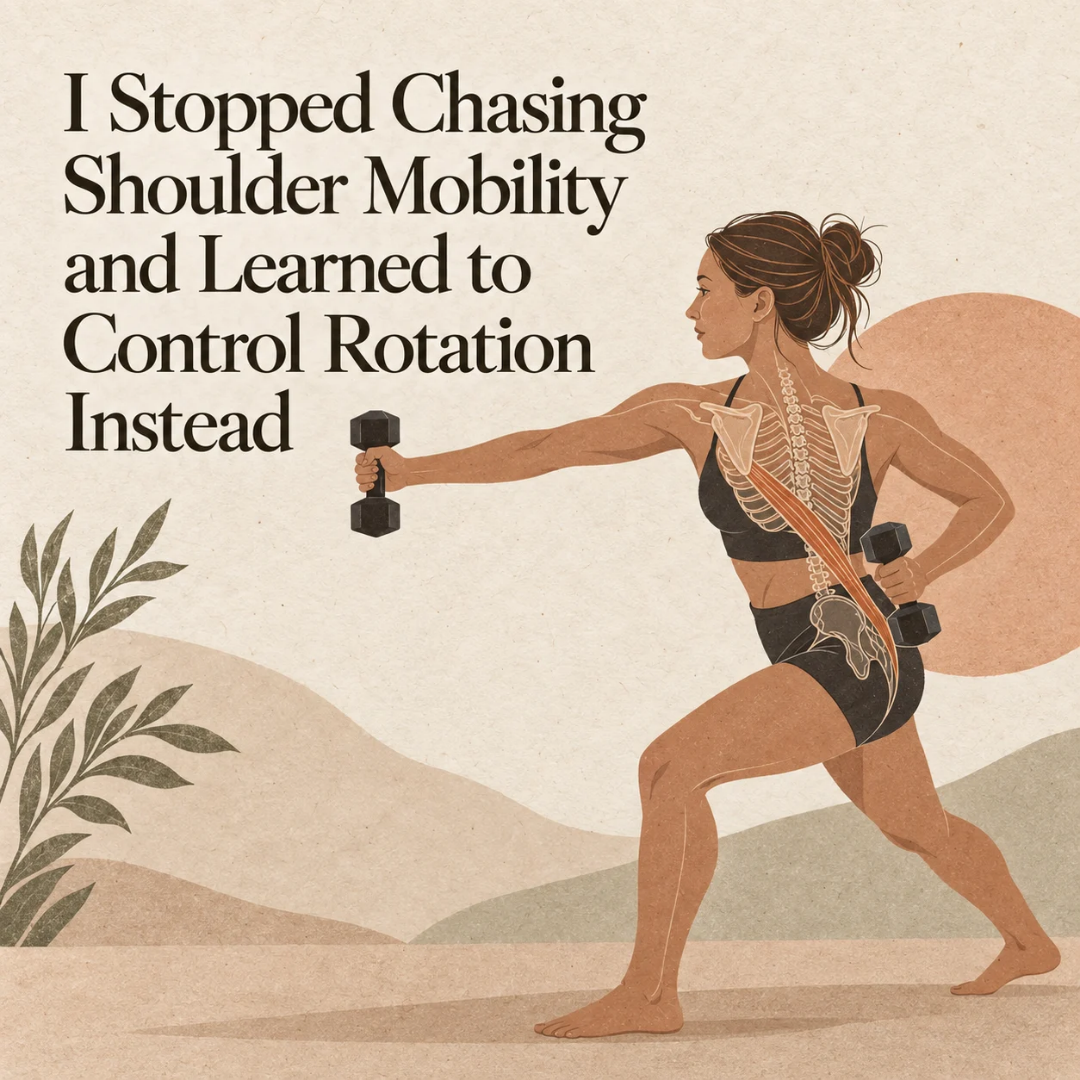
Years ago, when I was in far more pain, opening a heavy door could send my neck into a spiral. I would reach for the handle, pull with my arm and shoulder, and feel the force travel straight into my neck. There was no sense that my ribcage was supporting the movement or that my lat was connecting into the opposite glute. My whole body would likely turn with the door because I had very little ability to rotate through one area while counter-rotating through another.
At the time, I would have described the problem as shoulder or neck tension. The solution seemed to be more shoulder mobility. If I could loosen the area, stretch farther, or make the shoulder blade move more freely, I assumed opening the door would eventually feel easier.
I had misunderstood what the task required. Pulling a door is not an isolated test of how far the shoulder can move. The hand meets resistance, the arm receives that force, and the shoulder blade has to stay connected to a ribcage that is rotating over the pelvis. The trunk and legs need to help control how much of the body turns with the pull.
What I needed was rotational strength that connected my shoulder to the rest of me.
The Range Was Never the Whole Problem
I used to approach shoulder mobility as though the shoulder existed on top of the body rather than as part of it. I could move my arm through a drill and create more motion around the joint, but that did not mean I could use the range when my hand met resistance.
I do not train passive mobility now. Every movement has to connect to the rest of the chain. If I create range at the shoulder, I want to know how the scapula is responding to the ribs, how the ribs are rotating over the pelvis, and where the tension continues through my trunk and into the ground.
A shoulder can appear mobile while the ribcage underneath it contributes very little. The arm may travel, but the motion stays concentrated around the shoulder joint. Once load is added, the body has to find another way to manage force. In my old door-opening pattern, I did not have enough support beneath the arm to pull without the movement becoming painful and disorganized.
This is why I no longer judge shoulder mobility by how far my arm can be taken in isolation. I care about how much range I can control while the rest of my body participates.
My Shoulder Blades Needed a New Resting Relationship
For years, I learned to organize my shoulders by pulling my shoulder blades down and back. That gave me a clear position to hold, but it also reinforced the exact direction my scapulae already preferred. They sat retracted instead of staying available to move around the ribcage.
My shoulders now remain in a more relatively protracted position than they did before my current training. I am not trying to round forward or push the shoulder blades as far apart as possible. I am allowing the scapulae to stay wider and more connected to the back and sides of the ribs instead of pinning them toward my spine.
That position gives them somewhere to move from. As I reach, pull, press, or rotate, the scapula can follow the changing shape and orientation of the ribcage. As I return, it can retract without disappearing into the old clamping strategy.
This changed my understanding of shoulder stability. Stability does not mean that the shoulder blade stays still while the body moves around it. I experience it as a responsive relationship. The scapula remains connected while both it and the ribcage continue to adapt to the direction of the arm, the breath, and the force entering the body.
My Lats and Glutes Became Part of My Shoulder Strength
Much of my scapular connection now comes from how my lats connect to my glutes. When one lat can continue through the trunk toward the opposite glute, I have a diagonal line of tension that helps me rotate without collapsing the movement into my shoulder.
That diagonal connection is often described through the posterior oblique sling model. For me, the value of that model is practical. I can feel the difference between pulling only with my arm and creating a pull that continues from my hand into my lat, across my trunk, and into the opposite side of my pelvis.
The glute is not directly moving the shoulder blade. The connection gives my trunk a stronger way to organize and transfer the rotational force surrounding the shoulder. My scapula can stay relatively protracted and responsive on the ribs while the lat and opposite glute help control how the ribcage and pelvis rotate in relationship to one another.
This is the rotational strength I was missing when a door could pull my entire body with it. I had movement, but I did not have a strong enough counterforce. There was nothing underneath the arm that could receive the pull, distribute it diagonally, and keep one part of my body from dragging every other part in the same direction.
The Mace Shows Me Whether the Connection Is Real
I can see the new pattern most clearly in my one-handed mace work. The mace places the weight away from my hand, so its leverage changes as it travels. I cannot rely on placing my shoulder in one correct position and holding it there. I have to keep reorganizing around a moving load.
As the mace travels, my shoulder stays relatively protracted compared with the way I used to retract and pin my scapula. My shoulder blade remains connected to the ribs as the ribcage and spine rotate. My lat connects into the opposite glute, helping my pelvis and trunk create the counter-rotation that keeps the movement from becoming one large spin.
The arm is moving, but the exercise is not isolated shoulder work. My hand, scapula, ribcage, spine, abdominals, pelvis, and stance all have a role in directing the mace and controlling its return. If that chain is present, the motion looks large without becoming loose. I can rotate without losing the tension that brings me back.
This is why the mace footage tells a more complete story than a shoulder mobility drill. It shows whether the range survives leverage, resistance, rotation, and a change in direction. It also shows whether I can create motion in one region while controlling how the rest of the body responds.
My Neck Pain Was Part of a Larger Movement Problem
During the mace movement I train now, my neck is quiet because the movement has support through the ribs, trunk, lats, glutes, and ground.
The old door pattern was different. The force stayed concentrated in my arm, shoulder, and neck because I lacked the ribcage support and diagonal tension that now distribute the pull. My neck pain was part of that larger movement problem.
That distinction changes how I respond if an upper-body movement creates neck tension. I do not immediately assume the neck needs to be stretched. I look at whether my scapula has lost its relationship to the ribcage, whether I have retracted too far, whether my lat is connecting into the opposite glute, and whether my trunk can counter-rotate instead of being pulled around as one block.
When those relationships improve, the neck does not have to be the place where I feel the cost of the movement.
Control Means Being Able to Resist the Rotation Too
Rotation is not simply the ability to turn farther. I need one part of my body to move while another part manages, delays, or opposes that motion. Without that counter-rotation, the entire body can follow the force as one piece.
That is what I suspect was happening when I opened doors years ago. My hand pulled, my shoulder followed, and the rest of my body spun with the action. I could not create enough opposition through my ribcage, abdominals, pelvis, and stance to keep the pull distributed.
The mace makes that missing skill impossible to hide. The weight wants to continue traveling, especially when it changes direction. I have to decelerate it and bring it back without pinning my shoulder blade, losing my ribcage position, or letting my whole body fall into the arc.
The Same Connection Has to Carry Into Gait
I train the same relationship in movements that look more like walking and running. In this push-pull exercise, I move from a split stance into single-leg support while one arm reaches and the other pulls. The opposing arm actions give my ribcage a reason to rotate while my pelvis and stance leg organize underneath it.
The reaching scapula stays relatively protracted and connected to the ribs while the opposite side pulls back. My lats and glutes help carry the rotation diagonally across the trunk, and the transition onto one leg asks me to keep that connection as my base changes. I am not practicing a shoulder position on top of a stationary body. I am asking the shoulder to remain organized inside a gait pattern.
Opening a door asks me to pull against resistance. Pressing into the floor sends force from the hand back through the shoulder and trunk. Throwing requires force to travel through the body in sequence. Walking and running depend on the ribcage and pelvis rotating in relationship to one another while the lats and glutes help connect opposite sides.
None of those tasks is solved by an arm that can travel farther on its own. They require range that remains connected while force passes through it.
The Questions I Ask About Shoulder Mobility Now
I still use the word mobility, but I mean something more demanding by it now. I want to know whether the shoulder can move as part of a coordinated rotational system.
Can my scapula stay relatively protracted and connected to my ribs instead of retreating toward my spine?
Can I feel my lat connect through my trunk toward the opposite glute?
Can my ribcage rotate while my pelvis and abdominals create enough opposition to control the turn?
Can I reach, pull, or press without concentrating the force in my shoulder and neck?
Can I reverse the movement without losing the same relationships that brought me into it?
Those questions tell me more than the size of the shoulder range. They show me whether the movement can receive force, redirect it, and return from it without one area carrying the entire task.
I Stopped Training the Shoulder as an Island
My shoulder mobility changed when I gave the movement more places to connect.
My scapula now has a ribcage it can move with instead of being pinned behind it. My lat has an opposite glute to connect toward. My ribcage can rotate without taking my entire pelvis with it, and my pelvis can create enough counter-rotation to give the upper body something to pull against.
When I watch the one-handed mace footage, the shoulder still moves through a large arc. But the range itself is no longer the most impressive part to me. I notice the relatively protracted scapula staying connected to the rotating ribs. I notice the diagonal tension traveling toward the opposite glute. I notice that I can let the mace pull away from me without being pulled apart by it.
That is the strength I was missing at the door years ago. The difference now is not how far my arm can go. It is how much of my body comes with me without all of it being dragged in the same direction.
Keep Connecting the Pieces
If your shoulder moves well during drills but loses that freedom when you reach, pull, press, rotate, or walk, read What Makes an Exercise Transfer to Real Life? You will learn what I look for when deciding whether an exercise is building a relationship the body can use beyond the drill itself.
Ready to Work on Your Own Pattern?
If you can feel that your shoulder or neck is carrying too much but cannot see where the larger chain is losing support, this is exactly what I look for in a Movement Assessment. During our 90 minutes together, I assess how your breath, ribcage, pelvis, shoulders, and gait coordinate, then help you identify where your movement loses connection. You will leave knowing which patterns are creating extra work in your body and what to train first.
Framework note: The kinetic chain and posterior oblique sling are established movement concepts. The way I apply them to scapular position, mace training, and my history of neck pain reflects my own experience and coaching model.