Why Hypermobile Bodies Need Full-Body Loaded Tension
Some bodies are tight because they cannot access enough movement.
Other bodies are tight because they move too much without enough support.
Both bodies still need load, but the starting point may be different.
If you treat every kind of tightness the same way, you can end up stretching a body that actually needs stability.
A flexible body can still feel stiff. A hypermobile body can still feel restricted. A body with a lot of range can still feel disconnected, unstable, or guarded.
For many flexible bodies, the problem is not a lack of range.
The problem is a lack of usable control inside the range they already have.
You can fold forward, open your hips, twist deeply, or hang into your joints and still feel like your body is holding on tightly.
That does not mean you need to stretch harder.
It may mean your body needs load.
Not random load. Not heavy weight thrown on top of a disconnected system. Not pushing through instability.
The kind of load I am talking about is connected load.
Load that gives the body feedback. Load that teaches the fascia how to support. Load that helps force travel through the whole system instead of dumping into one joint. Load that gives the nervous system evidence that support exists.
One note before we go further: if you have a diagnosed hypermobility condition or significant joint instability, explore these ideas alongside a qualified professional rather than on your own. This article is education, not a treatment plan.
Flexibility Is Not the Same as Support
Flexibility is range.
Support is the ability to use that range without collapsing into it.
Those are not the same thing.
A flexible person may access positions easily, but that does not mean the body knows how to distribute force through those positions.
The joints may move, but the fascia, muscles, breath, feet, pelvis, ribs, and nervous system may not be sharing load well.
That is often where the feeling of "tight but flexible" comes from.
The body has access to motion, but it does not trust the motion.
So it grips. It guards. It creates tension to feel safe.
This is one reason flexible people can stretch constantly and still feel tight. The stretch temporarily gives sensation, space, or relief.
But if the body still does not have support, the tightness usually comes back.
What Load Gives a Flexible Body
Load gives the body information.
It tells the body where the ground is. Where the joints are. Where force is traveling. Where the ribs are collapsing. Where the pelvis is dumping. Where the knees are locking. Where the neck is doing too much. Where the body is hanging instead of organizing.
A flexible body often needs that kind of feedback.
Range alone does not teach the body how to support itself.
Stretching gives length.
Load gives the body a problem to solve.
That problem can teach support.
Loaded Tension: How Fascia Learns to Hold
Fascia is not just something to release.
It is living connective tissue that responds to pressure, movement, hydration, tension, and force. It is also one of the body's main systems for transmitting tension from one region to another.
When you load the body as a connected whole, the fascia gets different information than it does from passive stretching.
The feet press. The trunk organizes. The breath stays available. The arms and legs connect into the center. Force travels through pathways instead of dumping into one joint.
This is the idea behind loaded tension.
Instead of stretching a single tissue to make it longer, you create tension through the whole fascial system while it is under load.
Over time, the body learns something powerful:
It can support itself.
It does not have to grip a joint, lock a knee, brace a neck, or clench a jaw to feel stable.
The tension becomes distributed through the web instead of concentrated in one overworked area.
The principle is simple:
A flexible body changes when it learns how to produce support through the whole system, not when it keeps borrowing more range.
Force Travels Through Slings, Not Single Muscles
A connected body does not rely on one area to do everything.
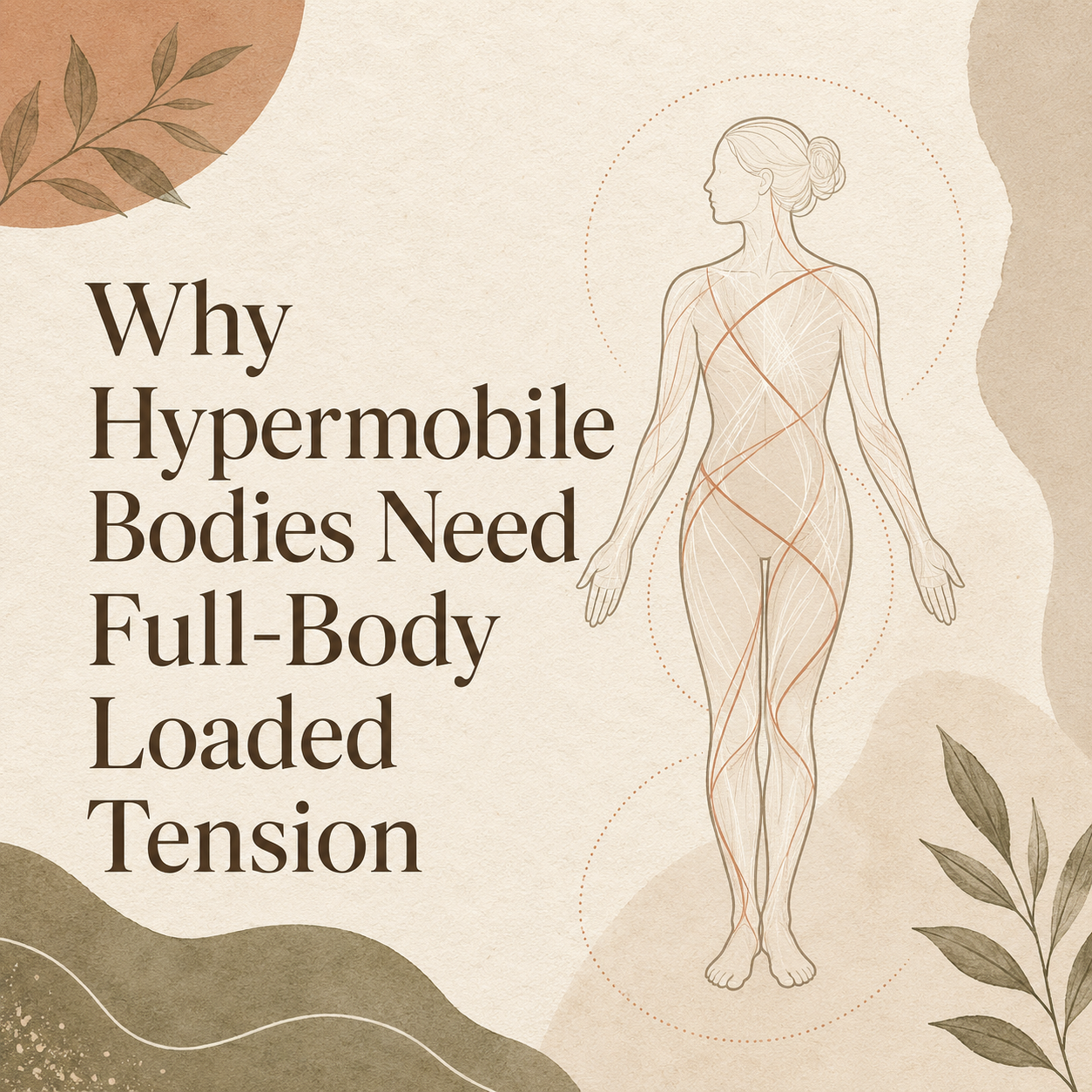
Force travels through fascial sling patterns. These are long chains of muscle and fascia that cross the body and link one region to another.
When you walk, your right glute and left lat coordinate across your back. When you rotate, your obliques and opposite inner thigh coordinate across your front. The body is built to move diagonally, spirally, and as one piece.
I wrote about these systems in more detail in my article on the oblique sling systems, and the same logic runs through the lateral line and the arm lines.
When the slings are working, force is shared.
When they are not, one area overworks while another avoids load completely.
This is common in flexible bodies:
The neck holds what the ribs are not supporting. The low back grips when the hips are not organizing. The knees lock when the feet and pelvis are not sharing load. The jaw grips when the breath and ribcage are not available.
Stretching the gripping area does not always solve the problem because the gripping area may not be the root issue.
It may be the employee doing three jobs.
Connected load gives the slings a reason to coordinate again.
Tightness Is Not Always Shortness
One of the biggest mistakes people make is assuming tightness always means something is short.
Sometimes tightness is protection. Sometimes tightness is the nervous system guarding a joint that does not feel supported. Sometimes tightness is fascia that has lost glide. Sometimes tightness is the body creating compression because it does not know how to create stability another way.
If you are flexible and always tight, the question may not be:
"What do I need to stretch?"
The better question may be:
"Where does my body not feel supported?"
That shifts the whole approach.
Instead of chasing the tight spot, you start asking why the tight spot is working so hard.
Why End Range Is Not the Same as Strength
Flexible bodies often know how to get to end range.
The knees lock back. The elbows hyperextend. The hips dump forward. The spine bends where it already knows how to bend. The shoulders hang forward. The ribs flare or collapse.
That may feel normal because it is familiar.
But familiar is not the same as functional.
The goal is not to fear your range.
The goal is to own it.
Can you enter the range slowly? Can you breathe there? Can you keep the joints from collapsing? Can you leave the range with control? Can more than one part of the body participate?
If not, the body may not need more range yet.
It may need more ownership of the range it already has.
Signs Your Body May Need Load
You may need more support, not more range, if you notice:
You stretch often, but the tightness keeps coming back. You are flexible, but still feel stiff. You feel unstable in your joints. Your knees or elbows lock back easily. You feel better with compression, pressure, or being held. Your neck or low back grips during movement. You have a lot of range, but not much control. You feel disconnected from your feet, hips, ribs, or core. You crave stretching but rarely feel stronger afterward. You feel loose in some places and compressed in others.
These are not failures.
They are clues.
Your body may not be asking for more length.
It may be asking for better support.
What Full-Body Loaded Tension Can Look Like
Load does not have to mean going to the gym and adding weight to a disconnected body.
For a hypermobile body, the right load is specific, gradual, and connected.
It is not just about making muscles stronger.
It is about teaching the whole body how to organize under tension.
That may look like holding a corrective position long enough for the body to stop escaping the pattern.
It may look like creating space in areas that are compressed while also building tension through the areas that are under-supported.
It may look like pressing the feet into the ground and learning how that pressure travels into the legs, pelvis, ribs, and arms.
It may look like connecting the arms into the ribs and back, or the legs into the pelvis, instead of letting the joints hang at end range.
It may look like working slowly enough that the nervous system has to notice where the body is compensating.
Then, once the body has a better reference point, dynamics can be added.
This is where the body starts learning whether it can keep that organization under more real demand.
A corrective can help create the position.
A long hold can help the body feel the tension.
A dynamic movement can help the system understand how to use that tension when force, timing, and momentum enter the picture.
This is an important distinction.
Dynamic work is not random movement added for intensity.
It is added after the body has started to find the pattern, so the nervous system can learn how to carry that organization into movement.
Full-body loaded tension may include:
Slow corrective positions held under tension.
Isometric holds where the whole body participates.
Ground tension through the feet.
Ribcage and pelvic organization.
Arms connecting into the back and trunk.
Legs connecting into the pelvis.
Breath that stays available while the body works.
Gait-based patterns that connect opposite sides of the body.
Rotational work that teaches force to travel instead of collapse.
Dynamic movement that tests whether the body can keep the pattern under load.
Enough tension to repattern, but not so much that the body braces.
The goal is not to load one isolated muscle.
The goal is to help the body create a connected line of tension through the whole system.
For a hypermobile body, this is important because instability often hides inside flexibility.
If the body can access range but cannot create support, it may keep gripping, collapsing, locking, or hanging into joints.
Full-body loaded tension gives the body a different option.
It teaches the system how to create support without relying on end range.
It teaches compressed areas how to open without becoming unstable.
It teaches loose areas how to participate without gripping.
It teaches the nervous system that the body can hold itself together under demand.
The point is not the exercise itself.
The point is whether the exercise helps the body organize.
A hypermobile body needs to learn how to meet force without disappearing into the joints.
That takes time, tension, breath, repetition, and eventually dynamic movement that teaches the body how to use the pattern in real life.
The Nervous System Has to Trust the Support
A flexible body will not stop guarding just because you tell it to relax.
It needs evidence.
It needs to feel that the joints are supported. It needs to feel that the breath is available. It needs to feel that force can move through more than one pathway. It needs to feel that the body can create tension without panic or collapse.
This is why slow, connected loading can be so powerful.
It gives the nervous system new information.
Not just:
"You can stretch farther."
But:
"You can hold yourself here." "You can push into the ground." "You can receive force." "You can move without falling apart." "You can create tension and still breathe."
That is the kind of information flexible bodies often need.
Work With Me
If you are flexible, hypermobile, or constantly stretching but still feel tight, your body may need a different kind of support.
At RootForce, I help clients look at how the whole body is organizing: feet, pelvis, ribcage, breath, fascia, nervous system, and movement patterns.
We work on building connected load gradually, so your body learns to support itself instead of gripping.
If stretching gives you temporary relief but never changes the pattern, this work may be a better fit.
Final Thoughts
Flexible bodies do not always need more flexibility.
They often need load.
Load gives feedback. Load builds proprioception. Load teaches fascia to support. Load helps slings share force. Load gives the nervous system evidence that support exists.
Stretching may give temporary relief, but if the body does not know how to support itself, the same tightness usually returns.
The goal is not to become rigid.
The goal is to become responsive.
A body that can create tension when needed can also soften when it is safe.
That is the difference between flexibility and true freedom of movement.
Read Next
Why Stretching Makes Tightness Worse: Understanding Fascial Release & Functional Movement
If stretching gives you temporary relief but the same tightness keeps coming back, this article explains why the body may need better movement, load, and fascial organization instead of more length.
Strong Doesn’t Always Mean Connected: 7 Signs Your Body Wants a Different Kind of Strength Training
Strength is not just about isolated muscle power. This article looks at the signs your body may need more whole-system connection, coordination, and force distribution.
360 Breathing: The Key to Optimal Pressure Management and Pain-Free Movement
Breath helps create internal pressure, support, and connection. This article explains why ribcage expansion, diaphragm movement, and pressure management matter for posture, movement, and stability.