Strong in Pieces, Disconnected as a Whole: The cross-body slings behind walking, balance, and rotation
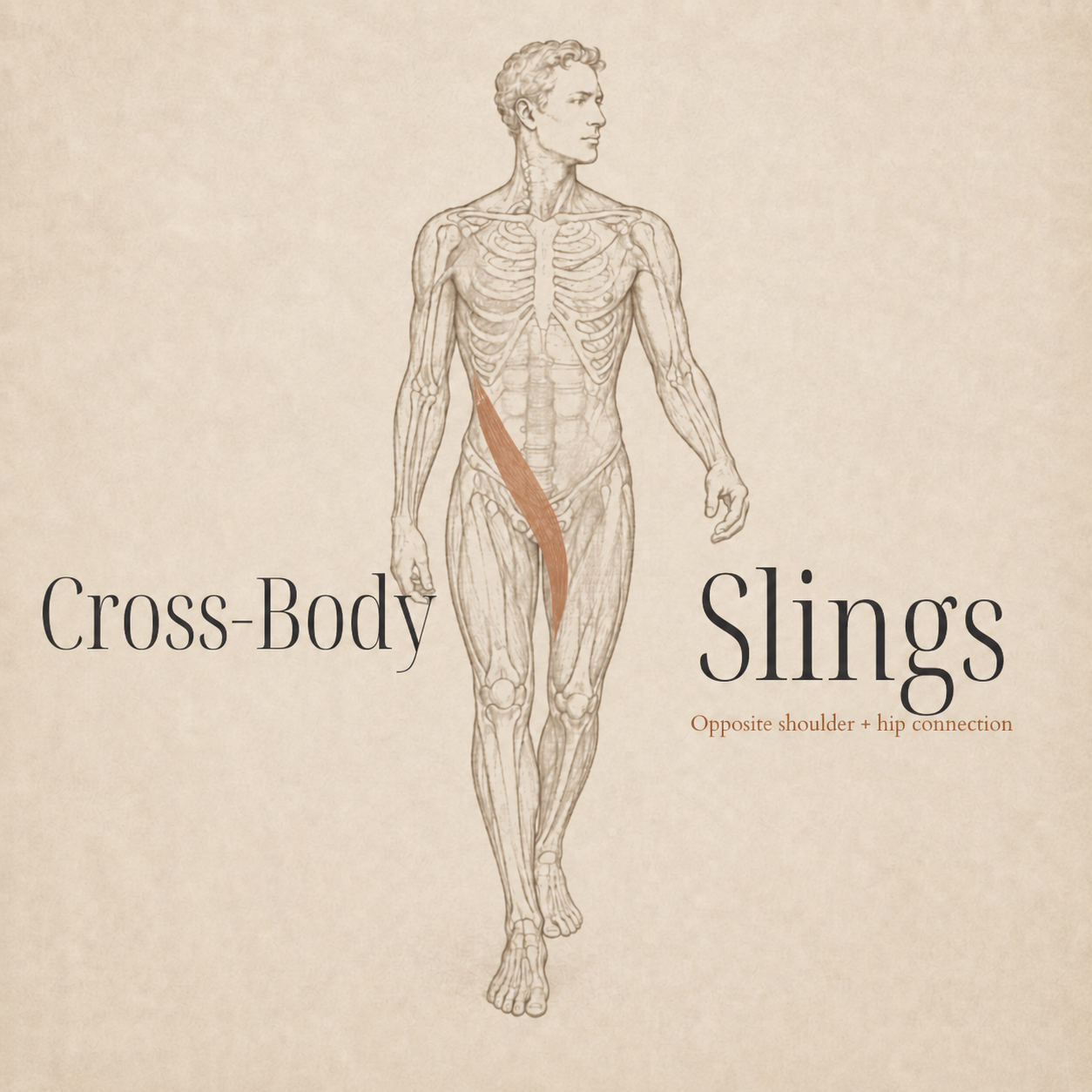
Have you ever noticed that one hip always feels tighter, one shoulder sits differently, one foot turns out, or one side of your back seems to work harder than the other?
Most people assume these are separate issues.
A tight hip.
A weak glute.
A stiff shoulder.
A cranky low back.
So they stretch what is tight, strengthen what feels weak, and work on their posture. And still, the same side grips. The same shoulder rolls forward. The same hip feels harder to access.
This is the problem with thinking about the body in pieces.
Your body is built through relationships. And one of the most important relationships in the whole system is the connection between your opposite shoulder and hip.
This is where the diagonal sling systems come in.
What Are the Oblique Slings?
The oblique slings are diagonal force-transfer pathways through the body. They help your upper body and lower body communicate when you walk, rotate, reach, balance on one leg, or transfer force through the trunk.
The two most commonly discussed are the posterior oblique sling and the anterior oblique sling.
Think of them as an X across your body. One diagonal connects through the back. The other connects through the front. Together, they help your body share load across opposite sides.
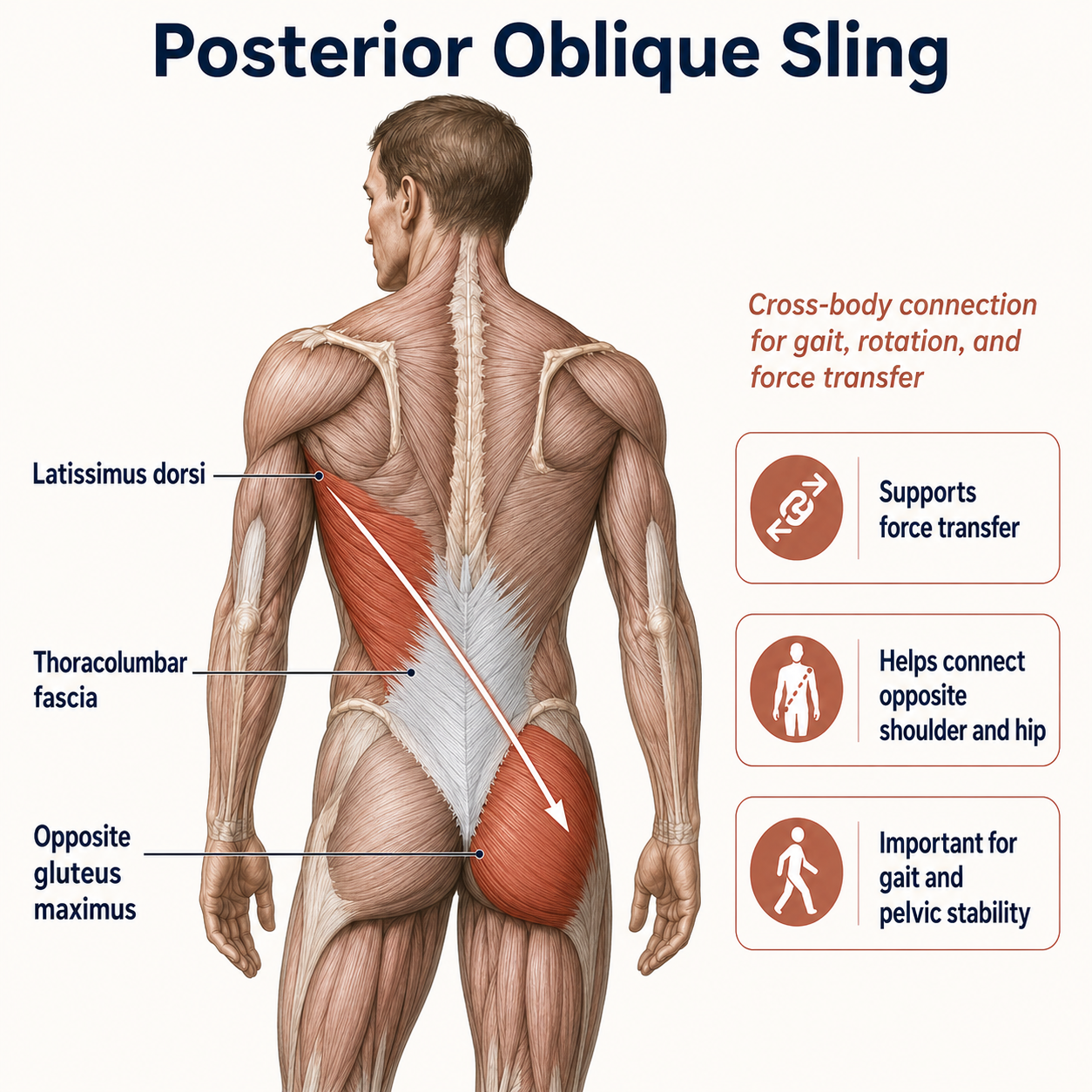
The Posterior Oblique Sling
This sling is often described as the relationship between the latissimus dorsi on one side, the thoracolumbar fascia, and the opposite gluteus maximus.
It crosses the back of the body and plays an important role in force transfer, pelvic stability, and rotational movement.
The Anterior Oblique Sling
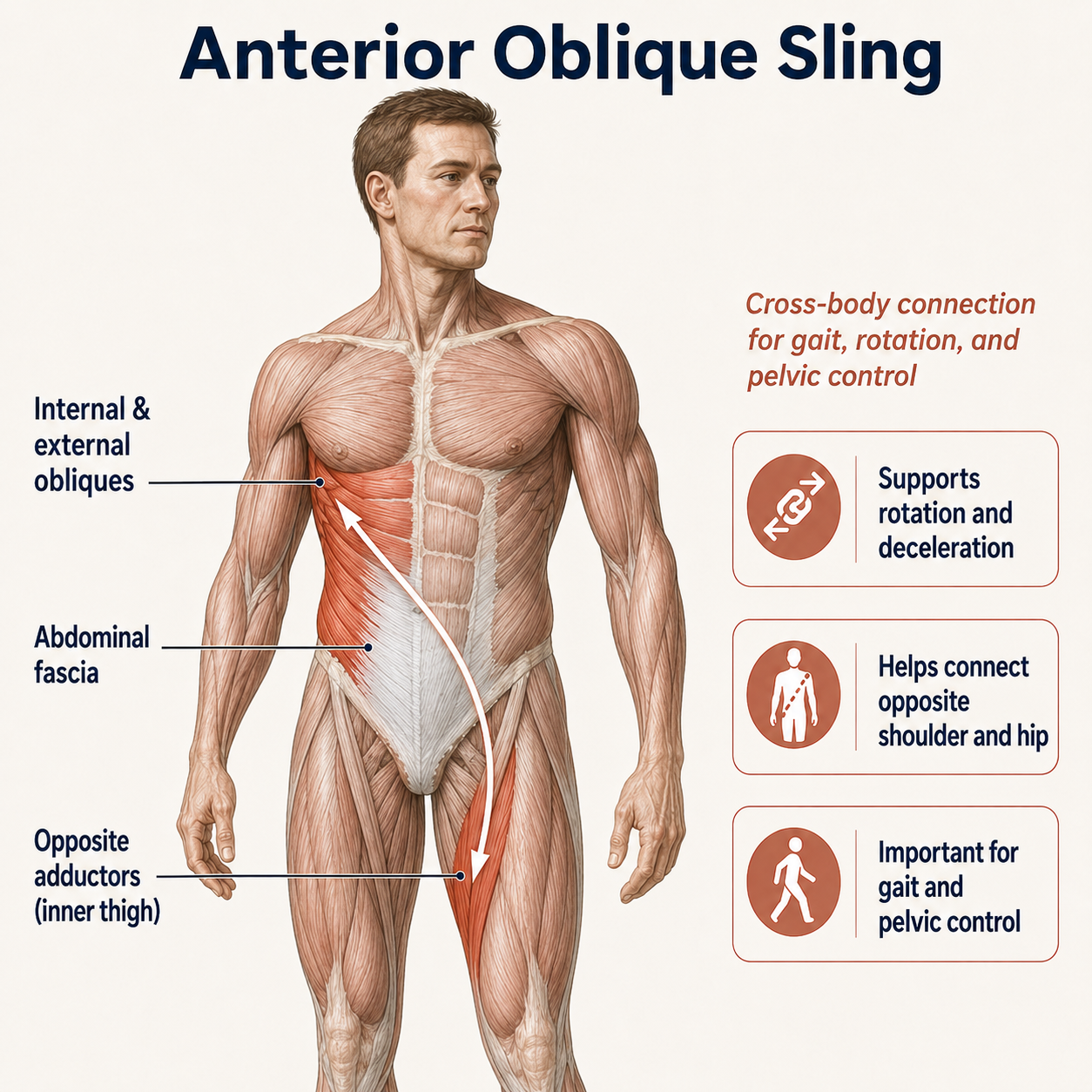
This sling is generally described as the relationship between the internal and external obliques, the abdominal fascia, and the opposite adductors, or inner thigh muscles.
It crosses the front of the body and helps with rotation, deceleration, and dynamic pelvic control.
These are not just anatomy trivia. They matter because they help explain how the body organizes walking, rotation, balance, and power at a whole-body level.
A Note on Functional Lines
If you have spent time in Anatomy Trains literature, you may have come across a related concept called the Functional Lines.
The Functional Lines describe myofascial continuities that connect the arm lines across the trunk to the opposite pelvis and leg. They become especially relevant when one limb complex is stabilized, counterbalanced, or powered by the opposite limb complex.
The Functional Lines and the oblique slings are not identical systems, but a simple way to understand the difference is this:
The Functional Lines are a myofascial map.
They show how tissue continuity connects the arm, trunk, pelvis, and opposite leg.
The oblique slings are a movement model.
They describe how the body uses diagonal relationships for gait, stability, and power.
There is meaningful overlap. Both point toward the same core truth:
Your opposite shoulder and hip are meant to work together.
How This Connects to the Spiral Line
If you read the previous article in this series on the Spiral Line, this cross-body concept may feel familiar.
The Spiral Line describes how the body wraps around itself in opposing helices, connecting the skull, shoulder, ribs, hip, leg, foot, and spine in a rotational pattern. It is a powerful map for understanding why one shoulder, one ribcage pattern, one hip, and one foot position may all be related to each other.
The oblique slings give us a slightly different lens.
The Spiral Line shows how the body wraps.
The oblique slings show how that wrapping becomes movement.
Every step you take is a rotational event.
Your right arm swings with your left leg. Your left arm swings with your right leg. Your pelvis and ribcage counter-rotate. Your body transfers force from the ground, through the hip, across the trunk, and into the opposite shoulder.
That is the cross-body system doing its job.
The Posterior Oblique Sling in Movement
The lat is usually thought of as a shoulder and back muscle. The glute is usually thought of as a hip muscle.
But through the thoracolumbar fascia, these two areas have an important cross-body relationship.
This is one reason arm swing matters when you walk.
Your arms are not casually swinging at your sides. They help counterbalance the pelvis, organize rotation, and support force transfer through the trunk.
From a movement perspective, this is why the posterior oblique sling is often discussed in relation to gait, rotation, hip extension, pelvic control, and the relationship between the shoulder and opposite hip.
When this sling is sharing load well, you may feel connected through the back of the shoulder, the opposite glute, the back/outer hip, and the foot pushing into the ground.
When it is not sharing load well, common patterns can include:
One glute that feels hard to access or load
The low back gripping during hip extension
One shoulder or lat that feels chronically tight
Walking that feels uneven or effortful on one side
Difficulty rotating in one direction
Tension or instability around the SI joint
These patterns do not automatically mean your posterior oblique sling is “the problem.” But they can be clues that your body may not be transferring force cleanly from one side to the other.
Sometimes the area that feels tight is not the whole story. It may be working overtime to create stability because the diagonal system is not sharing load well.
The Anterior Oblique Sling in Movement
Where the posterior sling is associated with back-body power and force transfer, the anterior sling is more associated with front-body control.
When this sling is working well, the front ribs, abdominal wall, pelvis, and inner thigh can connect without excessive bracing or gripping. The body can rotate and decelerate cleanly.
When it is not sharing load well, common patterns can include:
The belly falling forward even under low load
The hip flexors or inner thighs gripping to compensate
The ribs flaring or twisting unevenly
The low back taking over during core work
Rotation that feels stuck or unstable on one side
Core exercises that do not transfer into better movement
Again, these signs are not a diagnosis. They are patterns to notice.
This is where many people get stuck. They strengthen their abs. They stretch their hips. They work on their posture. But the body still does not feel integrated because it has not learned to transfer force diagonally.
Your Core Is Not Something to Tighten
This is worth noting.
Your core is not just something to tighten.
Your core is a transfer system.
The question is not only whether a muscle is strong. The better question is whether it can participate in the pattern it was built for.
Can your lat connect to your opposite hip?
Can your inner thigh connect to your opposite obliques?
Can your ribs rotate without collapsing?
Can your pelvis move without your low back gripping?
Can your foot receive the ground and send that force up through the body?
This is a very different conversation than stretching what is tight or strengthening what is weak.
You can have strong glutes and still not load your hips well when you walk. You can have strong abs and still brace your ribcage on every step. You can have strong shoulders and still feel like your arms hang off your body rather than participate in movement.
The body does not just need strength.
It needs relationship.
Why Gait Reveals Everything
Walking looks simple because we do it every day. But gait is one of the most complex and revealing expressions of whole-body coordination.
Every step requires one foot to receive the ground, one hip to load, the pelvis to rotate, the ribcage to counter-rotate, the opposite arm to swing, the trunk to transmit force, and the body to balance on one leg while the nervous system times all of it.
If the body cannot transfer force from one side to the other, walking will still happen. But certain areas may compensate.
The low back becomes the stabilizer.
The neck braces.
The hip flexors grip.
The foot turns out.
The shoulder hangs instead of participates.
The ribs stay compressed or flared.
The glutes go quiet.
The body always finds a way to move.
The question is whether the load is being shared well.
Signs Your Cross-Body Slings May Not Be Sharing Load Well
You do not need to memorize anatomy to notice when your diagonal systems are not coordinating.
Common signs include:
One side consistently feels tighter than the other
One hip feels harder to access or load
One shoulder rolls forward or feels disconnected from movement
One foot turns out more than the other
Your neck or jaw tightens when you move your arms
Your low back grips when you try to use your glutes
You feel unstable on one leg
Your stride feels uneven
You rotate easily one direction but not the other
Your inner thighs grip during core work
Your arm swing feels stiff or absent
Your body feels strong in parts but disconnected as a whole
These are patterns worth paying attention to.
A tight area may need more than stretching. A weak area may need more than strengthening. Often, the missing piece is the relationship between the two sides of the body.
What Helps Reconnect the Slings?
Reconnecting the diagonal systems is not about isolating one muscle chain or forcing more range of motion.
It is about helping the body organize itself as a whole.
This is where many people get stuck. They work on the parts, but the parts never learn how to communicate inside a full-body pattern.
They activate a glute.
They strengthen an adductor.
They train their abs.
They work on shoulder stability.
They practice breathing drills.
They stretch what feels tight.
None of those things are wrong. Sometimes the body does need focused attention in one area. But the goal is not to keep the body in pieces.
The goal is to use those pieces inside a connected system.
For the oblique slings to become useful in real life, the body has to learn how to receive load, transfer it through the trunk, and express it through the opposite side.
That means the foot, hip, pelvis, ribcage, spine, shoulder, and arm all need to participate in the same conversation.
This is why loading the whole chain matters.
Load gives the body information. It gives the nervous system something to organize around. When the load is placed well, the body does not have to guess which muscle to use. The whole system starts to respond.
The foot has to receive the ground.
The hip has to load.
The pelvis has to organize.
The ribcage has to respond.
The trunk has to transfer force.
The opposite shoulder and arm have to participate.
This is very different from simply trying to “turn on” one muscle.
The sling does not only need activation.
It needs timing, load, and integration.
A body that can breathe well but never learns to load the chain may still feel unstable when movement becomes more demanding. A body that is strong in isolated pieces but cannot transfer force diagonally may still compensate through the low back, neck, hip flexors, or shoulders.
This is also why 360 breathing can be such an important starting point.
Breath and ribcage mechanics help create access to the center of the body. If the ribcage is compressed, the pelvis cannot respond well, and pressure is not managed well, the body often finds stability by gripping somewhere else.
But breathing is not the whole solution.
Breath creates access.
Load teaches the body how to use that access.
The same is true for the feet, arms, hips, and core. You can focus on them individually when needed, but they are not meant to stay separate. They are meant to be reintegrated into walking, rotation, balance, reaching, and strength.
That is when the sling becomes functional.
Not when one muscle turns on.
When the whole chain starts to share load.
If your ribcage and breath mechanics feel like the place your body loses access to the chain, my 360 Breathing course is a good place to start. It is not meant to keep you in breathwork forever. It is meant to help your body create enough space and pressure control that better movement can become available.
The Bigger Point
This is the final article in this fascial chains series, which has been largely informed by the Anatomy Trains fascial lines, and here is what I want you to take with you:
Your body is not a collection of separate parts.
The back body affects the front.
The side body affects the breath.
The arm lines affect the neck and ribcage.
The Spiral Line shapes how the body wraps and rotates.
The Functional Lines and oblique slings reveal how your opposite shoulder and hip are meant to work together.
This is why chasing one tight spot rarely creates lasting change.
The body may need release. But it also needs coordination.
It may need strength. But it also needs timing.
The goal is not to fix every symptom in isolation.
The goal is to help the body share load again.
Where to Start
And if you want help seeing how these patterns show up in your own posture, gait, breathing mechanics, and movement, the next step is the RootForce Fit Form.
A movement assessment can help you understand where your body is compensating, how your ribcage, pelvis, feet, and arms are working together, and what kind of support would help you move forward.
Your body is not meant to move in pieces.
It is meant to move as a connected system.
And when your opposite shoulder and hip can finally find each other again, walking, balance, rotation, and strength all have a better foundation to build from.