I Had the Neurological Cues, But My Body Couldn’t Use Them Yet
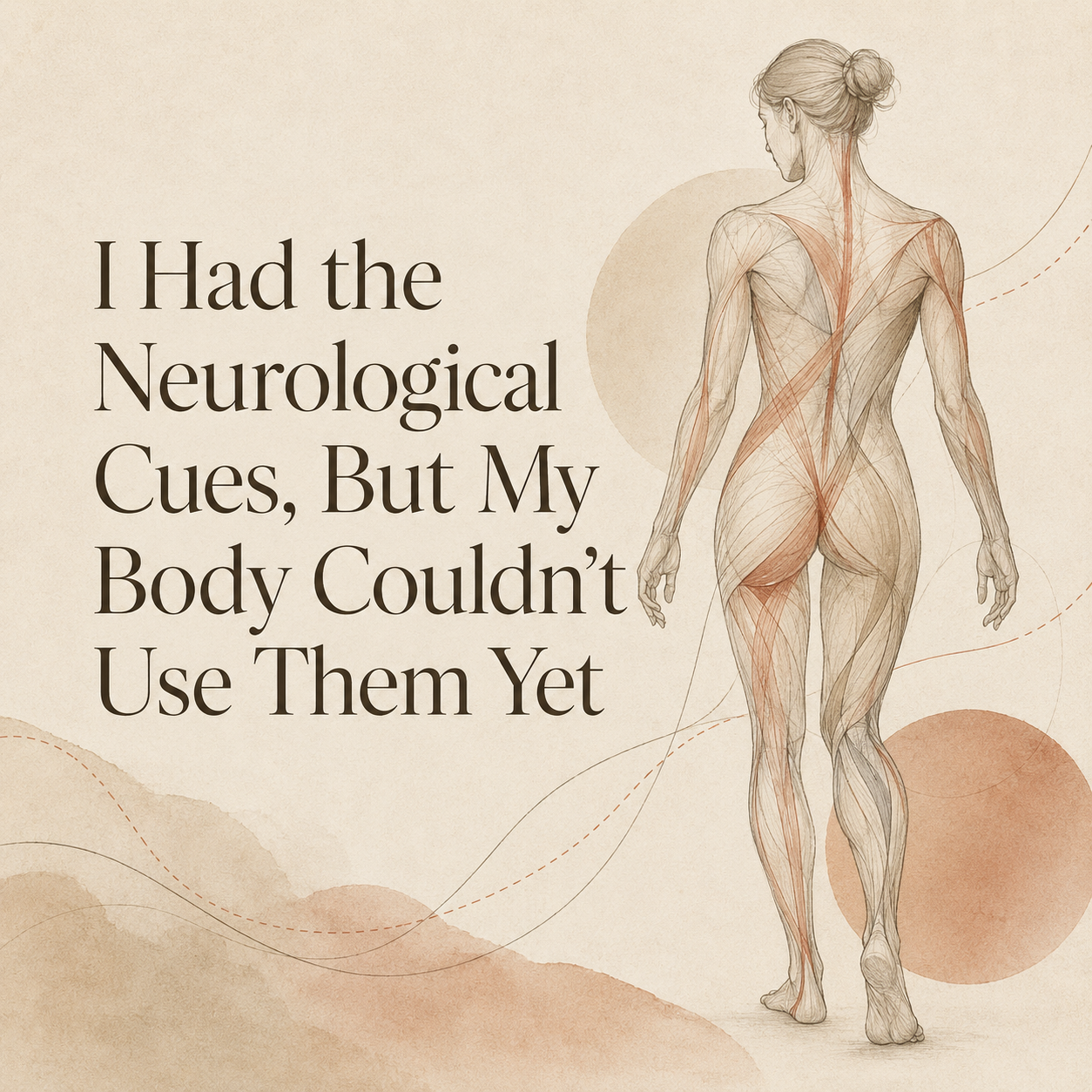
How fascial decompression, sling integration, and full-body loading helped me finally understand the postural reference points I had been chasing for years.
For years, I studied the body through a neurological lens.
I trained through a well-known postural restoration framework that taught me to understand the body through asymmetry, respiratory mechanics, neurological positioning, and patterned compensation.
The idea was not that the body was random.
The body had a pattern.
The organs, diaphragm, ribcage, pelvis, spine, hips, shoulders, feet, breath, and gait all related to one another.
That framework helped me finally feel like someone understood my body.
It taught me to stop seeing every symptom as a separate problem. It helped me understand that compensation is not always chaotic. One strategy can build on top of another, and what looks like a shoulder issue, hip issue, rib issue, or foot issue may actually be part of a much larger pattern.
That gave me language for things I had been experiencing for years but could not explain.
Instead of chasing every symptom on its own, I started asking better questions.
Why does one hip feel tighter?
Why does one shoulder sit differently?
Why does one foot sense the ground more clearly?
Why does one side of my ribcage expand differently?
Why does my neck or jaw take over when I am trying to breathe or stabilize?
I still believe those are important questions.
And for a long time, the answer seemed to come through specific reference points.
If I could feel the right reference point at the right time, then maybe my nervous system would finally understand how to reorganize.
That was the promise I kept chasing.
The body was patterned, and the reference points were supposed to help me find my way out of that pattern with more awareness and control.
But here is where I got stuck.
The cues were not wrong. They were pointing toward the deeper “why” behind the pattern.
But my body could not receive them yet.
I practiced the reference points faithfully.
Feel your left heel.
Find your left hamstring.
Find your left adductor.
Sense your left oblique.
Engage the right tricep.
Find the right low trap.
Stack the ribs.
Shift the pelvis.
Exhale fully.
Inhale into the back.
On paper, the theory felt sound.
In my body, something was missing.
I could understand what I was supposed to feel. I could sometimes feel it for a breath or two, most likely with other areas gripping to compensate. But the moment I stood up, walked, loaded, or moved through real life, it was gone.
For a long time, I thought I just was not doing it well enough.
Maybe I needed better awareness.
Maybe I needed a longer exhale.
Maybe I needed a stronger focus.
Maybe I needed to try harder.
But looking back, I do not think the issue was effort.
I think my body was too compressed to receive the information.
When the pattern becomes the lens
One of the most valuable things I learned was that the body is asymmetrical and patterned.
The body is not random.
Compensation is not random.
Position matters.
Breath matters.
Gait matters.
The way the pelvis, ribcage, feet, shoulders, and spine relate to one another matters.
That was extremely helpful for me.
It gave me a framework when my body had felt confusing for years.
But eventually, I also had to let the idea of one universal underlying pattern soften.
I had been taught to look for one primary pattern, with compensations layered on top of it. And for a while, that made sense. It helped me see relationships I had never seen before.
But over time, I started to realize that if I was already looking for one specific pattern, I could usually find evidence of it.
The positioning tests I learned can be useful. They can show rib orientation, pelvic position, foot contact, shoulder mechanics, and asymmetrical bias. They can give important information about how someone is organizing in a specific moment.
But tests can also carry the bias of the person administering them.
If the model assumes the pattern before the assessment begins, it can become easy to interpret the body through that lens.
And over time, that became limiting.
Because the body in front of me may not be asking to be fit into a model. It may be asking to be observed more honestly.
What has become more reliable for me is watching what happens when the body moves through space under load and gravity.
Where does it compress?
Where does it brace?
Where does it collapse?
Where does force stop transferring?
Where do the lines of tension travel when the person reaches, rotates, steps, absorbs, or produces force?
That is where the body tells a fuller truth.
A static test may give useful information, but movement under load shows me how the system is actually organizing.
When the body cannot access the cue
A cue assumes the body has enough sensory availability to respond.
When someone says “feel your left heel,” there is an assumption that your nervous system can find that area, differentiate it, and integrate it into the whole.
But what happens when the fascia is restricted?
What happens when the ribcage cannot expand?
What happens when the pelvis cannot shift without gripping?
What happens when the neck and jaw are constantly trying to stabilize a system that has no other options?
In that state, a cue becomes another thing to chase.
You may understand it intellectually. You may feel it for a moment. But it does not become usable because the body cannot organize around it.
That was my experience.
I had studied the pattern.
I had practiced the drills.
I could talk about the theory.
But my body still could not fully own the change.
It was like being given a map when the roads were closed.
The piece I had not accounted for: compression
My body had spent years finding ways to hold itself together.
It was not simply tight.
It was organized around protection, bracing, and compensation.
Compression through my fascia.
Compression through my ribcage.
Compression through my pelvis.
Compression through my spine.
Compression through my shoulders, neck, and jaw.
So when I was asked to feel specific reference points, my tissues did not have enough space, my joints did not have enough options, and my nervous system did not have enough clear feedback from the whole body to make those references meaningful.
It is one thing to say, “Find your left heel.”
It is another thing for the body to actually have a clear pathway from the left heel into the hamstring, adductor, pelvis, ribcage, obliques, spine, and opposite shoulder.
It is one thing to say, “Find your oblique.”
It is another thing for that oblique to become part of rotation, pressure management, gait, and force transfer instead of another gripping point I was trying to force.
That is what began to shift when I started focusing on fascial decompression and full-body loading.
Decompression gave me more to feel
When I talk about fascial decompression, I am not talking about randomly stretching everything or chasing softness for the sake of it.
I am talking about creating enough space for tissue to glide, expand, contract, load, and communicate again.
And that space did not come from becoming loose or passive. It came from creating more balanced tension through the whole system.
The more my tissues could expand and create responsive tension, the more my nervous system had to reference.
I could feel my feet differently.
My ribs differently.
My pelvis differently.
I could feel how one side of my body related to the other.
I could feel where I was collapsing, gripping, compressing, or skipping over entire areas.
The reference points started to feel less forced.
My left heel was no longer just a heel. It became part of a chain.
My adductor was no longer something I was trying to isolate and feel. It became part of how my pelvis, ribcage, and opposite shoulder could organize.
My oblique was no longer something I was trying to grip. It became part of rotation, breath, and gait.
But decompression alone was not the whole answer.
Loading taught my body how to use the access it had gained
This was the piece I had been missing for years.
I had spent so much time trying to find positions and reference points. But my body did not fully understand those changes until I started loading the entire system.
Instead of trying to activate one muscle, hold one position, or feel one side in isolation, I had to learn how to move force through my whole body.
That meant loading my feet into the ground.
Letting my hips organize through rotation.
Allowing my ribcage to experience both expansion and compression.
Connecting my arms into my trunk.
Training my spine through flexion, extension, and rotation.
And using the fascial slings that connect opposite sides of the body.
The body is not meant to organize itself only on the floor in a controlled setup.
Eventually, it has to manage force.
It has to walk.
Reach.
Rotate.
Push.
Pull.
Decelerate.
Absorb.
Produce.
When I started training the slings, something shifted.
Instead of gripping one reference point and hoping the rest of my body followed, I started to feel force move through larger relationships.
My foot related to my pelvis.
My pelvis related to my ribs.
My ribs related to my shoulder.
My shoulder related to my opposite hip.
My breath related to my spine.
My spine related to my gait.
The work felt less like finding one correct muscle and more like helping the whole chain communicate.
Less gripping.
More transmission.
That created a completely different sense of energy efficiency.
It is not that the neurological framework never accounted for connection. In many ways, connection was the whole point.
But in my body, reference points often became gripping points.
I was trying to make my nervous system understand connection through isolated points of awareness.
The theory was about relationship, but my body was experiencing it as effort.
Sling training felt different because it asked the whole system to participate.
When a sling started working, it did not feel like I was holding myself in a better position. It felt like the load was being shared.
That is when the reference points finally started to make sense in a lived, embodied way.
Not because I abandoned neurology, but because my nervous system finally had a moving, loaded, connected body to reference.
The reference points gave me information.
The slings helped me use it.
Want to start rebuilding access from the inside out?
For me, breath was not just about calming down or relaxing.
It was one of the first ways I began creating more internal space, better pressure management, and clearer sensory feedback through my ribcage, pelvis, spine, and trunk.
That is why I created 360 Breathing.
This course teaches you how to expand your ribcage in more directions, manage pressure more efficiently, and create a foundation for movement that does not rely on constant gripping or bracing.
I also had to change my relationship with extension
Another major shift was realizing that I had learned to fear certain positions.
For years, I had learned to see extension as something to avoid or correct.
And I understand why.
A compressed body can absolutely use extension as a compensation. It can arch through the low back, flare the ribs, grip the neck, and bypass true support.
But eventually, I realized my body did not need less movement.
It needed better movement.
It needed access to extension through the whole chain, not just compression through my low back, ribs, or neck.
It needed extension that was supported by my feet, pelvis, ribs, spine, arms, and breath.
It needed to load the front and back chains of fascia in a way that helped them become more responsive.
That was a turning point.
I had to enter ranges I had been avoiding.
I had to load postures I had learned were “bad.”
I had to teach my body that extension could be organized, connected, and powerful.
My body did not just need to be pulled out of a pattern.
It needed to learn how to move through bigger ranges with more support.
The body in front of me matters more than the model
This changed how I train and how I see other bodies.
I still value assessment.
I still think positioning matters.
I still think asymmetry matters.
I still think postural, sensory, and neurological reference points can be useful.
But I no longer want to force every body into one explanation.
A model can give me a starting point, but it cannot replace observing the person in front of me.
How does this person stand?
How do they breathe?
How do they load their feet?
What happens to their ribs when they reach?
What happens to their pelvis when they step?
What happens to their neck when they rotate?
What happens when gravity and load are added?
Where is the body compressed?
Where is the tissue overstretched?
Where is the body protecting?
Where is force moving?
Where is force getting stuck?
This has been especially important because sometimes the area that looks overstretched is not the true source of the issue.
Sometimes it is being pulled on by areas of compression somewhere else in the system.
A body may look like it needs strengthening in one place, but the deeper issue may be that another part of the chain cannot expand, rotate, absorb, or transfer force.
That is why watching the body move under load has become so important to me.
Load reveals strategy.
Gravity reveals compensation.
Movement reveals the real-time negotiation between tension, compression, protection, and possibility.
That is the information I could not get from chasing reference points alone.
Signs your body may need more than another cue
You may relate to this if:
You understand the cue, but cannot feel the area.
You can feel the right muscle for one breath, then immediately lose it.
You do an exercise correctly on the floor, but the pattern disappears when you stand up.
You keep being told to relax, but your body keeps bracing.
You feel better after release work, but the tension keeps coming back.
One side of your body is harder to access, but nothing seems to make it integrate.
You keep chasing your glutes, hamstrings, adductors, obliques, lats, traps, or abs as isolated pieces.
You have body awareness, but not body organization.
This does not mean the cues are wrong.
It may mean your body needs a different entry point.
Sometimes the nervous system needs more information from the tissues before it can create a new strategy.
Sometimes the tissue system needs enough space and feedback before muscles can respond well.
Sometimes the slings need to load before the brain can trust the new pattern.
What finally changed for me
I stopped trying to force my body to understand isolated instructions.
I also stopped trying to correct my body toward the pattern I intellectually knew.
Instead, I started observing what was actually happening.
Even when it contradicted what I thought I understood.
Instead of asking, “Am I in the right position?” I started asking different questions.
Where do I truly see compensation?
Where does my body compress?
Where does it brace?
Where does it collapse?
Where can tissue create space?
Where can it stretch and recoil?
Where is there elasticity?
Where does my body feel stuck, flat, or unable to respond?
Can my feet receive load?
Can one side of my body communicate with the other?
Can I take this reference point into movement?
Can this new strategy survive gravity?
The work became less about finding one perfect position and more about building a body that could adapt.
A body that could feel.
A body that could expand.
A body that could recoil.
A body that could load.
A body that could transfer force.
A body that could move through space without constantly bracing to survive it.
The cue was not wrong. My body needed more.
The cue was not wrong.
My body needed more.
More space.
More load.
More sensory feedback.
More whole-chain connection.
More fascia that could respond instead of protect.
More movement that linked the parts together instead of asking one area to magically wake up on command.
That is why fascial decompression and sling training became such a missing link for me.
They helped me access the reference points I had been chasing for years, not by thinking harder, but by giving my nervous system a clearer body map.
And once my body had that map, the cues started to land differently.
Less intellectual.
Less forced.
Less frustrating.
More embodied.
More connected.
More real.
Need help applying this to your own body?
If you feel like you understand the concepts but still cannot get your body to change, you may need more than another cue or generic exercise.
Inside RootForce coaching, we look at how your body is actually organizing under breath, gravity, load, and movement.
The goal is not to force your body into one perfect position.
The goal is to help your whole system create more space, transfer force more efficiently, and move with less compensation.