When most people hear “lymphatic system,” they think of detox.
Dry brushing. Drainage massage. A facial roller. Puffiness around the jaw. Swollen nodes when you are sick.
And those things are real. But they are pointing at something much bigger.
Your lymphatic system is one of the body’s primary systems for fluid balance, immune defense, tissue cleanup, and inflammation regulation. It helps protect you from infection, maintain healthy fluid balance, and clear waste, immune debris, excess proteins, and inflammatory byproducts from the places they accumulate.
When lymph flow becomes sluggish, restricted, or overwhelmed, the body starts to show it.
Not always dramatically.
Sometimes it feels like heaviness. Puffiness. Fatigue. Stiffness. Brain fog. Tender tissue. A low hum of inflammation that never quite resolves.
This is not because lymph is the only cause of disease.
It is because lymph is one of the systems responsible for helping the body complete the very processes that, when prolonged, can become disease-producing.
Lymph Is Not Just a Detox Pathway
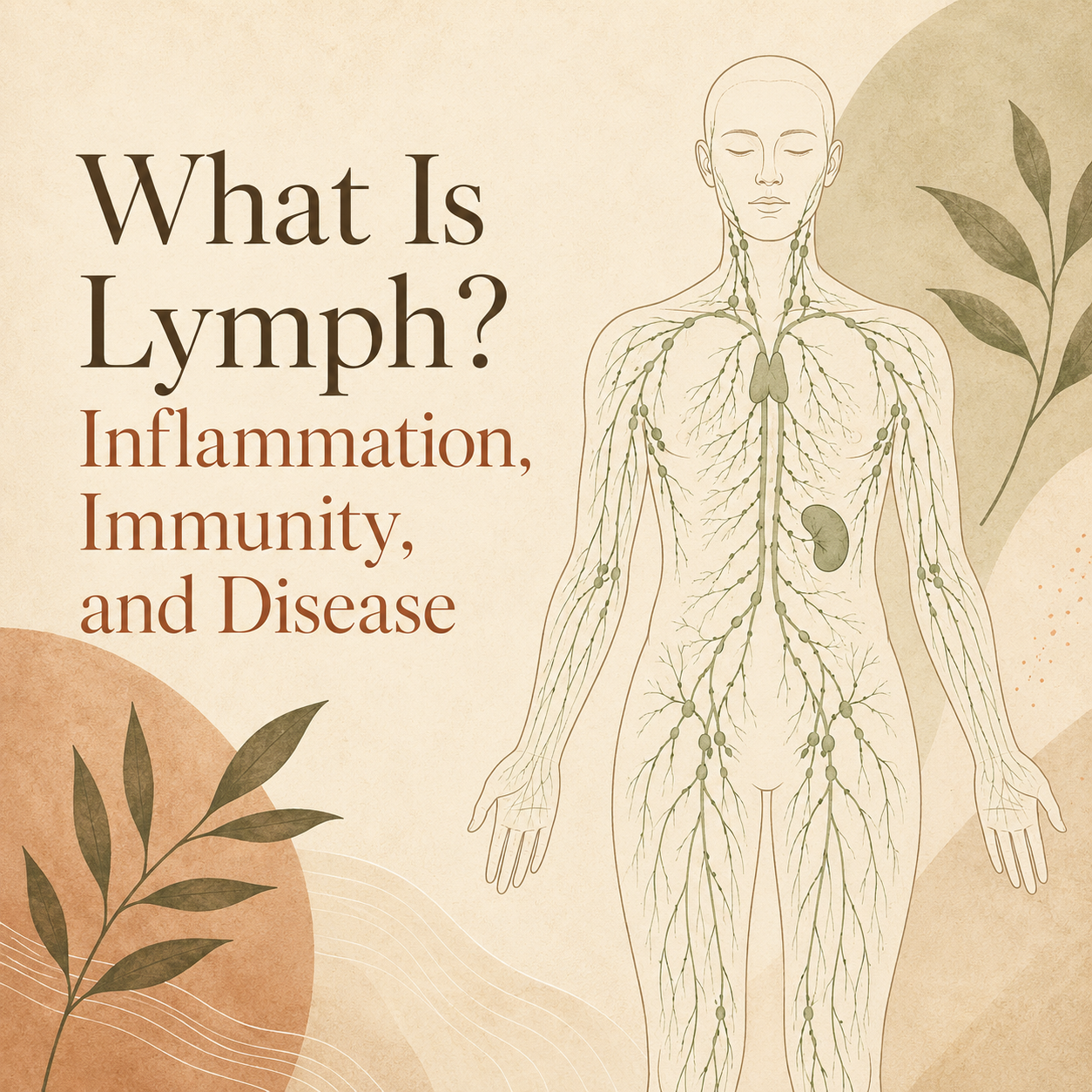
Lymph is a clear fluid that moves through a network of vessels, nodes, ducts, and lymphatic organs throughout the body.
But before it becomes lymph, it starts as fluid in the spaces around your cells.
Your blood vessels deliver oxygen, nutrients, and immune cells into your tissues. Some of that fluid leaves the bloodstream and enters the surrounding tissue space. This is normal. Your cells need fluid exchange to receive nutrients, communicate, and clear waste.
Most of that fluid returns to the bloodstream.
But some remains behind.
That remaining fluid can contain excess water, proteins, cellular waste, immune cells, inflammatory chemicals, damaged cell material, and anything else the body needs to monitor, filter, or clear.
Once that fluid enters the lymphatic vessels, it becomes lymph.
From there, lymph travels through lymphatic vessels and passes through lymph nodes, where the immune system can assess what is moving through the body.
This is one reason your lymph nodes may swell when you are fighting an infection. Your lymphatic system and immune system are not separate. The lymphatic system is one of the primary ways your immune system communicates, filters, responds, and protects.
So when we talk about lymph, we are not just talking about puffiness.
We are talking about whether your body can clean up after stress, injury, infection, inflammation, and daily cellular activity.
The Path of Lymph Through the Body
The lymphatic system is often described as a drainage system, but it is more intelligent than that.
It is a one-way transport system that helps move fluid from the tissues back toward the bloodstream.
The general process looks like this:
Fluid leaves the blood vessels and enters the tissue space.
Cells receive nutrients, oxygen, and immune support.
Waste, proteins, excess fluid, and immune debris collect in the tissue space.
Lymphatic capillaries absorb that excess fluid.
The fluid becomes lymph.
Lymph moves through larger lymphatic vessels.
Lymph passes through lymph nodes for immune filtering and surveillance.
Cleaned lymph eventually returns to the bloodstream near the collarbone.
This means lymph is not just waste.
It is information.
It carries signs of what is happening in your tissues. Infection. Injury. Inflammation. Cellular stress. Immune activity. Fluid overload. Tissue congestion.
Your lymph nodes act like checkpoints along the way.
They filter lymph, monitor for pathogens, activate immune responses when needed, and help the body decide what kind of protection is required.
This is why lymph matters so much for immune health.
Your immune system cannot respond well if it cannot receive information from the tissues. And your tissues cannot fully recover if the byproducts of immune activity do not have a clear path out.
Inflammation Is Not the Problem
Inflammation is not bad.
Inflammation is protection.
When you cut your skin, twist your ankle, breathe in something irritating, fight an infection, eat something your body reacts to, or experience tissue damage, inflammation is part of your body’s response.
The body sends immune cells, fluid, and chemical messengers to the area. Blood flow shifts. Tissue may swell. Pain may increase. Movement may become guarded.
This is not a mistake.
Your body is protecting you.
The problem is not inflammation itself.
The problem is inflammation that does not resolve.
A healthy inflammatory response is supposed to rise, do its job, and come back down.
The body senses a threat.
It responds.
It protects.
It clears.
It repairs.
It returns to baseline.
But when the stressor keeps coming, or the cleanup process cannot keep up, the body can remain in a prolonged inflammatory state.
That is where protection can start to become disease.
When Protection Becomes Disease
Disease is rarely caused by one single thing.
It is usually the result of many inputs over time: stress, sleep disruption, poor movement, environmental irritants, infection, injury, processed foods, blood sugar instability, emotional strain, tissue compression, poor circulation, nutrient depletion, and more.
But many chronic disease processes have one thing in common:
The body stays inflamed for too long.
Chronic inflammation is different from the short-term inflammation that helps you heal a cut or recover from an injury. It is a prolonged immune state where inflammatory signals continue over time. When inflammation persists, it can contribute to tissue damage and disease processes throughout the body.
This is where lymph becomes important.
Inflammation creates fluid.
It creates immune debris.
It creates cellular waste.
It creates damaged tissue byproducts.
It creates material that needs to be cleared, filtered, and moved.
If the lymphatic system is overwhelmed, restricted, or under-supported, the body may have a harder time completing the cleanup phase of inflammation.
That does not mean lymph is the only cause of disease.
It means poor lymph flow can contribute to the internal environment where inflammation lingers, tissues stay congested, and the body struggles to return to ease.
Dis-Ease Before the Diagnosis
I use the word dis-ease deliberately.
It describes what many people feel before they ever receive a diagnosis.
The body does not feel at ease.
It feels swollen.
Stiff.
Tired.
Reactive.
Heavy.
Foggy.
Tender.
Puffy.
Compressed.
Hard to move through.
This does not always mean something serious is wrong.
But it often means the body is struggling to return to baseline.
There is a difference between a body that is temporarily inflamed because it is healing and a body that is living in a constant state of low-grade irritation, stagnation, and immune activation.
That is the terrain where many people start to feel stuck.
Not sick enough to have clear answers.
Not well enough to feel vibrant.
Just inflamed enough to feel like their body is always working harder than it should.
This is why I do not see lymph support as a vanity practice.
Less puffiness can be a visible sign, but it is not the whole point.
The deeper goal is helping the body complete the cycle of protection, cleanup, and repair.
How Lymph Helps Inflammation Resolve
During inflammation, more fluid moves into the tissues.
That fluid contains immune cells, signaling molecules, proteins, damaged cellular material, and inflammatory debris.
All of it needs somewhere to go.
Your lymphatic system acts like a drainage, filtering, and communication network. It collects excess fluid from the tissues, transports immune cells, carries inflammatory materials toward lymph nodes, and helps the immune system decide what needs to happen next. Lymphatic vessels are now understood as active participants in immune regulation and inflammation, not simply passive drainage tubes.
This matters because healing is not just about what enters the body.
It is also about whether the body can clear, process, filter, and move through what has already happened.
If lymph cannot move well, fluid can stagnate.
If fluid stagnates, tissues can become congested.
If tissues are congested, pressure can increase.
If pressure increases, movement may feel harder.
If movement feels harder, the body may guard.
And when the body guards, circulation and lymph flow can become even more restricted.
This is one reason people can feel inflamed, swollen, stiff, and uncomfortable long after the original stressor has passed.
The body may still be trying to protect.
But it has not completed the cleanup.
The Loop That Keeps People Stuck
One of the things I see again and again is people who feel like their body is working against them.
But often, the body is still trying to protect them.
Swelling protects.
Tension stabilizes.
Fatigue forces rest.
Pain changes behavior.
Inflammation defends against injury or infection.
These are intelligent responses.
But when they become chronic, the same protective mechanisms can start to compound.
Inflammation creates fluid.
Fluid needs drainage.
Poor drainage creates congestion.
Congestion creates pressure.
Pressure creates pain or stiffness.
Pain creates guarding.
Guarding creates compression.
Compression makes fluid movement harder.
This is the cycle that makes people feel stuck.
Not because the body is random.
Because the body has not been given the conditions it needs to fully resolve.
Where Fascia Fits In
Fascia still matters here, but it is not the whole story.
Lymph does not move through empty space. It moves through your tissues. That means tissue quality, pressure, compression, movement, and hydration can influence how freely fluid moves.
When inflammation is active, more fluid moves into the tissues as part of the body’s repair and protection process. But if that fluid does not clear well, the tissue environment can start to feel stagnant.
This is where fascia can begin to feel different.
Instead of feeling elastic, hydrated, and responsive, the tissue may feel dense, sticky, swollen, dry, or hard to move through. It is not necessarily that fascia is “dry” in a simple water-in/water-out way. It is that inflammation, congestion, poor movement, and restricted fluid exchange can change the quality of the tissue.
Fascia needs fluid exchange.
Lymph needs movement and open pathways.
The body needs both to clear inflammatory load and return to baseline.
You can read more about the fascia side of this in The Fascia–Lymph Connection: Why Tight Tissue Blocks Drainage, Detox & Natural Glow
What Slows Lymph Down?
The lymphatic system does not have a central pump like the heart.
It relies on your body’s movement, muscle contraction, breathing mechanics, pressure changes, and the natural contraction of lymphatic vessels to help move fluid. Movement and muscle contraction are commonly described as key supports for lymph flow.
This is why lymph can become sluggish when the body is not moving well.
Common things that can slow lymph flow or increase lymphatic burden include:
Long periods of sitting
Shallow breathing
Chronic stress
Poor sleep
Tight or restrictive clothing
Lack of walking
Dehydration or low mineral intake
Inflammatory foods or alcohol
Environmental irritants
Injury or surgery
Chronic infection or immune stress
Poor tissue mobility
Emotional stress and nervous system guarding
None of these happen in isolation.
The body is always responding to the total load.
If the inflammatory load is high and lymph flow is low, the body may feel congested, reactive, swollen, and tired.
If shallow breathing is one of the patterns you notice in your own body, you may also like my article on 360 Breathing and how better ribcage expansion can support pressure management, movement, and fluid flow.
What Supporting Lymph Actually Means
Detox is a real process the body is doing all the time. The liver, kidneys, lymphatic system, digestive system, skin, lungs, and immune system are constantly helping the body process, filter, clear, and eliminate what it no longer needs.
But we also live in a world where the body is exposed to more stressors than ever.
Environmental toxins. Processed foods. Chronic stress. Poor sleep. Sedentary lifestyles. Artificial light. Emotional strain. Medications. Alcohol. Mold. Chemicals. Inflammatory inputs. Overstimulation.
The body has natural detox pathways, but those pathways can become overburdened.
That is why I believe there can be a place for periods of more deliberate detox support, especially when the body feels congested, sluggish, inflamed, or unable to clear well.
But detox should not be about punishing the body, forcing extreme elimination, or trying to drain yourself into health.
It should be about supporting the systems that already know how to clear.
And the lymphatic system is one of those systems.
Supporting lymph means giving the body the inputs it needs to move fluid, clear waste, regulate immune activity, and return to ease.
That looks like:
Better breathing mechanics.
More daily movement.
Walking.
Hydration and minerals.
Gentle self-massage and fascial work.
Less restrictive clothing.
Better sleep.
Sunlight.
Grounding.
Whole-body strength.
Nervous system regulation.
Regular elimination.
None of these are magic.
They are conditions.
They give the body more opportunity to move out of stagnation and back toward flow.
There may be times when deeper detox support is appropriate, but daily lymph support is the foundation. If fluid is not moving, if the body is braced, if sleep is poor, if elimination is slow, if breath is shallow, or if tissues are compressed, detox can feel harder on the body.
A single drainage massage, detox protocol, or lymphatic tool may be helpful.
But the foundation is what you do consistently.
Daily movement, breathing, hydration, minerals, sleep, tissue support, and regular elimination help the body keep moving fluid and clearing waste over time.
When You Need More Than a Few Random Lymph Tips
Some people feel better quickly when they start walking more, breathing better, hydrating, and adding gentle lymph support.
Others feel like their body has been stuck for a long time.
If you have been dealing with chronic puffiness, stiffness, inflammation, sluggishness, or a body that always seems to return to the same stuck pattern, you may need more than a few scattered tips.
You may need a structured way to support the system.
That is why I created the 28-Day Lymph Reset.
This course is designed to help you build a daily rhythm around lymph support through breath, movement, self-massage, and simple body awareness practices. Instead of trying to force detox, the goal is to help your body create better conditions for flow over time.
Why This Matters Long-Term
Disease is never caused by one thing.
That is important to hold.
But chronic inflammation is widely recognized as a major contributing factor in many disease processes. When the immune response stays activated over months and years, it can damage tissues and organs in ways that accumulate quietly.
This is why lymph matters beyond the wellness conversation.
If inflammation is part of how the body protects you, lymph is part of how the body cleans up afterward.
Without cleanup, protection can become congestion.
Without resolution, inflammation can become chronic.
Without movement, tissues can become stagnant.
Without enough recovery, the body struggles to return to ease.
That is why I keep coming back to this system.
Not because it is trending.
Because lymph sits at the intersection of fluid, immunity, inflammation, waste clearance, detoxification, and the body’s ability to heal.
The Body Knows How to Flow
The body is always responding.
To stress.
To sleep.
To movement.
To breath.
To inflammation.
To the environment around it.
When those inputs create more burden than the body can clear, the system adapts. Sometimes that adaptation looks like swelling, stiffness, fatigue, tenderness, puffiness, or a body that feels like it cannot fully return to ease.
This is why lymph matters.
It is part of how the body clears what it no longer needs, communicates with the immune system, and completes the cycle of repair.
Protect.
Clear.
Detoxify.
Repair.
Return to flow.
Supporting lymph is not about vanity.
It is about helping the body move through what it has been carrying.
If you are ready to begin with something simple, start with my free Morning Lymph Routine linked above.
If your body needs more individualized support, you can also explore working with me through a movement assessment and online coaching.