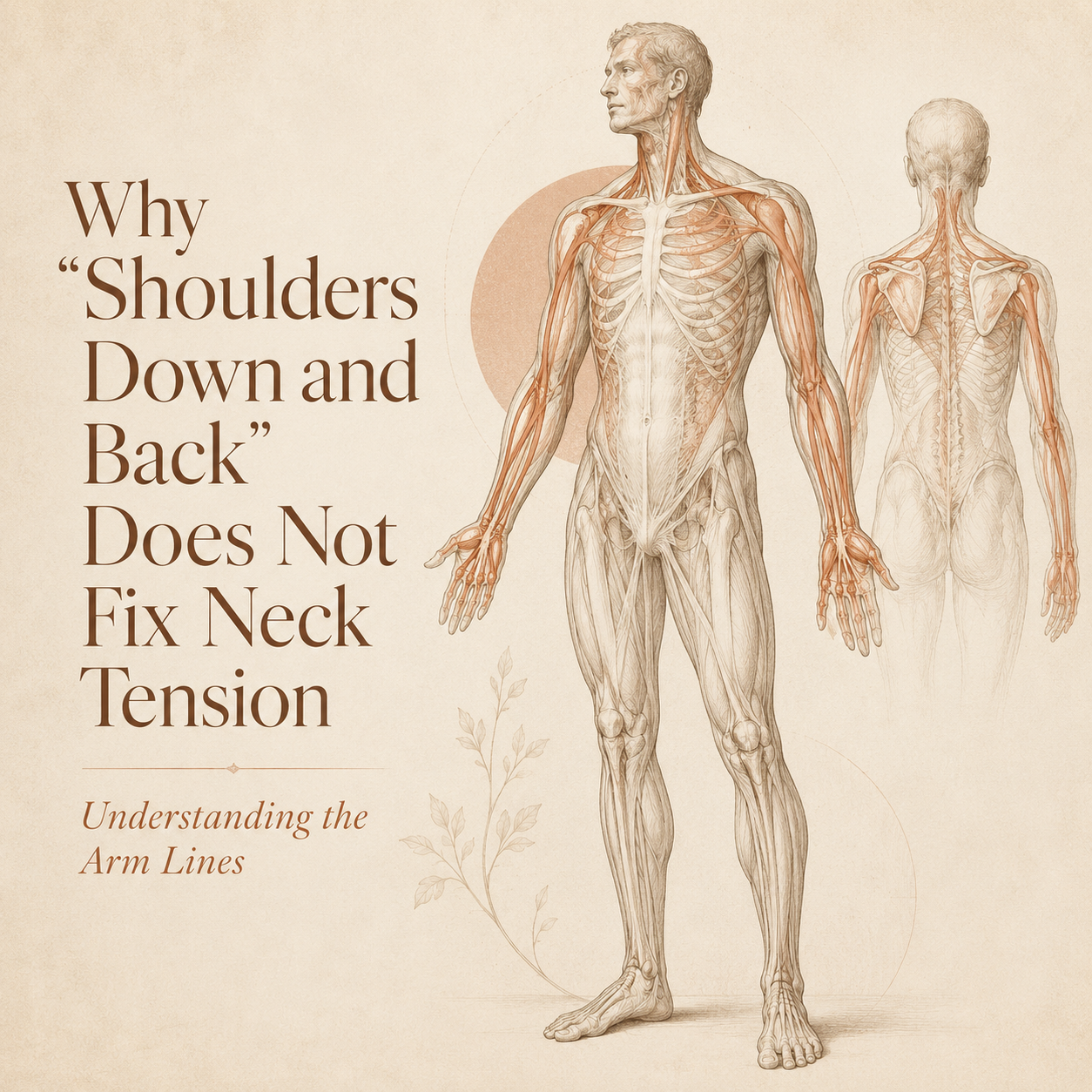
For years, I thought better posture meant pulling my shoulders down and back.
It made sense on the surface.
If my shoulders were rounded, I should pull them back.
If my upper traps were tight, I should pull my shoulders down.
If my neck felt tense, I should stop letting my shoulders live near my ears.
But the longer I have worked with my own body, and the more I have worked with clients, the more I have realized that this cue can be incomplete.
It is not that “shoulders down and back” is always wrong.
Sometimes it can help someone become aware that they are living in a shrugged, collapsed, or forward-rounded position. But if the arms are not integrated into the body, if the ribcage is compressed, and if the upper thoracic spine cannot extend, pulling the shoulders down and back may create more tension instead of more support.
The body may look more upright from the outside.
But internally, it may still be bracing.
The neck may still be gripping.
The ribs may still be flaring.
The upper back may still feel compressed.
The shoulder blades may feel pinned instead of supported.
The arms may still feel like they are hanging off the body.
That is where the arm lines become important.
Understanding the arm lines changed the way I think about neck tension, shoulder posture, upper back support, and the cue “shoulders down and back.”
Because your shoulders are not separate from your arms.
Your arms are not separate from your ribcage.
And your ribcage is not separate from your spine.
What Are the Arm Lines?
The arm lines are part of the Anatomy Trains model of myofascial meridians. They describe fascial and muscular connections that travel from the axial skeleton, through the shoulder, and into the arm and hand.
In simpler terms, the arm lines help explain why the hand, wrist, elbow, shoulder, chest, neck, and upper back are not separate conversations.
They are connected.
This does not mean every neck issue is “because of” the arm lines. It means the arms are part of the support system for the upper body. If that system is not working well, the neck and upper traps may start doing more than they are meant to do.
The arm lines include:
Superficial Front Arm Line: This line relates to the front of the chest, biceps, forearm flexors, and palm side of the hand.
Deep Front Arm Line: This line connects deeper structures of the chest, shoulder, arm, thumb side of the hand, and front body support.
Superficial Back Arm Line: This line relates to the upper back, shoulder, triceps, forearm extensors, and back of the hand.
Deep Back Arm Line: This line connects deeper posterior shoulder structures into the arm and little-finger side of the hand.
You do not need to memorize those names to benefit from the concept.
The main point is this:
Your arms are layered into your torso.
They do not simply hang from your shoulders.
Why the Cue “Shoulders Down and Back” Can Backfire
The problem with “shoulders down and back” is that it often starts at the wrong place.
It tries to change the shoulder position, but the real issue may be the system underneath the shoulder.
The cue assumes the shoulder blades can simply be moved into a better position by force. But the shoulder blades sit on the ribcage. If the ribcage is collapsed, compressed, flared, or unable to expand, the scapula does not have a good surface to move on.
So when someone pulls their shoulders down and back without changing the ribcage or thoracic spine underneath, they may simply create a new compensation.
They may pinch the shoulder blades together.
They may shove the shoulders down.
They may arch the low back.
They may lift the chest without actually opening the upper back.
They may grip the neck harder while trying to look relaxed.
They may create a posture that looks “better,” but feels rigid.
That is not true support.
That is a held position.
And held positions usually do not solve chronic tension because the body still has not learned how to distribute load differently.
The Arms Cannot Integrate Into a Compressed Thorax
This is the missing piece.
If your upper thoracic spine is compressed, your arms do not have a spacious place to connect.
The thorax includes the ribcage, thoracic spine, sternum, and the tissues that help the upper body expand, rotate, breathe, and support the shoulder girdle.
When the thorax is compressed, the arms often start to feel like they are hanging off the front of the body.
The shoulders may round forward.
The upper traps may stay overactive.
The neck may feel like it has to hold the arms up.
The chest may feel tight.
The upper back may feel flat, rigid, or stuck.
That is why the issue is rarely just “bad posture.”
It is often a lack of mobility, expansion, and support through the upper thorax.
So before the shoulders can find a better position, the thorax needs space.
The ribs need to expand.
The upper back needs to open.
The arms need to connect into the body instead of being pulled into position from the outside.
Why I Sometimes Teach People to Bring Their Shoulders Up
This is also why I sometimes teach people to bring their shoulders up before asking them to bring anything “down and back.”
At first, that can sound confusing.
Most people with neck tension have been told their shoulders are too high. So why would I ask someone to bring their shoulders up?
Because I am not teaching them to shrug into their neck.
I am teaching them to create space.
This is not a universal cue for everyone, and it is not about forcing the shoulders higher. It is a way to help someone feel space when their shoulder girdle is already locked down on a compressed thorax.
When the upper thorax is compressed, the shoulder blades may already be sitting on a ribcage that does not have much room to move. If someone immediately tries to pull the shoulders down and back from that position, they often just squeeze the shoulder blades together and mistake that sensation for thoracic extension.
But squeezing the shoulder blades is not the same thing as extending through the thoracic spine.
True thoracic extension requires space through the ribcage, upper back, and spine. It should feel like the upper body is opening from the inside, not like the shoulder blades are being pinned together from the outside.
Bringing the shoulders up can help someone feel where the compression is.
It can create a little more room in the thorax.
It can help the ribs and upper back expand.
It can give the shoulder blades a chance to move instead of staying locked down.
From there, the person can begin to find extension through the thoracic spine instead of forcing the shoulders into a posture.
This is the difference between creating space and holding shape.
The goal is not to keep the shoulders lifted.
The goal is to use that lift to help the body find room, breath, and connection. Then, once the thorax has more space, the shoulder blades can begin to find a better posterior scoop around the ribcage.
Not jammed down.
Not squeezed back.
Not hanging forward.
Integrated.
Scapular Scoop Is Different Than Pinning the Shoulder Blades
Once there is more space through the thorax, the shoulder blades have a better chance of finding what I think of as a scapular scoop.
When I say scapular scoop, I am talking about the shoulder blades finding a supported, slightly wrapping relationship around the ribcage instead of being squeezed together or shoved down.
This is not the same as “shoulders down and back.”
It is not a rigid posture.
It is not a forced depression of the shoulder blades.
It is not trying to make the upper traps disappear.
A better scapular scoop feels like the shoulder blades can glide, wrap, and organize around the ribs.
There is width through the upper back.
There is space in the neck.
There is a sense that the arms connect into the back of the body instead of dragging down on the neck and compressing the spine.
This is where training the arm lines becomes so valuable because the goal is not just strength. It is connection, coordination, and support.
Once the thorax has more space, the arms can begin to integrate into the upper body instead of hanging from it. The hands, arms, shoulder blades, ribs, spine, and core can start working as one connected system.
That is what creates full-body support.
Not just shoulder positioning.
Not just upper back squeezing.
Not just trying harder to stand up straight.
A better scapular scoop comes from connection.
Why This Has Been One of the Hardest Lines for Me to Integrate
Out of all the fascial lines I have worked with, the arm lines have been some of the hardest for me to integrate.
They were not as obvious as feeling my feet connect to the ground.
They were not as easy to sense as noticing my breath move into my ribs.
They were more subtle.
For a long time, when I used my arms, my neck wanted to help.
If I reached, my shoulders would creep up.
If I pushed, my upper traps would brace.
If I pulled, I would feel my neck and jaw take over.
If I tried to “fix” it by pulling my shoulders down and back, I could make the shape look better, but I did not actually feel more supported.
It felt like another layer of control.
The shift came when I stopped trying to place my shoulders into position and started learning how to connect my arms into my body.
I had to create more space through my thorax.
I had to feel my ribs expand.
I had to find more upper back support.
I had to let my shoulder blades relate to my ribcage instead of pinning them in place.
That changed everything.
My arms started to feel less like they were hanging from my neck.
My neck felt less responsible.
My upper back felt more available.
My shoulders felt more connected to my ribs.
And my hands started to feel like they belonged to my whole body.
Why Neck Tension Is Not Always a Neck Problem
When people have chronic neck tension, it is tempting to focus only on the neck.
Stretch the neck.
Massage the traps.
Release the jaw.
Strengthen the deep neck flexors.
Those things may help, but they may not address the full pattern.
Sometimes the neck is tense because it is compensating for a lack of support somewhere else.
The arms may not be connected.
The shoulder blades may not be supported by the ribcage.
The upper thoracic spine may not be extending well.
The breath may not be expanding into the back and side ribs.
The hands may be gripping because force is not traveling through the whole chain.
That nuance matters.
The scapula is not always “the cause.”
But it is often part of the conversation.
And if the arm lines, scapula, ribcage, and thoracic spine are not working together, the neck may keep stepping in to stabilize the system.
Signs Your Arm Lines May Not Be Integrating Well
You may need better arm-line integration if you notice:
Your shoulders lift toward your ears when you use your arms, but it feels like neck gripping instead of spacious support
Your neck tightens when you push, pull, lift, carry, or reach
Your upper traps feel like they are doing the job of your whole upper body
Your shoulder blades feel pinned, winged, or unstable on your ribcage
You squeeze your shoulder blades together to “stand taller,” but your upper back still feels compressed
Your ribs flare when you try to bring your shoulders back
Your jaw clenches when your arms are working hard
Your arms feel strong, but your neck still feels strained
You can hold “good posture,” but it feels rigid instead of supported
These patterns do not always mean something is wrong with the arm itself.
Sometimes they mean the arm is not being supported by the rest of the body.
The Role of Fascia in Feeling Support
Fascia is not just passive tissue wrapping the muscles.
It helps connect, support, and transmit information through the body.
That matters because arm-line integration is not just a mechanical idea.
It is sensory.
Your body has to feel where the arms are in space.
It has to feel how the hands connect into the shoulders.
It has to feel how the shoulder blades relate to the ribs.
It has to feel how the ribs expand under the shoulder blades.
It has to feel how the neck can soften because the rest of the system is participating.
You cannot force that with one cue.
You have to build it.
What to Do Instead of Forcing “Shoulders Down and Back”
Instead of starting with “pull your shoulders down and back,” I prefer to ask better questions.
Can the hands connect into the arms?
Can the arms connect into the shoulder blades?
Can the shoulder blades connect into the ribcage?
Can the ribcage expand?
Can the upper thoracic spine find extension?
Can the neck stay spacious while the arms work?
Can the shoulders feel supported without being pinned?
Can the scapula find a posterior scoop without the ribs flaring?
This is a very different approach.
It is not about ignoring shoulder position.
It is about creating the conditions for a better shoulder position to emerge.
A Simple Awareness Practice
Try this:
Stand facing a wall.
Place both hands on the wall at about chest height.
Spread through the fingers without gripping.
Soften your elbows slightly.
Let your palms feel the wall.
Instead of pulling your shoulders down and back, gently press the wall away.
Notice what happens.
Do your shoulders shrug?
Does your neck tighten?
Do your ribs flare?
Do your shoulder blades wing?
Do you collapse through the chest?
Do you feel the pressure stop at your wrists, or can it travel into your back?
Now breathe into your back and side ribs.
Let the upper back widen.
Let the shoulder blades feel like they are wrapping around the ribcage.
Keep the jaw soft.
Keep the neck long.
Keep the pressure through the hands connected to the back of the body.
This is not about doing a hard exercise.
It is about starting to feel the arms as part of the whole system.
Where Serratus Fits In
The serratus anterior is one of the key muscles for helping the shoulder blade connect to and move on the ribcage.
When serratus function is limited, the scapula may wing or lose its ability to stay organized on the ribcage during movement.
But the serratus does more than prevent winging.
It helps the shoulder blade protract, upwardly rotate, and stay in closer contact with the ribs during reaching and pressing movements.
This is why serratus work can be so helpful for people who live in neck tension and upper trap dominance.
It is not just about strengthening one muscle.
It is about helping the shoulder blade stay connected to the ribcage, so the arm line has something more stable and responsive to connect into.
A serratus drill done with a compressed ribcage and gripping neck may still reinforce compensation.
A serratus drill done with breath, rib expansion, thoracic space, and arm connection can feel completely different.
Free Resource
Why 360 Breathing Also Matters
Arm-line integration becomes much harder when the ribcage cannot move well.
Your shoulder blades need a thorax they can glide on.
Your neck needs the pressure system below it to be organized.
And all of that depends on how well your ribcage can expand with the breath.
When the breath only moves into the upper chest, the neck and shoulders often stay overactive.
When the ribcage can expand into the back, sides, and front, the upper body has more options.
The shoulders do not have to be forced into position.
The scapula has a better surface to move on.
The arms can connect into the torso with less gripping.
If your ribcage is collapsed, flared, or compressed, arm-line work may feel much harder than it needs to.
Restoring better rib expansion is often one of the most important first steps.
The Real Goal: Support Without Bracing
The goal is not perfect posture.
The goal is support without bracing.
That means your arms can work without your neck gripping.
Your shoulders can organize without being pinned.
Your upper back can expand without collapsing.
Your ribs can move without flaring.
Your scapula can find a posterior, wrapping scoop around the ribcage without being forced down and back.
Your hands can connect into your body instead of feeling like they are dragging your shoulders forward.
That is the difference between holding a position and building a pattern.
Final Thoughts
The cue “shoulders down and back” is not always wrong.
But it is often incomplete.
If the arms are hanging off the body, the upper thoracic spine is compressed, and the ribcage does not have space, pulling the shoulders down and back may only create another compensation.
The body may look more upright, but the neck may still be gripping. The shoulder blades may still be pinned. The ribs may still be flaring. The spine may still feel compressed.
That is why the goal is not simply to pull the shoulders down.
The goal is to stop the arms from dragging on the neck and compressing the spine.
Sometimes that means teaching the shoulders to come up first. Not because we want to live in a shrug, and not because neck gripping is the goal, but because the body may need to feel space before it can organize support.
When the shoulders are allowed to move up with awareness, it can help create more room through the thorax. It can help someone feel the difference between true upper-back opening and simply squeezing the shoulder blades together. It can give the ribs, upper back, and scapula a chance to move instead of staying locked in a forced posture.
From there, the body can begin to find something different.
The arms can connect into the body.
The thorax can expand.
The upper back can find more extension.
The shoulder blades can learn how to scoop, wrap, and glide around the ribcage.
Then the shoulders can find a more supported position.
Not forced.
Not pinned.
Not held.
Integrated.
For me, this has been one of the hardest fascial lines to integrate, but also one of the most valuable. Once my arms started to connect into my back, ribs, and core, my neck did not have to hold everything together in the same way.
That is the real gift of understanding the arm lines.
They remind us that the shoulders are not just a posture problem. They are part of a whole-body support system.
Ready to Work on This?
If this feels familiar, it may not be because your shoulders are lazy or your posture is bad. It may be because your upper body has never learned how to organize support from the arms, ribs, shoulder blades, and spine together.
If you are realizing your neck tension may be connected to how your arms, ribs, shoulder blades, and upper back are organizing, this is exactly the kind of pattern I help clients work through inside an assessment.
If you want a simple starting point, use the Serratus Reset form above before you leave this page.
Explore 360 Breathing if your ribcage position and breath mechanics feel like part of the issue.
Or fill out my Fit Form if you want help understanding what your body is actually doing and what to prioritize next.