The Hidden Fascial Line Connecting Your Feet, Pelvic Floor, Breath, and Jaw
When most people think about their core, they think about abs.
Planks.
Crunches.
Bracing.
Holding everything tight.
But your deepest support system is much more than a ring of abdominal muscles. It is a whole-body relationship between your feet, inner legs, pelvic floor, diaphragm, spine, neck, jaw, and tongue.
This is where the Deep Front Line comes in.
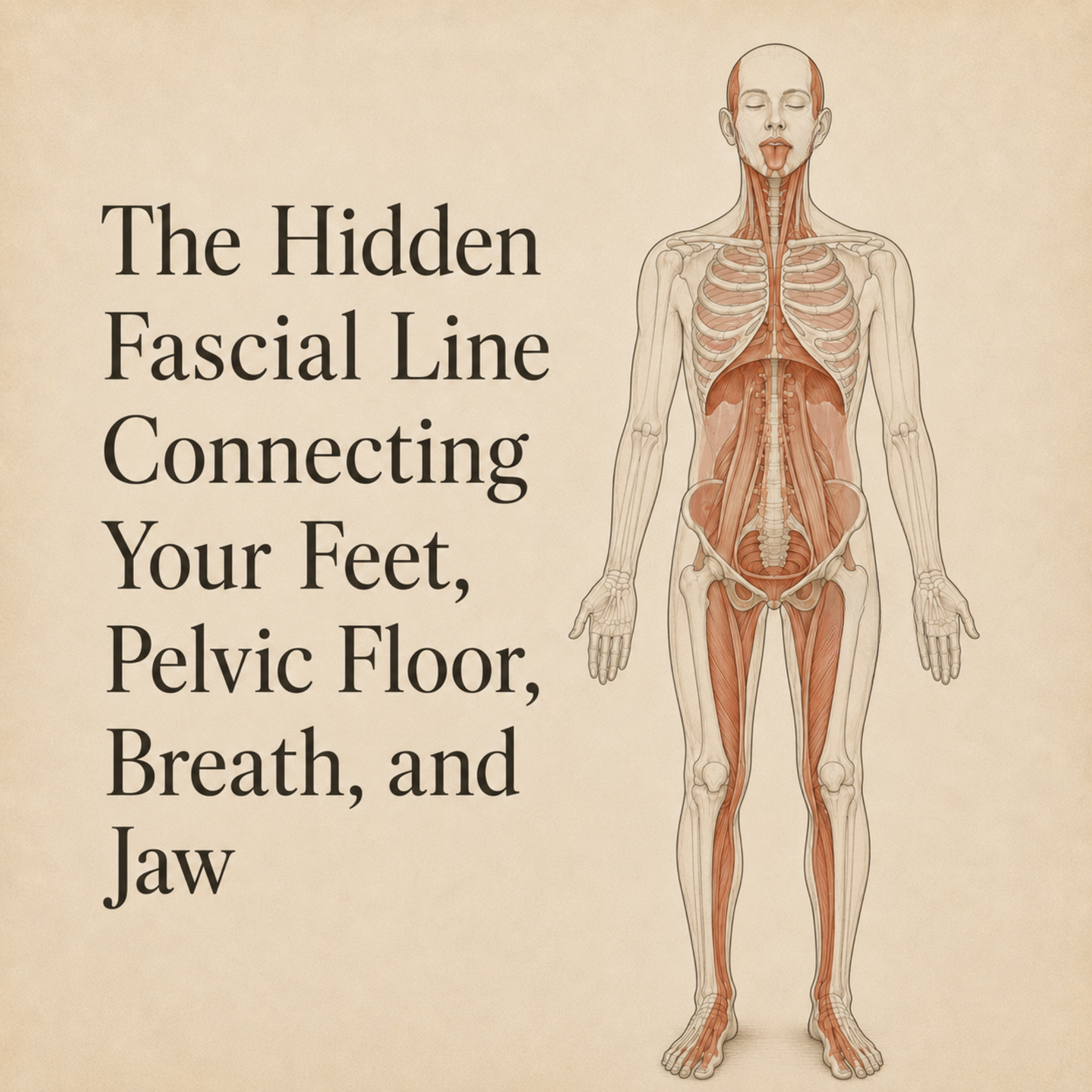
In the Anatomy Trains model, the Deep Front Line is often described as the body’s myofascial core. It begins deep in the underside of the foot, travels up the inner leg, passes through the pelvis and trunk, supports the front of the spine, and continues upward toward the throat, jaw, and tongue.
That means your “core” is not just something you strengthen from the outside.
It is something your body organizes from the inside.
And when this deep line cannot create support, your body often finds support somewhere else.
You may brace your abs.
Grip your pelvic floor.
Clench your jaw.
Lock your knees.
Collapse through your arches.
Hold your breath.
Or feel like your neck and shoulders are always doing the work your deeper system cannot access.
This article will help you understand why deep core support is not only about strength, why your feet and jaw may be more connected than they seem, and why the Deep Front Line has to be organized through breath, pressure, tension, and movement.
What Is the Deep Front Line?
The Deep Front Line is one of the fascial lines described in the Anatomy Trains model developed by Thomas Myers.
Unlike the more visible front and back body lines, the Deep Front Line sits closer to the center of the body. It is not a surface line you can easily see in the mirror. It runs through deeper structures that help organize posture, breath, pressure, and internal support.
A simplified way to picture it is this:
Foot arch → inner ankle → inner calf → inner thigh → pelvic floor → deep hip → diaphragm → front of spine → throat → jaw → tongue
This does not mean there is one single rope running through your body. Fascia is a web, not a cable. But this map gives us a useful way to understand how deep structures influence one another.
The Deep Front Line is especially important because it helps coordinate:
Arch support in the feet
Inner leg tone and adductor connection
Pelvic floor responsiveness
Diaphragm movement
Ribcage and spinal support
Neck and head positioning
Jaw and tongue relationship
Breath and pressure management
This is why one area of tension may not be as isolated as it seems.
A collapsed arch may change how the inner leg and pelvis organize.
A gripping pelvic floor may change the way the diaphragm moves.
A ribcage that cannot expand and recoil well may affect the neck and jaw.
A tongue that lacks support or resting tone may influence how the head and neck are held.
The body is always looking for support.
The question is whether that support is coming from deep coordination or from compensation.
Deep Core Support Is Not the Same as Bracing
A lot of people are taught to “engage their core” by tightening their abs.
There is a time and place for abdominal tension. The problem is when bracing becomes the only strategy the body knows how to use.
True deep core support is more responsive than rigid.
It should be able to expand, recoil, stabilize, and adapt as you breathe and move. It should help you manage pressure without locking the body down.
When deep support is missing, the body often creates a false sense of stability through gripping.
You might notice:
Belly gripping or constant abdominal tension
Pelvic floor tightness or inability to fully relax
Shallow breathing or upper chest breathing
Low back compression
Hip flexor tightness
Jaw clenching
Neck tension
A feeling that you cannot stand tall without effort
Difficulty expanding the ribcage in all directions
Feet that collapse, grip, or feel disconnected from the ground
This is why strengthening the abs alone does not always solve the problem.
Sometimes the body is already working too hard.
The deeper question is:
Can your body create support without gripping?
Why the Feet Matter in Deep Core Function
The Deep Front Line begins deep in the foot.
This matters because your feet are not just passive platforms. They are sensory organs, pressure managers, and the first place your body negotiates force with the ground.
When the foot can sense the ground and maintain dynamic arch support, it gives the rest of the chain better information.
But when the foot collapses, stiffens, or grips, the inner line of the leg may have to compensate.
You may feel this as:
Flat feet or overpronation
Foot cramps
Toe gripping
Inner knee strain
Adductor tightness
Hip flexor tension
Pelvic floor gripping
Low back compression
This does not mean every foot issue is caused by the Deep Front Line. But it does mean foot function can influence much more than the foot.
If your arches cannot participate in support, the body may look for stability higher up.
That may show up as gripping in the inner thighs, pelvic floor, abdominals, jaw, or neck.
The Inner Thighs Are Part of the Core Too
The inner thighs are often treated like an isolated muscle group.
People stretch them when they feel tight.
They strengthen them when they feel weak.
They ignore them unless they are sore.
But the adductors are not just “inner thigh muscles.” They are part of the deep support system between the legs, pelvis, and trunk.
When the adductors cannot coordinate well with the pelvis and breath, you may feel like your hips are tight no matter how much you stretch.
You may also notice:
One hip feels stuck or pulled inward
The pelvis feels unstable
The low back takes over during leg movement
The pelvic floor feels tense or hard to access
The knees collapse inward or lock backward
Walking feels more like dragging the legs than rotating through the whole body
The inner thighs should not be gripping all day.
They should help transmit force between the ground, pelvis, and trunk.
This is one reason deep core work cannot be separated from lower body mechanics. Your pelvis does not float in space. It is constantly receiving information from your feet and legs.
The Pelvic Floor and Diaphragm Are Pressure Partners
The pelvic floor and diaphragm are often talked about separately.
But they are part of the same pressure system.
When you inhale, the diaphragm should descend and the ribcage should expand. The pelvic floor should be able to respond to that pressure change. When you exhale, the diaphragm recoils and the pelvic floor should be able to respond again.
This relationship is not about forcing the pelvic floor to squeeze.
It is about restoring rhythm.
A healthy pressure system needs both expansion and recoil.
If the diaphragm cannot move well, the pelvic floor may compensate.
If the pelvic floor grips, the diaphragm may lose freedom.
If the ribcage cannot expand in 360 degrees, pressure may move into the belly, low back, neck, or pelvic floor instead.
This is why some people feel worse when they are told to simply “take a deep breath.”
If the body does not have space for that breath, it may create more pressure instead of more ease.
Signs your pressure system may not be transferring well through the Deep Front Line include:
Belly pushing forward with every inhale
Rib flare
Low back arching during breathwork
Pelvic floor tension or heaviness
Hip flexor gripping
Breath holding during movement
Feeling like your “core” only works when you brace
Anxiety with deep breathing
Neck and jaw tension during breathing exercises
This is one of the main reasons I teach 360 breathing as a foundation.
The goal is not to breathe bigger for the sake of breathing bigger.
The goal is to help your ribcage, diaphragm, pelvic floor, and deep support system communicate again.
Why Ribcage Expansion Changes the Whole Line
The ribcage sits in the middle of this deep support system.
If the ribcage is lifted, flared, collapsed, or stuck in one position, the diaphragm cannot move as well. If the diaphragm cannot move well, pressure may not transfer cleanly through the pelvis, spine, neck, and jaw.
This can affect both posture and movement.
You may feel like:
You cannot get a full breath into your back or side ribs
Your belly pushes forward even when your body weight is low
Your low back feels compressed
Your upper traps take over
Your neck feels tight after core work
Your jaw clenches when you focus
Your ribs flare when you try to stand tall
You cannot relax without collapsing
This is the difference between expansion, compression, and collapse.
Expansion happens on the inhale. The ribcage should be able to widen, the diaphragm should descend, and the deep front system should receive pressure without the belly simply pushing forward.
Compression happens on the exhale. This is not a bad thing. Healthy compression is recoil. The body gathers inward, the ribs move down and in, and the system organizes pressure without gripping.
Collapse is different. Collapse is what happens when the body does not have enough expansion or internal support. Instead of recoiling with control, the ribcage drops, the pelvis dumps, the spine compresses, or the jaw and pelvic floor start gripping to create stability.
The goal is not to avoid compression. The goal is to restore the rhythm between expansion and recoil so the body does not have to collapse.
The Neck, Jaw, and Tongue Are Not Separate From the Core
This is where the Deep Front Line becomes especially interesting.
The line does not stop at the diaphragm.
It continues upward through the front of the spine, throat, jaw, and tongue.
That means neck tension and jaw clenching may not be only local problems. They may be part of a deeper support strategy.
If your body cannot find support through the feet, pelvis, breath, and ribcage, it may search for stability near the head and neck.
You may clench your jaw to focus.
Push your tongue into your teeth.
Hold your breath when concentrating.
Lift your chest to stand tall.
Grip your throat during effort.
Feel like your head is always slightly forward, even when you try to correct your posture.
The tongue matters because it influences the mouth, jaw, throat, swallowing, and head position.
This does not mean tongue posture is a magic fix for your whole body. But it does mean the tongue is part of the deep front system.
If the jaw and tongue are always gripping, your body may be using them as part of a compensation pattern.
This is why I rarely look at jaw tension as “just jaw tension.”
I want to know what the ribcage is doing.
What the breath is doing.
What the pelvis is doing.
What the feet are doing.
And whether the person can create support without clenching from the top down.
Signs Your Deep Front Line May Be Over-Gripping or Under-Supported
The Deep Front Line can become dysfunctional in different ways.
Sometimes it feels too tight.
Sometimes it feels disconnected.
Often, it is both.
You may feel tension in one area because another area is not contributing enough.
Here are a few common signs this deep support system may need attention:
1. Your feet grip the ground instead of sensing it
If your toes grip, arches collapse, or feet feel rigid, your body may be struggling to receive support from the ground.
2. Your inner thighs always feel tight
Stretching the adductors may give temporary relief, but if the inner thighs are compensating for poor foot, pelvic, or ribcage mechanics, the tightness usually returns.
3. Your body borrows stability from gripping
This may show up as pelvic floor tension, abdominal bracing, jaw clenching, throat tension, or neck gripping during effort.
4. Your breath does not expand through the ribcage
If the ribcage cannot expand in the back and sides, pressure may push into the belly, low back, neck, or pelvic floor instead.
5. You cannot stand tall without flaring your ribs
If posture requires rib flare, low back arching, or chest lifting, the body may be substituting extension for true internal support.
6. You feel disconnected between your upper and lower body
The Deep Front Line helps bridge the feet, pelvis, spine, breath, and head. When it is not coordinating well, the body may feel segmented.
What Actually Helps the Deep Front Line?
The Deep Front Line usually does not reorganize through aggressive stretching, isolated release, or trying to relax one tight spot at a time.
Because this line runs from the feet through the inner legs, pelvis, diaphragm, spine, neck, jaw, and tongue, it responds best when the body learns how to engage the whole chain under appropriate tension.
That does not mean forcing harder.
It means creating the right conditions for the line to participate.
The foot has to sense and press into the ground.
The inner legs have to connect without gripping.
The pelvis has to organize instead of dumping forward or tucking under.
The ribcage has to expand on the inhale and recoil on the exhale.
The neck, jaw, and tongue have to stay involved without becoming the place the body over-grips for stability.
This is where fascia work becomes more than release.
A tight fascial line does not always need to be stretched. Sometimes it needs to be loaded in a way that gives the body a new option.
That might include:
foot pressure and arch connection
inner thigh tension that connects into the pelvis
breath that expands the ribcage instead of pushing only into the belly
positions that create length and load through the whole front body
slow strength work that teaches the line to stay connected under tension
gait and rotational movement that ask the deep system to coordinate with the rest of the body
The goal is not to make the Deep Front Line loose.
The goal is to make it responsive.
Some areas may need more tone.
Some areas may need more length.
Some areas may need better timing.
Some areas may need to stop compensating for a missing connection somewhere else.
This is why isolated stretching often falls short.
If your body is gripping because it does not know how to distribute tension through the whole line, stretching the tight area may only create temporary relief.
The body needs a better strategy.
It needs to learn how to organize the whole line under breath, pressure, tension, and movement.
A Simple Deep Front Line Awareness Check
Try this gently.
Stand barefoot if possible.
Notice your feet on the ground.
Can you feel:
The base of your big toe?
The base of your little toe?
Your heel?
Your inner arch?
Now notice your inner thighs.
Are they gripping?
Are your knees locked?
Are your toes grabbing the floor?
Next, place your hands around your lower ribs.
Take a slow inhale.
Can your breath move into the back and sides of your ribcage without your belly pushing forward or your shoulders lifting?
Now soften your jaw.
Let your tongue rest gently in your mouth.
Notice whether your posture changes when your jaw softens.
This is not a test to pass or fail.
It is simply a way to notice how connected these areas are.
If softening your jaw makes you feel unstable, that is information.
If breathing into your side ribs makes your pelvic floor tense, that is information.
If sensing your feet helps your neck relax, that is information.
Your body is always communicating.
The Deep Front Line gives you another map for listening.
Why This Matters for Pain, Posture, and Movement
When the Deep Front Line is not coordinating well, the body may still move.
But it often moves with extra effort.
The superficial muscles may take over.
The joints may compress.
The breath may get smaller.
The jaw may clench.
The feet may grip.
The pelvic floor may hold.
Over time, this can make posture feel like something you have to constantly correct instead of something your body can organize from within.
That is the deeper issue.
Posture is not just about stacking body parts.
It is about how your body manages pressure, support, force, and orientation.
The Deep Front Line helps explain why someone can have strong abs and still feel unstable.
Why someone can stretch their hips every day and still feel tight.
Why jaw tension may show up during core work.
Why foot mechanics can affect the pelvis.
Why breathing can change how the whole body feels.
Everything is connected, but not in a vague way.
It is connected through tissue, pressure, sensation, and movement.
Where to Start
If this article made you realize your core, breath, pelvic floor, feet, and jaw may be more connected than you thought, do not try to fix everything at once.
Start with breath and pressure.
Not because the Deep Front Line is only a breathing problem, but because breath is one of the clearest ways to feel whether the whole line can expand, recoil, and stay organized under tension.
When the ribcage can expand in 360 degrees, the diaphragm can move, and pressure can transfer through the pelvis and spine, the feet, inner legs, pelvic floor, neck, and jaw often have a better chance of participating without so much gripping.
That is why I created the 360 Breathing Mini-Course.
It is designed to help you move beyond shallow breathing, belly-only breathing, and constant bracing so you can begin rebuilding a more responsive relationship between breath, pressure, posture, and movement.
You will learn how to feel expansion into your back and side ribs, notice common compensations, and practice breathing in a way that supports posture, movement, and deep core connection.
When You Need More Individual Support
Sometimes breathwork alone is not enough.
If your body has been compensating for years, you may need a more individualized approach that looks at your posture, gait, breath, foot mechanics, ribcage position, pelvic organization, and movement patterns together.
This is where coaching can help.
In a RootForce assessment, we look at how your body is organizing as a whole system, not just where you feel symptoms.
If your jaw, hips, low back, pelvic floor, and feet all feel connected in the problem, they likely need to be addressed as part of the solution too.
Final Thoughts
Your deep core is not just your abs.
It is your relationship with the ground.
Your ability to breathe without gripping.
Your pelvic floor’s ability to respond.
Your ribcage’s ability to expand.
Your spine’s ability to receive support from the inside.
Your jaw and tongue’s ability to stop carrying tension that belongs somewhere else.
The Deep Front Line reminds us that real support is not always visible.
It is often quiet.
Subtle.
Internal.
Built through rhythm, awareness, tension, breath, and better coordination.
When this line begins to function better, posture can feel less forced.
Breath can feel less restricted.
Movement can feel less segmented.
And the body can start to find support from the inside out, not by forcing one tight area to relax, but by teaching the whole line how to participate.